

Mason-Dixon Poll: Virginia Voters Support Collective Bargaining Reforms

Share this article on:

With several localities in Virginia having passed ordinances allowing government unions a monopoly on representing public employees, the Thomas Jefferson Institute for Public Policy today released results of Mason-Dixon poll commissioned to measure certain provisions commonly contained in those ordinances.

Those provisions are unpopular with Virginia voters.  The results may be found by clicking here.

The Institute asked Mason-Dixon Polling & Strategy to include four labor policy related questions on a recent survey of 625 registered Virginia voters. The issues touch on policies that have surfaced in local ordinances allowing government union collective bargaining, but could be addressed in statewide legislation or executive action.

Eighty-three percent of overall respondent’s, including more than 2/3rds of Democrats, support allowing public employees the right to leave and stop paying a union at any time. Many local ordinances allow unions to lock public employees into paying union dues for up to a year, even after they resign their union membership.

Similarly, 82 percent of respondents (76 percent of Democrats) support good bookkeeping practices protecting employees’ paychecks by requiring public employers to get a signed form directly from an employee before union dues are withheld from their paycheck, rather than simply taking a union’s assurance that the employee wants to pay dues.

By an eight to one margin respondents agree that if a public employee is doing union work while on the job they should be paid with union funds instead of taxpayer dollars.

Respondents also support transparency by similar margins agreeing that government union negotiations sessions to determine collective bargaining agreements should be open to the public.

Delegate Nick Freitas and Senator Mark Obenshain have introduced a suite of bills to address these issues and help protect the rights of public employees, promote union democracy and protect taxpayers. You can read more about the legislation here.

“It is clear that the many provisions of local ordinances allowing government union to collectively bargain are out of step with Virginian voter’s values,” said F. Vincent Vernuccio, Visiting Fellow with the Thomas Jefferson Institute

He continued, “Counties such as Fairfax, Arlington, Loudoun, and cities such as Alexandria and Richmond are doing favors for special interests to the detriment of hard-working public employees and taxpayers. While these localities are putting government union interests above others, lawmakers in the Richmond and the Younkin administration can protect them at a state level with commonsense reforms.”

For more information on see “Securing Workplace Freedom and Rights: Ideas for the New General Assembly” and “Virginia Collective Bargaining: Recommendations and models for local collective bargaining in Virginia” available by clicking here.

Polling results and methodology may be found in this report from the polling organization, which has a long history of sampling Virginians on campaign and policy questions without any partisan leaning by the firm.
Posted in Business, Labor, Local Government, Public Sector Unions, State Government, Workplace Freedom | Comments Off on Mason-Dixon Poll: Virginia Voters Support Collective Bargaining Reforms

Energy Reform Agenda Inspires Multiple Pending Bills

Share this article on:

The highest priority on a Virginia energy reform agenda proposed a few weeks ago was restoring State Corporation Commission oversight over decisions on massive renewable energy investments.  Under current law, the General Assembly has basically dictated billions of dollars in such future investments, responding too often to donor demands.

Several bills are pending at the 2022 General Assembly to accomplish that goal, some more comprehensive than others but all with merit.  Many of the reform bullet points are checked off.  The bills are in the House of Delegates and must be acted upon by February 15.

Other elements of the agenda, addressed below, have also been translated into proposed legislation.   First for attention are the bills restoring the SCC’s proper independence and oversight.

Three Republican-sponsored bills would reverse in whole or in part the 2020 Virginia Clean Economy Act, which deemed major solar, offshore wind and battery projects “in the public interest” and directed the state’s major utilities to undertake them on a schedule.  The projected consumer cost of that and other General Assembly decisions became a significant campaign issue last November, with GOP candidates including new Governor Glenn Youngkin promising to address it.

The three proposals are worth discussing, including one of them already rejected by the Republican-controlled House Commerce and Energy Committee.  That proposal, the simplest, was House Bill 839 by Delegate Tony Wilt, R-Harrisonburg.  It did not change the demands now in the law to soon eliminate the use of fossil fuels but gave back to the SCC authority to reject projects it deemed as unnecessary, unreasonable or imprudent.

Its fate was reported last week elsewhere, perhaps indicating the likely outcome for the other two major bills.  None are expected to survive the Virginia Senate anyway, as the committee on that side is dominated by Democrats 12-3.   But there were hopes some reforms would pass in the House, generating debate and media attention.

The broadest bill is House Bill 118, sponsored by Delegate Nick Freitas, R-Culpeper, billed as full repeal of VCEA.  It covers the waterfront, removing the renewable energy targets, the wind and solar mandates, and even authorization for Virginia’s participation in the Regional Greenhouse Gas Initiative (RGGI).  It also reaches beyond VCEA.

Sections appear to remove provisions that direct how the utilities will charge customer for the disposal or safe storage of all the coal ash at its generating facilities.  That is a major expense for customers, without doubt, but takes the bill beyond the question of VCEA repeal.  It is unclear what the effect of that would be, and a very thin and content-free impact statement from the SCC doesn’t mention it.

The most obnoxious practice of recent General Assembly majorities (of either party) has been to designate some major utility expense as “in the public interest,” ending SCC discretion.  This bill commits that very sin again, this time for planning and engineering a new nuclear plant.  If tying the SCC’s hands is wrong for wind or solar it is also wrong for nuclear, despite its merits.

House Bill 73, from Delegate Lee Ware, R-Powhatan, has a narrower focus than the Freitas bill, but accomplishes the main task of restoring SCC oversight.  It should be the SCC deciding how much solar, how much wind, and how much battery backup, is “reasonable and prudent” and will be needed for reliability.  It also changes some rules on energy efficiency mandates.

Restoring the SCC’s traditional authority over utility rates and refunds is the purpose House Bill 1288 from Delegate Sally Hudson, D-Charlottesville.  That, too, is in the spirit of the reform proposal and is pending in a House Commerce and Energy subcommittee, likely to be heard soon.

The national movement to ban the use of natural gas in residences and businesses has come to Virginia, is being answered by House Bill 1257, creating and protecting a right to natural gas service in state law.  This was another of the bullet points in the reform agenda that could prevent major expenses for millions of Virginians.  If a Democratic local government (such as Richmond’s) wants to close its municipal gas utility to prove its climate change bona fides, the bill would require it sell the utility instead.

Yet another major reform recommendation dealt with eliminating or limiting campaign contributions from the various vested interests, including the utilities, advocacy groups and the companies who develop generation in any form and profit from these decisions.  Bills that would have imposed general contribution limits on everybody involved have failed, but still pending are bills that prohibit contributions from the utilities.

Senator Richard Stuart, R-Montross, has Senate Bill 568, which prohibits contributions from any public utility, similar to the approach taken by Senate Bill 45 from Senator Chap Petersen, D-Fairfax.  Stuart announced last week that Governor Glenn Youngkin (R) would like to see such a bill pass so he can approve it.  Youngkin would probably also sign House Bill 71, from Delegate Ware, which affects only Appalachian Power Company and Dominion Energy Virginia.

Finally, the list of recommendations included making a change on the State Corporation Commission.  One of the principal authors of the VCEA is now serving there, filling out an unexpired term which is about to end.  Her reelection to a full term has not been acted on either way.  There are news reports she has become a chip in the trading game over appointments that develops when one party controls the House and the other the Senate.

Whatever happens with that appointment is less important than the fate of the various bills addressed above.  If the proper role of the SCC is restored, and the Commission must focus on consumer cost, system reliability and the prudence of proposals; if the General Assembly stops making and changing rules every session, the process will produce better results.

Posted in Energy, Environment, Government Reform, State Government | Comments Off on Energy Reform Agenda Inspires Multiple Pending Bills

Overwhelming Support Shown for Virginia’s Sole Education Choice Program: Highest Backing Among Black Voters

Share this article on:

As National School Choice Week 2022 concludes, the Thomas Jefferson Institute for Public Policy today released results of a polling question demonstrating the overwhelming popularity of Virginia’s sole education choice program. Support is particularly strong in the state’s Black community.

The question, contained in a poll about current General Assembly issues and conducted by Mason-Dixon Polling & Strategy, asked about support for the Virginia Education Improvement Scholarship Tax Credit (EISTC), which offers a 65 percent tax credit to donors to nonprofit organizations that distribute private school scholarships to low-income children.

The poll surveyed 625 registered Virginia voters.  Only 19 percent opposed the EISTC program, with 68 percent in favor and thirteen percent undecided.

Support for the education choice program was evident in every region and demographic in Virginia.  Its highest support was seen among Black voters, 74-16 percent, with 66 percent of White voters expressing support.  The issue is a political winner as well, with support from 64 percent of Democrats, 71 percent of Republicans and 69 percent of Independents.

The question can be found in this report issued by the polling organization, which has a long history of sampling Virginians on campaign and policy questions without any partisan leaning by the firm.
“After a year of closed school buildings and parents often forced to fend for themselves and their children, there is a hunger in the Commonwealth for additional quality options offering hope and opportunity for children,” said Chris Braunlich, president of the Thomas Jefferson Institute and a former president of the Virginia State Board of Education.

“It is not a coincidence that the greatest support for the EISTC scholarship program is among Black parents and those living in urban areas,” Braunlich noted. “These are the parents – and children – who have suffered the most in the last two years.

“Parents are experiencing the limitations of a ‘one size fits all’ system of education and it is overdue time that we increased parental options – whether through and expansion of the EISTC, enactment of Education Savings Accounts, or effective college partnership lab schools and charter schools,” Braunlich concluded.


Posted in Education, Government Reform, State Government, Taxes | Comments Off on Overwhelming Support Shown for Virginia’s Sole Education Choice Program: Highest Backing Among Black Voters

The Largest Tax Relief Ever Given…

Share this article on:

New Governor Glenn Youngkin has now submitted his tax cut proposals to the 2022 General Assembly in the form of bills and budget amendments, and if all his campaign pledges are adopted it will be the most significant tax cut in the state’s recent history.

“There is one vital thing we can do to help Virginians,” Youngkin told assembled legislators in his first policy address on January 17. “And that is remove some of the tax burden — added on top of rising prices for groceries, gasoline and housing.” He said the proposals outlined below “represent the largest tax relief ever given to the people of Virginia, $1,500 this year for the typical Virginia family.”

In all, the package would reduce the state’s revenue over the coming 30 months by $5 billion or more. It starts with a one-time cash rebate to all Virginians who pay the state income tax, $300 per individual taxpayer or $600 for a couple filing jointly. That would be about $1.25 billion in rebates overall. You can find more details in Youngkin’s recently released summary of his high priority legislative agenda.

Of even greater value to most who pay the state income tax would be his proposal to double the standard deduction, up to $18,000 for a couple filing jointly. The additional $9,000 in tax-free income for that couple would likely save them almost $520 per year.

The rebates and standard deduction changes are complemented by a) a brief suspension of higher motor fuel taxes, b) a proposal with a history of bipartisan support to eliminate the sales tax on groceries, c) a one-time income tax reduction for small businesses and d) an income tax subtraction for up to $40,000 in military retiree pay.

Those six proposals are supplemented by one more, his effort to eliminate the carbon tax imposed on the state’s electricity generators, a tax which the state’s largest power company simply adds to its monthly bills. That tax is expected to raise about $300 million in 2022 and more in subsequent years.

The rebates, motor fuel tax suspension and small business tax breaks are short term. The change to the standard deduction, military retirement subtraction, end to the grocery tax and elimination of the energy carbon tax will be long term, saving Virginians about a billion and a half dollars per year going forward.

The challenge, of course, will be making all of Youngkin’s additional revenue changes and still producing a budget bill satisfying his spending priorities and those of the legislature. The House and Senate money committees must produce balanced draft budgets by February 20, then proceed to reconcile them by March.

Youngkin’s version of the tax rebate to individual taxpayers is $300 per person and $600 per couple. It appears the taxpayer will get it upon filing their 2021 taxes, as an additional refund amount (but they are only eligible for a rebate if they owe at least that much in tax.)

His proposal to double the standard deduction taken by individuals who do not list itemized deductions is the big ticket item. That would reduce income tax revenues by $1.24 billion in Fiscal Year 2023 and $852 million in the second year, Fiscal Year 2024. Another version of the bill is here. Similar tax reductions would extend into future years.

During the campaign it was not clear just what Youngkin had in mind as he promised a tax break for small businesses. Now this bill (and this one) spells out which companies or individuals would qualify for a one-year break on their state income tax returns, but sets a $75 million cap on the tax relief available in Fiscal Year 2023. If too many folks qualify, the tax relief may be prorated.

Youngkin’s proposal to eliminate the sales tax on groceries can be found in this Senate and this House bill. It is more generous than a version outgoing Governor Ralph Northam (D) had included in his introduced budget. Value to taxpayers (including the local share): $594 million the first year and $667 million the second, according to a fiscal impact statement.

Northam proposed full conformity with the Internal Revenue Code, which places into Virginia’s tax system all the rule changes coming from Congress or Internal Revenue Service decisions since last year. That means Virginia will not tax the 2021 federal Paycheck Protection Program funds that business received, keeping another Youngkin promise. Last year Northam took the position those funds for 2020 were taxable and sparked a major legislative battle.

Value to taxpayers of the Northam’s conformity decision: $159 million in this fiscal year (mainly from not taxing PPP), and $35.6 million in the second. Youngkin’s version of the IRS conformity bills are here and here, and seeks a retroactive change to the tax treatment of PPP for 2020. That would add another $110 million in tax relief over two years.

A substantial fiscal impact will result from Youngkin’s campaign promise to create a state income tax subtraction for military retiree pay, with House and Senate versions. His budget amendments put the taxpayer value at $287 million in Fiscal Year 2023 and $228 million in the next year. The exclusion is $20,000 for 2021, $30,000 for 2022 and $40,000 for 2023 and later.

Youngkin also proposed a break on motor fuel taxes in a budget amendment. His campaign rhetoric indicated a roll back of taxes already imposed, but his proposal now is also forward looking, delaying a scheduled 2022 increase tracking the inflation rate. No budget amendment yet indicates a fiscal impact, but a story in the Richmond Times-Dispatch cited about $200 million less revenue.

Finally, Youngkin keeps his promise to require local government referendums on real estate tax increases with this House and this Senate bill. The voters would be asked to approve if the proposed tax collected based on the reassessed values and proposed tax rate would be more than one percent above the amount collected the previous year. The attached fiscal impact statement makes no effort to estimate how many such local plebiscites would occur annually.

How much support voters express to legislators for these tax changes will matter. The Virginians seeking to defeat them and have the state spend the money will not be shy.

Posted in Government Reform, State Government, Taxes | Tagged , | 1 Comment

Mason-Dixon Poll: RGGI Opposition Overwhelming, Includes Democrats

Share this article on:

The high consumer cost of Virginia’s forced conversion to a fossil fuel free economy remains unpopular with Republican and Independent voters, but is supported by many Democrats, a recent poll revealed. Even Democrats, however, dislike a new carbon tax that is now targeted for repeal.

Thomas Jefferson Institute for Public Policy asked Mason-Dixon Polling & Strategy to include four energy policy related questions on a recent survey of 625 registered Virginia voters.  All touch on issues pending at the 2022 General Assembly or facing the new Glenn Youngkin Administration.

Only 22 percent of overall respondents supported, and 73 percent opposed, the new carbon tax that now appears on Dominion Energy Virginia monthly bills. It was imposed in September to recover from customers the dominant electricity provider’s costs under the Regional Greenhouse Gas Initiative (RGGI).

Governor Youngkin has made removing Virginia from the RGGI compact an early priority.  Even self-identified Democrats in the sample opposed it by 59 to 36 percent, with 91 percent of Republicans and 73 percent of Independents expressing opposition.

You can read the four questions and see the response breakdowns in this report from the polling organization, which has a long history of sampling Virginians on campaign and policy questions without any partisan leaning by the firm.
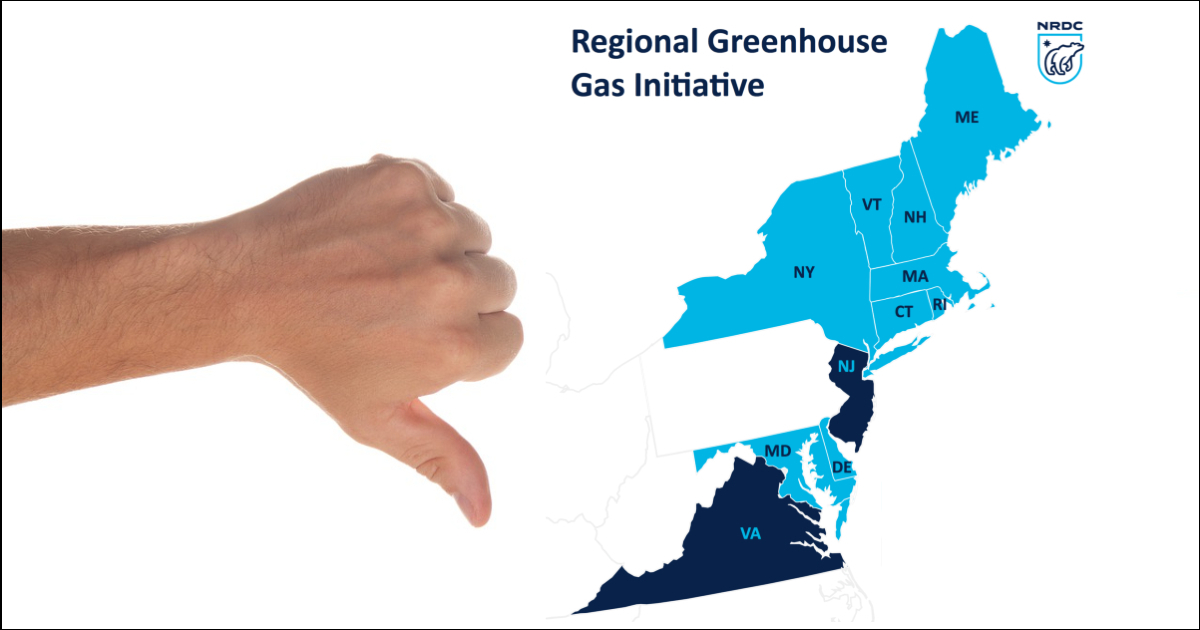
The 22 to 73 result on RGGI has statistical significance.  When Virginians understand that RGGI is a direct tax on their monthly bill which is going to continue to grow, they oppose it.

RGGI was described in the question as costing residential consumers from $25 to $30 per year, with an increase expected next year to $50 to $60 dollars.  That is based on the actual current tax and an increase for late 2022 proposed by Dominion, and typical household usage.  Conserving electricity lowers the RGGI tax, and advocates are happy it creates a disincentive.

Much larger coming consumer costs are expected as a result of the proposed conversion of major generation facilities to renewable sources.  Another question about that, citing $700 per year as a likely residential cost increase (a State Corporation Commission review estimate), actually drew a more positive response than the RGGI question:  31 percent of respondents in favor and 64 percent opposed.

Republicans opposed that 91 to 7 percent, and Independents opposed it 60 to 33 percent.  Democrats narrowly supported it, 48 to 47 percent.  It was also most popular in the Northern Virginia region, with 44 percent in favor and 48 percent opposed.  Several bills are pending to repeal or amend the 2020 legislation driving the utilities to close fossil fuel plants and focus on wind and solar.

Democrats were even stronger in their support for an element of the 2020 legislation that creates a subsidy program to help low-income Virginians pay electric bills.  Called the Percentage of Income Payment Plan (PIPP), a tax on all other electricity customers will fund the subsidies.  The amount of the tax won’t be set until the program is ready to start covering power bills.

Overall, only 37 percent of Virginians supported the idea and 58 percent opposed it.  Democrats supported it 54 to 43 percent, and it drew the support of 19 percent of Republicans and 35 percent of Independents.  Full repeal of the 2020 legislation would end this proposal, but not all pending bills on the issue include PIPP repeal.

A much stronger partisan divide appeared on the final question, dealing with a new state regulation that marries Virginia vehicle fleet fuel economy rules to those of the state of California.  Rules in California will apply in Virginia as well, without any Virginia agency needing to act.  The California Air Resources Board has control of Virginia policy as of 2025, and it is preparing to ban the sale of gasoline and diesel cars and trucks by 2035.

That was the question posed: Do you support or oppose banning the sale of new gasoline or diesel-powered cars and trucks in Virginia after 2035?  A full third of Virginians expressed support, including 53 percent of Democrats, 35 percent of independents, and 52 percent of Northern Virginians.  Republicans opposed it 93 to 6 percent.

“Hostility to fossil fuels is deeply embedded now in parts of the Virginia population, in particular with Democrats and Democratic-leaning Northern Virginians.  Most of them are ready to ban their use in cars and trucks, it seems, and are ready to pay a huge premium on their monthly electric bills to get mainly wind and solar power,” summarized Thomas Jefferson Institute Senior Fellow Steve Haner. 

“But they remain a vocal minority, with the Independent, Republican and downstate population skeptical of or hostile to this vision of our energy future.  The key to finding out where Virginians really stand is to be honest about the likely cost.  Idealism is easier without a price tag. 

“We saw this two years ago, when we specifically polled on a similar issue dealing with a carbon tax on motor vehicle fuels. Mention the claimed environmental benefits, and the idea was applauded, but add in the information about the tax and many voters suddenly lost enthusiasm.”

Posted in Government Reform | 1 Comment