
Lawmaker Introduces Bills Protecting Workplace Freedom

Share this article on:

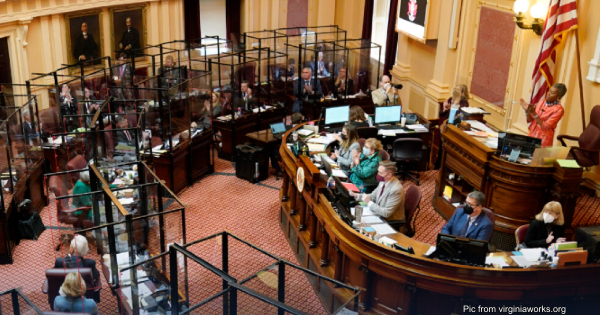
As a handful of localities push to give government unions a monopoly over public employee contracts, lawmakers in Richmond are looking to protect public employees around the state.

Del. Nick Freitas, R-Culpeper, has introduced a suite of bills to help protect the rights of public employees, promote union democracy and protect taxpayers.

The three bills would 1) ensure that public employees are informed of their rights to choose not to join and pay a union and allow them to leave the union at any time, 2) allow public employees the opportunity to vote to keep or remove the union at their workplace, and 4) prevent taxpayers from having to pay for union work.

The legislation is in response to troubling provisions that have emerged in some county and school district ordinances that are harmful to public employees and taxpayers. Last May, a new law went into effect that allowed localities to pass ordinances giving government unions a monopoly on contracts for public employees.

Here are more specifics on the three bills:

  1. Protecting the rights of public employees:

HB 341 makes sure that public employees are aware that they have a First Amendment right to choose whether or not to join and pay a union.

It prevents unions from imposing arbitrary windows during which public employees can opt out of the union and stop paying. Several local ordinances include language that allow unions to trap public employees into paying union dues for up to a year.

HB 341 ensures good bookkeeping and protects public employees’ paychecks by requiring employers to get agreement directly from a public employee and confirm that agreement before any money is deducted from their paychecks. Most of the local ordinances that have passed allow public employers to deduct union dues from their employees simply by taking the union’s word for it. They also allow unions to get agreement from the employee over the phone when the employee may not be aware of what they are agreeing to.

There have been several examples on the West Coast of unions forging workers’ consent then collecting dues from them.

HB 341’s good bookkeeping practices will prevent forgery, deception or simple misunderstanding from causing unwanted deduction from public employees’ paychecks.

Finally, the bill makes sure that ­– if a public employee agrees to pay union dues – they are not locked in forever. HB 341 gives public employees the ability to decide annually if they want to continue to pay dues.

  1. Defending union democracy:

HB 336 ensures that, if a union has a monopoly to represent all public employees on a job, they have support from a majority of those employees.

In many states, a union card becomes an heirloom. Once a union is certified to represent workers, they never have another opportunity to vote on the union at their workplace. In Michigan’s 10 largest school districts only 1 percent of teachers were working when the union organized their school. 75 precent were not even alive when the union came in – let alone working or having the ability to vote for or against the union.

HB 336 prevents that from happening and gives public employees the ability to have a secret ballot vote on the union at their workplace. 

  1. Safeguarding Taxpayers:

HB 337 protects taxpayers from having to pay for union work. Local collective bargaining ordinances currently allow for a process called release time wherein a public employee can do union work – in some cases, full-time – and still keep their taxpayer funded salary.

The release time prohibition in the bill ensures that, if public employees are being compensated, they are doing their job, not union work.

One study from the Yankee Institute in Connecticut estimated in that state “taxpayers subsidized state employee unions with 121,000 hours of paid time off [in FY 2015], costing $4.1 million”

If a public employee wants to do union work, they are still free to take vacation time or work unpaid. The union is also free to compensate them for their time.

HB 337 also requires unions to reimburse a public employer fair market value for the use of employer resources such as office equipment or space.

For more information on these concepts, see the Securing Workplace Freedom and Rights: Ideas for the New General Assembly in the Jefferson Policy Journal and  Virginia Collective Bargaining: Recommendations and models for local collective bargaining in Virginia.
Posted in Labor, Public Sector Unions, State Government, Workplace Freedom | Comments Off on Lawmaker Introduces Bills Protecting Workplace Freedom

A Change in Wind Direction on Virginia Energy Policy?

Share this article on:

“The Department of Energy, in consultation with the Department of Environmental Quality, shall analyze the life cycle of renewable energy facilities, including solar, wind, and battery storage components. The analysis shall assess the (i) feasibility, costs, recycling and salvage opportunities, waste strategies, and liability for the decommissioning of materials; (ii) potential impacts of underground infrastructure post-decommissioning; and (iii) potential impacts of the life cycle on farming, forestry, and sensitive wetlands.”

Now what science-denying Republican tool of the fossil fuel industry put in that silly bill?  No, wait:  Senate Bill 499 is sponsored by a Democratic state senator, Lynwood Lewis from the Eastern Shore.  (And Senator, you should amend the bill to cover the life cycle impacts of offshore wind on our ocean, and those retirement costs.)

Are Democrats getting shaky in their firm religious faith that an ocean full of turbines and whole counties plowed under for solar panels will Save Us from Doom?  Would a sufficiently stark analysis of life cycle costs have them pining again for a nice gas plant?  Wait, there is more.

There are these two companion bills, from two Democrats even more deeply connected to the Myth of Net Zero.  House Bill 414 and Senate Bill 280 both “Require each investor-owned electric utility and each electric cooperative utility to file a plan for monitoring and reporting electric service reliability and an annual electric service reliability report with the State Corporation Commission for approval.”

Those bills were probably filed in response to constituent complaints following weather-related power outages.  But as they say, be careful what you ask for.  What happened in Texas last winter, and in the United Kingdom Europe late last year, were massive weather-related reliability outages complicated by over reliance on renewable sources.

An honest appraisal on lifecycle costs of renewable energy projects and their intermittency will not be good news for advocates of the Virginia Clean Economy Act and other legislated efforts to eliminate the inexpensive, reliable fossil fuels still crucial to our daily lives.

This may indeed be the General Assembly session that backs off the massive, expensive and immutable energy mandates imposed by VCEA in that famous 2020 legislation.  If so, the Republican-sponsored repeal bills (ink still drying) probably won’t be the vehicles.

Guess who else is sending clear warning signals that the solar-wind-battery vision of the future is actually dystopian.  Dominion Energy Virginia included the following warnings in the most recent update to its integrated resource plan, the same plan which eliminated certain proposed new natural gas generation (emphasis added)

The SCC directed the Company to consider market purchases during the winter from the PJM wholesale market or from merchant generators located in the DOM Zone. The Company is concerned that overreliance on the market for purchases could present issues if other states within PJM build significant amounts of solar generation and those zones expect the market to provide energy at the same time the Company is expecting that energy (e.g., extended cloudy winter periods). If that were to become reality, either energy shortages or extreme price spikes would occur.

And elsewhere:

“…when the Company adds increasing amounts of solar resources to the system, this will result in intra-day, intra-month, and seasonal challenges posed by the interplay of solar generation and load. These challenges could expand as neighboring states increase the amount of renewable energy generation on their systems, potentially leading to higher peak prices and a reduction in the level of imports available, similar to what happened during the Texas power crisis of February 2021.

The final clue, and frankly the biggest clue, that change is in the offing was provided right at the end of its term by the outgoing administration of Governor Ralph Northam (D), who pushed and signed VCEA.  It produced a report on how Virginia can best meet the goal of ending the use of fossil fuels, which included the counterintuitive advice to keep natural gas around.

The report sparked a story in the green energy cheerleader publication Virginia Mercury. 

 “The 2045 carbon-free electricity generation goal can be met through existing natural gas infrastructure, existing nuclear energy facilities (with renewed permits) and new renewable energy investments,” wrote Secretary of Commerce and Trade Brian Ball and Secretary of Natural and Historic Resources Ann Jennings (emphasis theirs). “A moratorium on new carbon-emitting generating units is not required to meet clean energy goals… 

“Among the provisions of the VCEA that the Weldon Cooper study found will likely increase ratepayer costs are the law’s mandates for Dominion and Appalachian Power to propose large quantities of solar, wind and storage. The researchers’ modeling concluded that those mandates could cost ratepayers more than $250 million per year by 2035 and $450 million per year by 2040 compared to a “least-cost” scenario. Wind and storage in particular were found to be more expensive than other options like solar.”

The numbers are somewhat different, but the conclusion is absolutely the same one that has concerned many of us for two years. That is the same warning of unnecessary high consumer cost.  Clean energy advocates have accused us of falsehood, political motives, exaggeration and (of course) science denial.  Then an analysis conducted by their friends concurs.

The 2022 energy regulation bills filed so far are piling up, and more could come in by Friday.  Stay tuned. The public silence on these issues so far doesn’t mean things are not moving around in the dark. The course reversal may already be underway.

Posted in Energy, Government Reform, State Government | 1 Comment

A Regulatory Path to Repeal the RGGI Carbon Tax

Share this article on:

Governor Glenn Youngkin (R) will proceed to remove Virginia from the Regional Greenhouse Gas Initiative carbon tax compact by the same route Virginia entered it:  He will push to repeal the underlying regulation.

As with much else in his promised “Day One” agenda, it will actually take time.  What he gave Virginia on Day One was an executive order outlining the coming steps, which still must follow the letter of Virginia’s administrative process rules.  Regulations are created, amended and repealed routinely.

His administration will also notify the RGGI organization of Virginia’s intent to withdraw, a step contemplated and allowed under the governing memorandum of understanding.

It was a vote of the Air Pollution Control Board, citing authority over airborne carbon dioxide emissions, that implemented the cap and trade rules that require electric power producers to buy carbon allowances.  That allowance cost is then passed on to power customers, in the case of Dominion Energy Virginia customers directly on every month’s bill.

The Virginia General Assembly authorized (that’s the key word) Virginia’s participation in the regional compact that auctions the allowances, but no law says Virginia must belong. What everybody keeps tiptoeing around is whether the repeal vote must be taken by the same Air Pollution Control Board.  Maybe not.

On paper, the members appointed or reappointed under previous Democratic Governor Ralph Northam have fixed terms to complete, and Youngkin can replace only two of the seven members come July 1.  Need he wait years for a majority?  Four years ago Northam fired two air board members out of the blue, right on the eve of a key regulatory vote involving the Atlantic Coast Pipeline.

A recent Air Board permit vote against the Mountain Valley Pipeline, unrelated to RGGI but totally related to the overall War on Fossil Fuels, will also have some Youngkin supporters clamoring for rapid change on that body.

Participation in RGGI, which reaches from Virginia up to New England, was first proposed through regulatory action starting under Governor Terry McAuliffe (D).  Under full Democratic control, the 2020 General Assembly passed legislation which stated the Department of Environmental Quality was “authorized” to implement the program and start charging power companies for the allowances.

RGGI defenders will be scouring the code and precedents seeking to argue the bills passed actually require participation.  If so, a fresh Assembly vote would be needed to reverse course, and the Virginia Senate remains under Democratic control.  Be resigned to the fact some judge will get the question eventually, probably.

Since Youngkin’s initial pronouncement,  supporters of the tax scheme have attacked the straw man of “repeal by executive order,” something he never actually said he would do.  The lame duck Attorney General even issued an opinion that stated the legally obvious, and completely ignored the other possible path of regulatory repeal.  He offered a half answer to satisfy half-wits.

As the struggle unfolds, Virginia’s electricity producers will continue to participate in the auctions to buy carbon allowances (the next one is in March).  The tax added onto Dominion bills will remain, although the company recently told the State Corporation Commission to put on hold its request for an increase in the tax rate.  If RGGI remains in force, that rate hike request will be reinstated (it wasn’t set to happen until September anyway.)

This is mainly about Dominion and its Virginia customers.  Repeal of RGGI, however, would lower costs for a handful of other generation firms or manufacturers, some of them locked into contracts that have prevented them from passing the cost on in prices.

Virginia is sitting on the largest mountain of free cash flow in its history.  Every tax source is bursting at the seams in the forecasts. Even the outgoing Northam Administration proposed billions in tax cuts.  But the $228 million that the state extracted from its citizens under RGGI last year, expected to be $300 million this year, is suddenly crucial to the survival of Planet Earth and the Human Race.

While the administration is working to end the tax, the General Assembly should find funding for the flood mitigation projects being paid for with the dollars.  Hurricanes and storm surges are real threats, even if the sea never rises another inch, and Virginia is not ready.  Massive federal infrastructure funding is pending and may be sufficient for this and other purposes.

But RGGI taxes are not the only potential source of funding, nor will any of those mitigations in themselves do anything to change relative sea levels or change rainfall patterns.  The constant claims that RGGI is a tool in the fight against climate change are nonsense.

Other laws passed by the Democrats when they held control do far more to force Virginia away from using fossil fuels, but without the addition of a tax consumers can see.  Frankly, they will cost consumers far more over time then the RGGI taxes will.  Amending or repealing them is far more important to Virginia’s economic future than dealing with RGGI.

Those laws will also be under attack in the 2022 General Assembly, but in their case, it will take legislative action to change direction, and the shrinking group of ostensibly-sensible Democrats will need to decide if Virginia really can prosper in an ell-electric economy tied to unreliable wind and solar sources.

Stephen D. Haner is Senior Fellow with the Thomas Jefferson Institute for Public Policy.  He may be reached at steve@thomasjeffersoninst.org.

Posted in Energy, Environment, Government Reform, State Government, Taxes | Comments Off on A Regulatory Path to Repeal the RGGI Carbon Tax

Time To Reform Virginia’s Energy Policies

Share this article on:

Dominion Energy Virginia’s November announcement that its proposed offshore wind project has jumped almost 25% in cost to $10 billion, with years to go before construction even starts, has put Virginia’s energy policy and its response to claims of climate disaster on the front burner for 2022.

Dealing with these issues should be a top priority of the Youngkin Administration and the General Assembly, and the Governor-elect has already taken important first steps by pledging to leave the Regional Greenhouse Gas Initiative and its accompanying power bill tax.

Here are additional suggested priorities, based on 15 years of dealing with these issues at the General Assembly and the State Corporation Commission.  First and foremost:

  • Restore the proper oversight role of the State Corporation Commission over utility rates, profits, and capital planning. Let the SCC decide how to allocate costs between customer classes. The General Assembly has dangerously usurped that function, often leaving the SCC nothing but an administrative agency subject to changing political winds.
  • One of the first key decisions the new General Assembly will need to make is whether to give a full term on the SCC to Angela Navarro, elected by the Democrats last year after serving as an architect and advocate for the Virginia Clean Economy Act of 2020 and other anti-fossil fuel efforts.  As I wrote elsewhere, personnel is policy.
  • Limit campaign contributions from all donors (still important even if the General Assembly stops usurping the SCC’s job in the future.)  We’ve now held another election where utilities and the vested interests behind unreliable, intermittent generation sources poured incredible amounts of money on candidates and parties.
  • Limit or eliminate non-disclosure agreements in cases before the SCC. Too much vital information is redacted and never made public.  The first motion Dominion Energy Virginia has made to the SCC in its effort to build 2,600 megawatts worth of ocean wind turbines is a motion to seal much of its data.  Outgoing Attorney General Mark Herring should have opposed that motion and demanded transparency.  He didn’t.  Incoming Attorney General Jason Miyares should.
  • Move the Consumer Counsel function outside of the Office of the Attorney General. Perhaps the job should be filled in the same manner as the SCC itself, or some other judicial position.  But it needs to be at least shielded from the election process and the person holding it should have a term certain and perhaps no expectation of reappointment.
  • Review every code section dealing with electricity regulation or other energy use and reconsider each instance of the phrases “in the public interest” or “shall be deemed reasonable and prudent.” Those are the words the General Assembly uses to dictate policy to the SCC despite the ignorance of most legislators on these matters, and their sensitivity to donors.  Likewise remove hard numerical targets for various forms of energy generation, which were based on politics, not engineering.
  • Review every code section and reconsider any financial subsidies or rewards offered to influence utility decisions about one project over another, especially any remaining bonus returns on equity for stockholder-favored investments. This would include recently approved (but not yet funded) subsidies for rich people to buy electric cars.
  • Require local governments providing monopoly utility service to maintain that service or turn it over to the private sector if they wish to exit.  The recent indication that the City of Richmond might close its gas utility and leave 120,000 customers stranded is a warning the Assembly must heed.
  • Require more competition for utility-scale generation services both to discourage placing all the cost and risk on ratepayers, and to be sure of fair and honest pricing on utility-owned projects.  The monopoly utilities don’t need to own so much of the generation.

Virginia should not abandon the current structure entirely. The pure competitive supplier model has plenty of downsides (See Texas).  It is only attractive to so many in Virginians at this time because Dominion Energy Virginia has corrupted the market to unfairly enrich its stockholders.  If all these other steps are taken and electricity costs in Virginia stabilize, the desire to bolt from the monopoly service will wane.

Now to the various controversial decisions on generation and transmission being dictated by the Virginia Clean Economy Act, which will be radically revised by several of the points above.

  • The remaining coal generation should be allowed to die a natural death from market forces. As the environmental costs grow, and the revenues shrink, remaining facilities will be closed early without any action by the SCC necessary.  Requests to fund improvements should be viewed with skepticism.  No new coal plants are going to be built.  Dominion’s Virginia City plant in Southwest Virginia was always a good political investment, never a good energy investment. If it is now a financial liability; it should be closed.
  • The SCC should be making the decision how much utility-scale wind or solar generation is justified, and when, and what are the best options for reasonable cost and reliable supply. That will likely reduce the amount of those wind and solar investments over the next 25 years below the VCEA’s goals, with more natural gas remaining.   The offshore wind proposal in particular demands a real evaluation of its cost and prudence.

This is not a complete list, and of course some of these points would engender incredible debate and maybe even full-scale war at the General Assembly.  But it is where Virginia needs to go to keep energy abundant and costs reasonable.  With the flip in the Governor’s Mansion and House of Delegates, a change of direction on this front must follow.

Posted in Economy, Energy, Government Reform, State Government | 1 Comment

Virginia Should Boost Standard Deduction, Index for Inflation

Share this article on:

One of big financial winners with the May 2021 and then January 2022 Virginia minimum wage increases is the state itself, because the entire raise is subject to a 5 percent state income tax.  With its low standard deduction and personal exemption amounts, Virginia squeezes income tax out of even its lowest wage workers.

In light of the massive tax increases Virginians have seen resulting from Governor Ralph Northam’s recent policy changes, some of the heaviest falling on the state’s businesses, it is clear the state is on a sound financial footing.  An almost unthinkable cash surplus was announced at the end of Fiscal Year 2021, and from that new base even higher state revenues are now expected for several years.

The initial 2019 promise made by the legislature to continue efforts for tax reform, abandoned by both parties after the 2019 election, should be immediately revived.  There is no need to wait for further studies, nor should new Governor Glenn Youngkin feel bound by any proposals from his predecessor.

The recommended focus remains the same as the Thomas Jefferson Institute outlined more than two years ago:

  • Virginia needs to substantially increase the standard deduction it offers to all taxpayers, with the goal of matching the amount offered on their federal taxes.  That would be an increase from $9,000 tax free income for a couple filing jointly to $25,100 for that same couple, removing more than $16,000 from taxable income.  An individual’s standard deduction is $12,550.
  • Virginia needs to index its tax code to inflation, again mirroring federal practice.  Failure to do so, and allowing tax rates to increase due to inflation, is itself a form of tax increase.  This is even more important now because the massive federal deficit spending on individual cash benefits, and other federal actions to overheat the economy, have now produced the kind of inflation many of us remember from the 1970s.

Governor-elect Glenn Youngkin has already endorsed the first proposition but has not yet provided details.  He should complete the task, endorse the second idea and send the Commonwealth back down the road to becoming a low-tax state.  Other ideas he has proposed have merit, but adjusting the standard deduction and then protecting taxpayers from inflation are major, long-term reforms.

Complaints that the state cannot afford this should be hooted down, although it may need to be phased in, starting with a standard deduction increase to $6,000 for an individual and $12,000 per couple.  State General Fund tax revenues are up about 30 percent in just four years, and the explosion from the tax increases and super-heated economy is just starting.  If the Biden Administration gets even part of the tax package it wants through Congress, Virginia will quickly conform to any of the changes that produce additional revenue for the state.  Most of them will.

The next Governor and 2022 General Assembly should act immediately to protect Virginia families and the Virginia economy from what is coming.  Shielding a higher portion of every Virginia family’s income from income tax is easy to explain and provides a level tax benefit to rich and poor.  As a portion of income, it is of far greater benefit to the lower income workers.

In 2019, Virginians were asked about doubling the standard deduction as a method to return some of the coming state tax bonanza due to the 2017 federal tax bill.  By wide and bi-partisan margins they endorsed the idea, but the General Assembly took only a small step and raised the deduction 50 percent.  A major increase in the standard deduction will be just as popular today, if not more so.

The Thomas Jefferson Institute also recommended changes to the corporation income tax in 2019, which again were roundly ignored by leaders of both parties.  It was clear that the federal rules changes in the Tax Cuts and Jobs Act of 2017 would produce an avalanche of new state corporate taxes unless we made state-level adjustments.  Fixing that is of lower priority than the other two goals, a meaningful standard deduction and annual inflation adjustments.

Much of Virginia’s business income is reported and taxed on individual returns, since many businesses are not structured as corporations.  An increase in the standard deduction is of direct benefit to those unincorporated business owners.  For corporations, the higher standard deduction is of benefit to employees and stockholders but not the business entity.

The General Assembly has now decided to increase the state’s fuel taxes annually to keep up with inflation in future years.  It has voted to raise the minimum wage annually due to match inflation.  It is long past time to give the same protection to Virginia’s taxpayers.  The former chair of the House Finance Committee in the General Assembly, Delegate Vivian Watts, D-Annandale, has introduced an indexing bill in prior years, but so far has been unsuccessful.  A Republican-sponsored attempt is expected this year.

Many Democrats share the desire to reduce income taxes on Virginia families by working up from the bottom but prefer to do it with a mechanism called the Earned Income Tax Credit.  Recent General Assemblies have also considered and rejected efforts to make that tax credit “refundable,” meaning that taxpayers who qualify could actually receive an annual check from the state.  The proposal has surfaced again in, but increasing the standard deduction is a better reform.

A refundable EITC does nothing to reduce the tax burden on middle income Virginians because the EITC phases out quickly as income rises.  And it involves the state taking the taxes out of paychecks and then returning them at a later time, rather than simply not taxing it in the first place.  EITC becomes just another government entitlement, more bureaucracy.

Many Democrats also oppose the idea of a higher standard deduction because the benefit is nearly universal, reaching even higher income families if they do not take itemized deductions.  If the federal tax changes President Joe Biden wants are enacted, the higher state standard deduction will make only a small dent in higher tax bills coming their way.

Finally, matching the federal standard deduction brings Virginia into line with a number of other states competing with Virginia for new jobs and residents.   The District of Columbia and South Carolina match the federal amount, and North Carolina comes close.  For most low income Virginia workers and many retirees, there would be zero income tax, the same as in Florida, Texas, or Tennessee.

Posted in State Government, Taxes | 1 Comment