Blame COPN for Looming Bed Shortages

Share this article on:


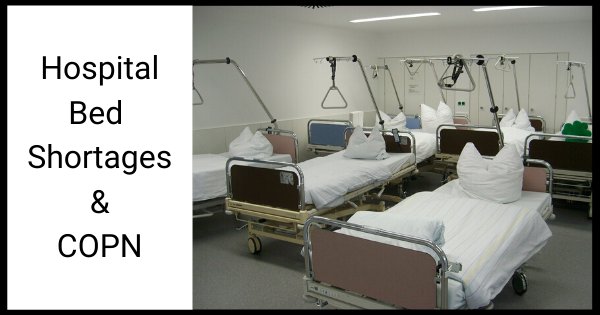
The hospital bed shortages cited by Jim Bacon in his post at his online blog Bacon’s Rebellion, “Not Nearly Enough Hospital Beds, is a direct outcome of how the Virginia Department of Health (VDH) has administered Virginia’s Certificate of Public Need law. Virginia’s scarcity of physicians and nurses also can be traceable in part to COPN’s denial of opportunities to doctors, as I have written previously, but this column will address the impact of the legislation on beds and facilities.
Virginia’s Health Commissioner has sole responsibility under the COPN law for determining how many beds are “needed.” Commissioners since 1973 have taken no discernible action to make sure there are enough beds, only that there are not too many, whatever that means on a given day.
The COPN Process. The VDH COPN Division makes recommendations on each application, and the Commissioner makes the decision. There used to be five regional review authorities that made recommendations before applications reached headquarters, but four of them died out and only the Northern Virginia regional authority survives. The judgments of approval or disapproval are entirely subjective.
Often the COPN Division has made a different recommendation than the regional review authority, or the Commissioner has made a different decision than recommended by the COPN Division.
There were 1228 applications for a certificate of need between the beginning of the year 2000 and the October 2019 COPN Monthly Report that I used as a source here. Of those applications:

  • 646 were approved at all three levels and 84 through two levels more recently required for approval. Thus 61% received “clean” approvals.
  • Twenty seven applications were recommended for denial at both regional and staff levels and yet approved by the Commissioner;
  • Twelve were recommended for approval by the COPN Division and denied by the Commissioner;
  • One hundred ninety five applications did not survive the process: 142 were denied, 42 withdrawn pending denial and eleven were delayed indefinitely.

I could cite more data but you get the idea. Remember every one of the applicants spent a lot of time and money on the planning and application process and expected approval. Hundreds more projects — mainly surgical centers and diagnostic imagery centers — were never initiated because physicians knew the score and did not bother to apply. The unwritten rule has always been that while hospitals and health systems may be denied a few applications, especially when they butt heads with one another, seldom will the state allow competition to threaten their core interests. The amount of money at stake has been and remains breathtaking.
The Effects on COVID-19 Capacity. Since the year 2000, VDH has denied dozens of applications and dozens more were withdrawn that would have expanded significantly the number of beds available for this emergency. Since the applications came from successful corporations with business plans supporting the projects, it fell to VDH to deny that business case based on its own vague concepts of need.
The certificate denials or withdrawals in the past 20 years that reduced pandemic capacity include:

  • New Acute Care Hospitals. Nine applications, three from Bon Secours in south Hampton Roads, two from Doctors’ (Riverside) Hospital in Williamsburg (second one revised, re-submitted 18 months later and again denied), one from Sentara to be built in Northern Virginia, one from Inova in an unspecified Northern Virginia location, a second different one from Inova Loudoun Hospital Center, and one from HCA, also to be located in Northern Virginia, were denied.
  • Additional hospital beds: The state denied six applications: three from Inova, two Sentara, and one Carilion.
  • Acute care infant bassinets: two from HCA Lewis-Gale Medical Center were denied.
  • Inpatient Long-Term Care or Rehabilitation Hospitals: 11 applications, nine for new facilities and two for additional beds were denied.
  • Outpatient surgical facilities. Thirty applications for outpatient surgery centers, which would serve to relieve pressure on hospitals during the crisis, were denied. Hundreds more applications were never submitted.
  • Nursing homes. Ten applications for nursing homes, one for a 180-bed facility and nine for additional beds, were denied. Those would have provided space for COVID-19 isolation wards for the elderly in a nursing home setting.

What to do? This terrible law, so badly administered for almost 50 years, must be repealed. Tens of billions of dollars worth of decisions were made without the consistent applications of objective principles. The data since 2000 alone show that both the COPN process itself and the wealthy regional monopolies it created are ripe for an investigation by the Virginia Attorney General and/or the Justice Department.
This commentary was originally published on March 16, 2020 in the online Bacon’s Rebellion.
E-Mail this Author

Posted in Health Care | 2 Comments

Sixteen Tax Hike Bills Approved by the General Assembly

Share this article on:

What did this year’s General Assembly cost you in taxes?
Here are at least 16 bills approved by the 2020 General Assembly which create or raise taxes on Virginians or authorize a local government to do so. No one told Virginians at the start of session that major tax increases were coming, and there is little recognition of what has now happened. It is time to tally the bill.
If anybody would or could run the fiscal projections on these 16 tax bills, they might combine into a major tax hike comparable to those in 2004 and 2013. Over five years this will cost families or businesses multiple billions of dollars, but most will be collected by wholesalers (cigarettes and fuel) or too deeply buried on receipts to see.
Assessments on business eventually get passed down to the customer: you.
Bills of Statewide Impact (where companion bills passed, only one is linked):

  1. The Budget Bill, which includes an increase in the state tax on cigarettes and other tobacco products, and which creates a new tax on nicotine vaping products. The initial revenue estimate was $119 million in fiscal year 2021 and $130 million in fiscal year 2022.
  2. House Bill 1414, which raises the statewide tax on gasoline and diesel by five cents per gallon on July 1 of this year and then against July 1, 2021. The bill also imposes an additional 7.6 cents per gallon to be collected in all the state’s localities not otherwise covered by a regional transportation tax. The tax on gasoline for your car rises from about 16 cents to just under 34 cents per gallon in 16 months. An additional grantors tax on Northern Virginia real estate transactions is also created, to be used in that region. No revenue total is yet provided, but it is likely $300 million or more next year, and close to $400 million the following year.

Local Taxing Authority

  1. House Bill 785 grants to all counties the ability to collect four taxes previously allowed to cities but denied to most counties. If all exercise the options allow, Virginians in them could be paying an additional $500 million by 2022. Most of that would come from taxes on restaurant meals and prepared foods, now allowed only after a referendum (often rejected.) Most of that would come if Fairfax County imposed that tax, rejected by its voters in 2016.
  2. House Bill 534 allows any Virginia locality to impose a 5-cent tax on plastic bags at retailers, on a local option basis. In response to a question on the floor, the patron said if a retail uses two bags to make sure items are secure, that will cost a dime.

Taxes Hidden on Your Electricity Bill

  1. Senate Bill 851, the clean energy omnibus, imposes the state’s first carbon tax on electric power generation, collecting perhaps $150 million or more in 2021. By 2021 your electric bill will also include a tax to fund a new low-income benefit program, capping electric bills for public assistance recipients, called the Percentage of Income Payment Plan. That is likely to be another $200-250 million per year, only for customers of the two largest providers.

Business Taxes

  1. House Bill 4 authorizes five casinos in Virginia, if approved by local referenda, and sets the tax rates on their gross receipts at from 18 to 30%, depending on the amount. It will be shared with the host localities.
  2. Senate Bill 735 creates a new regulatory structure and tax for the peer-to-peer vehicle sharing business, a growing Internet-based alternative to traditional auto rental (already taxed).
  3. House Bill 1428 creates a new state health benefits exchange and funds its operation with an assessment on health insurers, similar to the hospital provider assessments previously used to fund the 2018 Medicaid expansion. The assessment is expected to collect about $3 million next year but more than $50 million annually once the exchange is fully operational.
  4. House Bill 1145 imposes an increase in the state’s small litter tax on retailers and the beverage industry.
  5. House Bill 129 increases the gross receipts taxes paid by public service companies to fund the State Corporation Commission’s operations. No revenue estimate was provided.

Regional Transportation District Taxes

  1. House Bill 1541 creates a Central Virginia Transportation District in the Richmond region, copying similar special taxing regions for Hampton Roads and Northern Virginia. Richmond area residents and businesses will pay an additional 0.7% on the sales and use tax and the 7.6 cent regional fuel tax. The taxes will raise $179 million next year and $198 million the following year.
  2. House Bill 1726 creates a regional transient occupancy tax and grantors tax on deeds in the Hampton Roads Region to provide an additional $25 million per year for mass transit operations.

The final four (13-16) are local sales tax increases dedicated to school construction. House Bill 200, House Bill 486, House Bill 1631 and Senate Bill 224 allow a total of nine localities to add another 1% on their sales and use taxes dedicated to local school construction. This is a pattern likely to spread to other localities in future sessions unless some other school constructing funding sources is identified.

E-Mail this author

Posted in Taxes | 2 Comments

Virginia’s Vengeful Politicians

Share this article on:

Terry McAuliffe is a terrific politician. If you’ve met the former Virginia governor you know what I mean. He’s smooth. He oozes charm.
Like many skilled politicians, underneath that affable exterior lurks a ruthless operator with an elephantine memory.

LaBravia Jenkins


Just ask LaBravia Jenkins, the well-respected commonwealth’s attorney for the City of Fredericksburg. It appears that she may have lost a bid to become a general district court judge last week over a four-year-old grudge harbored by McAuliffe and his disciples.
Another commonwealth’s attorney, Chuck Slemp, of Wise County was also bumped, apparently for the same reason.
In 2016, Jenkins was one of 43 prosecutors who signed a friend of the court brief opposing McAuliffe’s blanket restoration of voting rights to more than 200,000 felons.
The Virginia Supreme Court agreed and found McAuliffe’s sweeping move unconstitutional. Governors are required to restore rights on a case-by-case basis.
It wasn’t that Jenkins didn’t believe in the restoration of civil rights to wrongdoers. In an interview last year she said she and other prosecutors simply opposed the lawless way McAuliffe was going about it.
(Cynics among us – like me – believe this brash move by the governor was designed to pad the voter rolls with felons in time for the fall presidential election to help his close friend, Hillary Clinton.)
Jenkins’ resume is impressive. She’s been the top prosecutor in her city for 12 years and she personally tried more than 100 cases. Jenkins is a “recipient of the Robert F. Horan award for her leadership in the Virginia Association of Commonwealth’s Attorneys,” she’s also been recognized as one of Virginia’s Leaders in the Law and is President-Elect of the Fredericksburg Area Bar Association.
On top of that, Jenkins was the bipartisan nominee of her local delegation for the open judgeship, which is usually the key to a judgeship. Virginia Lawyers Weekly says she’s an independent.
Jenkins was approved unanimously by the State Senate but her name was left off the list of judges approved by the House of Delegates.
A list of new and re-appointed judges went forward. Jenkins was not on it.
Jenkins herself said that her decision to sign the amicus brief was the only explanation she was given as to why her name was withdrawn from consideration,” reports the Fredericksburg Freelance-Star.
Clearly, a number of powerful Democratic House members are deeply indebted to McAuliffe.
According to a blistering editorial in the Fredericksburg newspaper, “House Picks Politics Over Professionalism,” Jenkins said the only reason she was given for her exclusion was her opposition to McAuliffe’s illegal actions.
House Democrats have now decided that as long as they are in power, even a successful and independent veteran prosecutor like Jenkins—who is a leader in her field and has the bipartisan backing of her local legislative delegation—will not be elevated to the bench just because she publicly objected to an unconstitutional action by a former sitting governor.
“The flip side of this new standard means that only craven sycophants who are willing to approve anything the chief executive does, legal or not, will be considered for judgeships,” wrote the editors.
This is disturbing.
In a news story headlined “Pay-Back Keeps Two Prosecutors Off the Bench,” Virginia Lawyers Weekly reported that Jenkins’ supporters believe “the hand of former Gov. Terry McAuliffe” was behind the shabby treatment of her by the House of Delegates.
“McAuliffe apparently was stung by what he saw as party disloyalty by Democratic prosecutors. He openly opposed two Northern Virginia Democratic Commonwealth’s Attorney seeking re-election last year.
“Republican senators this month suggested the same desire for retribution was at work in removal of the Fredericksburg judgeship from the list of eligible vacancies.”
Revenge politics is at work here and is an alarming sign of things to come from the new, deeply partisan majority in the House.
Virginia is one of only two states where the state legislature elects judges. Politics are always part of the process, of course.
But rejecting the nomination of a respected prosecutor because she stood up for the rule of law when a reckless governor ignored it is spiteful. Leaving judgeships vacant over political pique is the antithesis of good government.
Seems to me, LaBravia Jenkins is precisely the sort of lawyer Virginians would want on the bench.
You know, honorable.
This commentary originally appeared on March 11 on Kerry Dougherty’s blog, Kerrydougherty.com
E-Mail this author.

Posted in Politics | 1 Comment

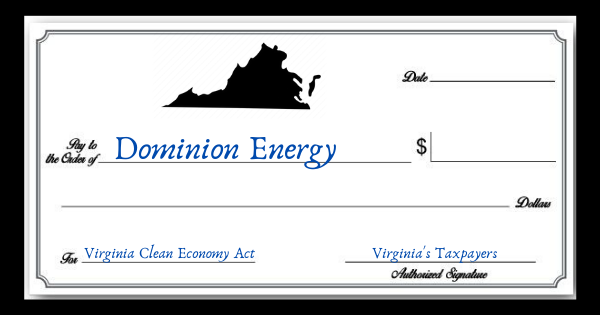
Dominion Energy Gets a “Blank Check” from the Virginia Clean Economy Act

Share this article on:


Gov. Ralph Northam and Dominion Energy combined their powers during the 2020 General Assembly to push to passage the Virginia Clean Economy Act (VCEA). Advanced by House Bill 1526 (carried by Del. Rip Sullivan, D-Fairfax) and Senate Bill 851 (patroned by Sen. Jennifer McClellan, D-Richmond), the VCEA strips the State Corporation Commission (SCC) of its constitutional responsibility to protect ratepayers from unreasonable and imprudent utility expenditures. Majorities voted for the bills despite warnings from both the SCC and the attorney general that the legislation essentially gives Dominion Energy a “blank check” to build the most expensive offshore wind project in U.S. history and create a half-dozen programs with few cost constraints.
The SCC estimates that electricity rates will increase by a minimum of 24% on top of existing mandated costs, such as ongoing transmission-line undergrounding programs in Northern Virginia or coal ash disposal. In total, it is possible that residential electricity bills could increase as much as $50 per month while bills for smaller industries could increase by as much as $235,000 a year. The residential increase is equivalent to one month’s rent in a basic one-bedroom apartment, a 3-hour course at a community college, two average car payments, two months of groceries, four months of Medicare insurance premium payments, or for industries, three full-time jobs at a small factory.
What about the social cost of carbon dioxide emissions? As some might ask, “Isn’t any cost worth the environmental benefits?” Despite that fact that neither the Virginia Department of Environmental Quality (DEQ) nor the SCC has ever developed a social cost of carbon dioxide test or measurement, the benefits of the VCEA’s offshore wind facility are no different than any other renewable energy resource. Further, the U.S. Environmental Protection Agency’s social cost of carbon measurement ranges from $7 to $50 per ton of carbon dioxide emissions. Using these measurements, the 33.5 million metric tons of carbon dioxide from Virginia’s entire electricity generation fleet has a social cost of $235 million to $16.8 billion. Yet, just one solution, the offshore wind project mandated in the VCEA, would cost Virginia ratepayers an estimated $15.5 billion over its expected service life.
As noted this past November by former SCC Judge Hullihen Moore, in a Times-Dispatch column, “The project energy cost is 13.8 times greater than new solar facilities.” Moore went on to state, “The forecasted cost of energy from the pilot is 78 cents/kWh.” For comparison, Dominion Energy residential customers currently pay an average electric rate of 10.83 cents per kilowatt-hour.
What about the economic and environmental benefits? Advocates have argued that the bills will address climate change and create 13,000 jobs. Yet, the bills have no performance requirements, no job-creation mandates, no ratepayer refunds for construction failure, no sea-level rise measurements or reductions, and no atmospheric carbon dioxide measurements or reductions.
Virginia gave an estimated $750 million in performance-based incentives to Amazon to create 25,000 permanent full-time jobs. Even the VCEA advocates have not clearly articulated how many of their jobs would be permanent full-time jobs and how many would be temporary construction jobs. Further, since Hampton Roads employers already have challenges finding skilled workers, what is to stop the utility project from simply luring workers from existing businesses across the commonwealth or importing labor from across the world?
Northam and Dominion Energy have not convinced consumers that renewable energy must be gold-plated. The VCEA’s environmental, social and economic goals can be achieved, but only with the unrestricted oversight of the SCC. Virginians should not have to choose between a car payment, rent, groceries, insurance, tuition or their electric bill. Virginians should not have to give Dominion Energy a “blank check” to achieve reasonable carbon reduction goals.
This commentary originally appeared in the March 12, 2020 issue of The Richmond Times-Dispatch.

Posted in Energy | Comments Off on Dominion Energy Gets a “Blank Check” from the Virginia Clean Economy Act

Yes, Virginia, Media Bias is Real

Share this article on:


There are far more liberal/Democratic journalists than conservative/Republican journalists, but political bias has little influence over how they report the news, finds a new study on media bias, “There is No Liberal Media Bias in the News Political Journalists Choose to Cover.
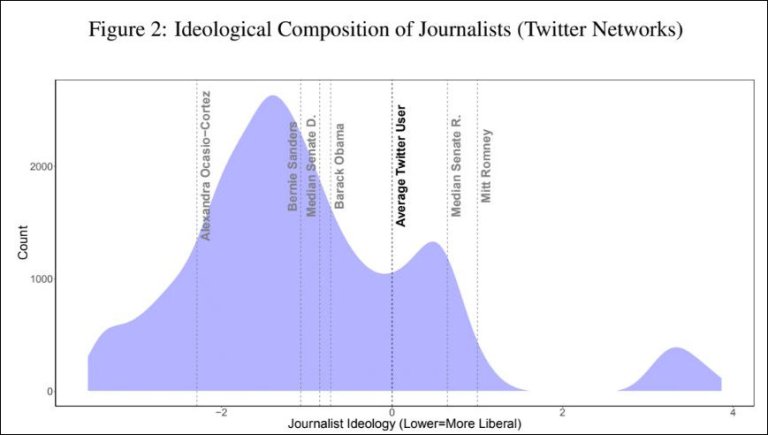
The study, one of whose three co-authors, John B. Holbein, is an assistant professor of public policy at the University of Virginia, uses Twitter postings as a tool to measure the ideological leanings of thousands of journalists. By this measure, the scholars confirm the widespread public perception that journalists are far more liberal than the public at large.

The figure above shows the ideological distribution of 13,500 journalists based on their Twitter interactions. “As can be seen, journalists are dominantly liberal and often fall far to the left of Americans,” the study says. “A full 78.1% of journalists are more liberal than the average Twitter user. Moreover, 66% are even more than former President Obama, 62.3% are to the left of the median Senate Democrat (in the 114th Congress), and a full 14.5% are more liberal than Alexandria Ocasio-Cortez (one of the most liberal members of the House). In short, journalists are overwhelmingly liberal/Democrats.” 
However, the authors write, journalists strongly value objectivity in reporting the news. Based on responses of the 18.3% who responded to a survey, they conclude, “Despite being dominantly liberals/Democrats, journalists do not seem to be exhibiting liberal media bias (or conservative media bias) in what they choose to cover.”
Nice try, fellas. But you’re not going to persuade anybody.
I will accept the methodology for using Twitter to measure the political leanings of journalists. Perhaps someone should take a closer look at the findings, but I find nothing surprising here. Well, I guess I’m somewhat surprised that 14.5% of journalists are further to the left than Ocasio-Cortez — I didn’t know such a thing was even theoretically possibility. Still, the findings align with my view of reality.
The disputable finding is that liberals and Democrats don’t exhibit liberal media bias. Here’s how Holbein and his co-authors came to that conclusion:
We created an artificial campaign email address for a fictitious candidate for the state legislature. We emailed the journalists on our list asking them to cover the potential candidate. Covering campaigns and the people who run in them is a vital part of political journalists’ jobs. …. This story appears to be something that is generally considered newsworthy, but it subject to journalist discretion and is exactly the type of story where gatekeeping biases would be manifest. 
Our email appeared to be from a campaign staffer indicating that the candidate was about to announce his candidacy within the next week and asking if the journalist would be interested in sitting down with the candidate sometime in the following week to discuss his candidate and vision for state government. The text in each of the emails was identical except for the bio of the candidate we included at the end of each message. … Each email described the candidate as being either a “Conservative Republican,” “a moderate Republican,” “a moderate Democrat,” or a “Progressive Democrat.” 
In the responses received, journalists showed no meaningful bias in their responses to the candidates. They were just as likely to favor conservatives as liberals. In conclusion: “Despite the overwhelming liberal composition of the media, there is no evidence of liberal media bias in the news that political journalists choose to cover.”
While the narrow finding may be defensible — liberal reporters show no bias in choosing to write about conservative candidates — it is ludicrous to extrapolate to the larger conclusion that “there is no liberal media bias.”
That conclusion totally misses the point. You don’t hear conservatives/ Republicans griping about the media ignoring conservative/ Republican candidates. The Virginia media didn’t ignore Sen. George Allen when he ran for re-election in 2006, for example. To the contrary, the media devoted endless ink to the “macaca” fiasco, which kept him on the defensive, to the exclusion of other issues that might have favored him. Bias comes in the narrative framework embraced by the media. What issues do the media regard as important, and which can be safely ignored? 
This point is so blindingly obvious that it astonishes me that some people take the trouble to deny it. Here at Bacon’s Rebellion, we do not pretend to be unbiased in our selection of news articles and the way we frame the issues. We do try to be fact-based, accurate and objective enough to acknowledge that stories often are multi-faceted, complex and have other ways of looking at them. But each of our contributors brings a distinct point of view to bear, and we don’t pretend otherwise.
At the blog I publish, Bacon’s Rebellion, I put a different spin on news and commentary than that of most reporters in the commercial/philanthropic media. So do Steve Haner and Don Rippert, who can, to varying degrees be described as moderate conservative or libertarian, and Dick Hall-Sizemore, who can be described as a moderate Democrat (which makes him less “liberal” than most journalists, according to the study). Peter Galuszka is the most liberal in his sentiments — we appreciate his efforts to keep us honest and prevent Bacon’s Rebellion from becoming a center-right echo chamber. 
Coverage of the 2020 General Assembly session is a vivid illustration. With our different sets of biases, Bacon’s Rebellion has focused on very different news stories coming out of the legislature. We have highlighted story after story that has gotten virtually zero coverage in the newspapers. That’s not because liberal reporters and editors are consciously quashing stories they don’t like, it’s because they are actively pursuing stories that conform to what they think is important. What they think is important is not the same as what we think is important. It’s as simple as that. 
Is that really so hard to understand?
A version of this commentary originally appeared in the February 21, 2020 online Bacon’s Rebellion.
bacon-90E-Mail this author

Posted in Media | Comments Off on Yes, Virginia, Media Bias is Real