
Youngkin to Withdraw from RGGI, End Carbon Tax

Share this article on:

Governor-elect Glenn Youngkin told a business group audience Wednesday afternoon that he intends to withdraw Virginia from the Regional Greenhouse Gas Initiative. His decision came two days after Dominion Energy Virginia filed a petition to increase the RGGI tax on its bills by 83 percent next year.

“RGGI describes itself as a regional market for carbon,” Youngkin told a meeting of the Hampton Roads Chamber of Commerce. “But it is really a carbon tax that is fully passed on to ratepayers. It is a bad deal for Virginians. It is a bad deal for business and as governor, I will withdraw us from RGGI by executive action. I promised to lower the cost of living in Virginia and this is just the beginning.”

The Thomas Jefferson Institute for Public Policy sought to dissuade the state from joining RGGI and imposing this carbon tax and has reported on the development and imposition of Dominion’s bill added to collect it. We applaud this decision, knowing that Youngkin may face a struggle to implement it.

Virginia has been part of the interstate tax, cap and trade compact for a year now. Every large electrical generating facility in the state must buy allowances in a multi-state auction equal to the number of tons of carbon dioxide its operations will emit. With the only large fleet of Virginia coal and gas generators, this is basically about Dominion Energy Virginia and its 2.6 million customer accounts.

During the four RGGI allowance auctions held in 2021, Virginia collected about $228 million from the sale of CO2 allowances.  Dominion has been buying them since 2020, but in September of this year added a cost line to all of its customer bills to collect that money back from customers, with interest and even some profit.

The State Corporation Commission reviewed and approved an initial charge of $2.39 per 1,000 kilowatt hours of usage, starting this past September, but that was always a backward-looking figure. Allowance costs have been far higher than originally projected by the Governor Ralph Northam administration when it peddled this idea to the General Assembly. The knowing underestimate is also something the Jefferson Institute warned about years ago. 

Looking at the 2021 RGGI allowance costs, on December 6 Dominion sent the SCC its first annual update for the special charge on its bills. It wants to increase that $2.39 per 1,000 kWh to $4.37, an 83 percent jump in just one cycle. Even that may not be enough for Dominion to have fully recovered the cost of RGGI allowances it will have used in its first two years.

The first auction in 2021 set a price of $7.60 per ton of CO2 emitted, and by the fourth and final 2021 auction last week that has risen to $13 per ton.  Dominion’s new request is based on a projected $10.53 per ton. That won’t cover the full tab going forward and they know it.

All customers pay this tax, of course, not just residential users. All customers of any size pay the same amount, with no volume discount. So $4.37 per kWh represents an even higher percentage of the typical bill for a large industrial or commercial user.  The SCC’s process for reviewing this will have to proceed despite Youngkin’s announcement, which at this point is just a proposal. If he succeeds with the withdrawal, Dominion will likely still recover its costs to that point.

The previous governor, Terry McAuliffe, started the process of requiring electric utilities to pay for carbon allowances as a proposed air pollution regulation. The General Assembly split on partisan lines on the proposal with Republicans throwing up roadblocks when they had the votes. Once the Democrats won full control in the 2019 election RGGI proceeded.
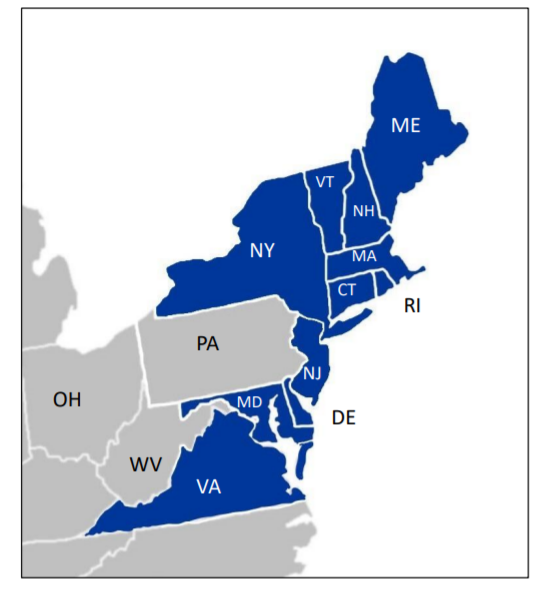
The 2020 Virginia Clean Economy Act and other bills “authorized” the executive branch to participate in RGGI and implement the regulation, but no law mandates that Virginia remain in RGGI and continue to require the allowances. The Memorandum of Understanding behind the interstate compact allows for withdrawal by member states upon notice. Regulations can be amended or repealed within the executive branch.

Youngkin’s exact plan or timetable for extraction was not detailed. Other laws passed under Governor Northam create broad goals for reducing or eliminating the use of fossil fuels throughout the Virginia economy, including for power production, and if those transformations take place as planned those higher costs are also coming the way of Virginia consumers.

First out of the box with a comment today was future Speaker of the House Todd Gilbert, R-Shenandoah, praising Youngkin’s decision while also pointing out that Virginia was already reducing its CO2 emissions before any RGGI tax was created.

“When a policy costs the public a significant amount of money for no tangible benefit, that policy should be examined carefully, and if practical, rolled back. Governor-elect Youngkin’s announcement is a perfect example of the common-sense decision making we’ve been missing for the past 8 years,” Gilbert wrote.

Posted in Economy, Environment, Government Reform, State Government, Taxes | Comments Off on Youngkin to Withdraw from RGGI, End Carbon Tax

Heat Rule Gets Cold Shoulder

Share this article on:

Virginia’s Safety and Health Codes Board on Friday voted down a proposed workplace heat protection standard, strongly opposed by the state’s business community but ardently sought by organized labor and farmworker advocates.

The Department of Labor and Industry (DOLI) was seeking to push the proposed rules out for a final round of public comments.  Abiding by the standard schedule for regulatory adoption would have meant final approval rested with incoming Governor-elect Glenn Youngkin.  Perhaps the December 3 vote was an early sign attitudes toward the regulatory state are expected to change.

As is always the case with these proposals, a massive amount of staff work had been put into preparing the draft standard, including several industry and labor stakeholder groups meeting throughout 2021.  According to public comments made before Friday’s votes, those stakeholder groups had divided along similar lines.

The briefing document for Friday’s meeting exceeds 350 pages, with the actual proposed standard covering pages 177 to 199.  The first round of public comments is also reproduced in the document or can be found here.  The early, written comments were heavily favorable to the rules, but the oral testimony Friday was dominated by opponents.

No one disputed the dangers of heat stroke, heat exhaustion and the related risks of working in a hot environment, whether inside or outside.  But serious issues are rare.  According to the DOLI data, Virginia deaths from work-related heat exposure happen less often than once per year, and industry speakers noted that deaths and injuries have been on the decline as working conditions improve.

In October, the federal Occupational Safety and Health Administration (OSHA) began its own effort to develop a national workplace standard around heat exposure.  Opponents of the Virginia effort suggested Virginia defer to that, to prevent any confusion, but worker advocates complained it will take years to create such a rule at the federal level, if it succeeds at all.

The proposed Virginia work standard would have been activated whenever the workplace heat index (not just the air temperature) reached 85 degrees Fahrenheit.  With modest or high humidity, that could happen well below 85 degrees of air temperature, and for outside workplaces would be common many months in Virginia.  The first iteration of the rule kicked in at 80 degrees in heat index.

When workplaces – inside or out — are at that ambient heat level, and employees spend 15 minutes or more per hour in the warmth, employers would be required to provide shaded cool-down locations which employees could seek out “when they feel the need to do so to protect themselves from overheating.”  Once employees went there, the employer had a duty to check on their condition.

After the public hearing but before the vote Friday, a Department of Environmental Quality representative in the room asked about their folks out on boats doing their jobs for long periods.  “Are you expecting staff to have shade on the vessel? Or return to shore?” she asked.  The meeting was being monitored on a phone line (the visual link was an issue) so her name escaped this listener.

It was probably the sheer impracticality of the proposal that sank it, as various employer groups complained it seemed aimed at protecting farm workers in the sun but had little application to waitresses working out on a patio, repair workers in a welding shop or a truck driver unloading his vehicle.   Yet it was to be basically universal with no industry-specific adjustments.

Dale Bennett of the Virginia Trucking Association told the board that during this pandemic period, some drivers have been told they couldn’t enter the facility where they were making a delivery.  That would be the most logical method for a cooling or water break for them.

At the 85 degree level, employers would be required to provide each worker a full quart of water per hour, at specified water temperatures.  Specific periods of time were mandated for new employees, or those returning from a week off, to be “closely observed by a supervisor or designee” while they become acclimated to the warmth.  How closely? Observed for what signs?

At 95 degrees of heat index, mandatory rest periods in a cool down area of ten minutes every two hours would supplement the ability of the employee to head there on their own initiative.  On those warmest days, a buddy system would be implemented, and additional communication steps required to facilitate everybody being able to contact emergency services.

The paperwork and training requirements in the rules were extensive.  And it ended with prohibitions against any employer from discharging or discriminating against an employee exercising their rights under the rules or “who raises a reasonable concern about heat illness hazards to the employer, the employer’s agent, other employees, a government agency, or to the public such as through print, online, social, or any other media.”

Prior to DOLI taking on this task, legislation had been introduced in both the 2020 and 2021 General Assembly sessions.  All the bills quickly died before any committee vote on their merits, even as other regulatory matters popular with organized labor were advancing.  As has been typical with many new rules, the heat standard bill also created a private right of action for any employee to sue the employer for alleged failures to meet this standard.

A regulation also adds legal liability risk along with compliance risk for employers. But as several business speakers pointed out, they are already highly motivated to prevent workplace injuries or deaths, prodded by their workers’ compensation providers or other regulatory bodies.  The “general duty” clause requiring safe workplaces applies to preventing heat issues.

Unraveling the regulatory structure added since Democrats took full control of Virginia government has been a promise from Governor-elect Youngkin.  The six-to-five vote Friday (with three board members absent) removed one of the likely targets in advance.

Posted in Business, Labor, Regulation, Workplace Freedom | Comments Off on Heat Rule Gets Cold Shoulder

As Cost Kills TCI in Connecticut, Virginia Dems Dig In To Defend Virginia Green New Deal Laws

Share this article on:

The Governor of Connecticut has abandoned his efforts to enroll that state in the Transportation and Climate Initiative, an interstate compact which would impose a cap, tax and ration scheme on gasoline and diesel fuel.

Virginia remains a part of the planning group that developed the compact, which has now been under consideration for more than a decade but not implemented anywhere.  In late 2020, Connecticut was one of four jurisdictions pledging to go forward in 2021, while Virginia remained on the sidelines

As in Virginia, Connecticut’s participation in the compact required legislative blessing, which Governor Ned Lamont was unable to secure during 2021, even in a legislature controlled by his own party. In light of that failure, and the lack of any other signs of movement toward an agreement, Lamont announced Tuesday he would not try again in 2022.  He was quoted in the Hartford Courant:

“Look, I couldn’t get that through when gas prices were at a historic low, so I think the legislature has been pretty clear that it’s going to be a pretty tough rock to push when gas prices are so high, so no,’’ Lamont said Tuesday, acknowledging that the cost of motor fuel was likely to rise under the initiative, known as TCI.

At a later appearance in East Hartford, Lamont said that gasoline prices had reached a seven-year high and there was not enough support in the legislature in 2022 — a year when both Lamont and the entire legislature are up for reelection.

The Rhode Island legislature also passed on the issue in 2021 despite its governor’s efforts.  Only Massachusetts and the District of Columbia are poised to join TCI once enough states make it viable, and in Massachusetts opponents have put the issue in front of the voters in a 2022 referendum question.

Virginia Governor-elect Glenn Youngkin has made no pronouncements on TCI, which would first cap and then slowly reduce the total volume of gasoline and diesel fuels available for sale in Virginia.  While they enjoyed full control of all branches of Virginia government, Democrats signed the state up for the Regional Greenhouse Gas Initiative (RGGI) cap and tax on fossil fuels used in electric power plants but failed to even introduce legislation on joining TCI.

They have now shifted to a defensive posture, promising their supporters that Democratic control of the Senate – and one key committee in particular – provides a firewall to protect various climate-fear-driven measures approved in 2020 and 2021.

Typical was a prediction made by Senator George Barker, D-Alexandria, at a meeting with the Alexandria City Council Monday, reported on Virginia Public Media outlets.  He and other Democratic legislators who represent that city were asked about coming efforts to repeal or amend some of those earlier laws, efforts that now might be successful in the House of Delegates.

“If the bill, a bill, does come over backing down on some of the climate change types of things from the House, and it’s certainly possible it will,” Barker says. “I think we have the ability to deal with it in the Senate and box it up and it’ll probably never get to the floor and have the bill basically defeated in the committee.”

The committee in question, Senate Commerce and Labor, has 12 Democrats and only three Republicans as voting members, and it only takes seven votes or even a tie to defeat a bill in committee.  That imbalance exists despite a 21-19 split in the body overall.  Barker went on to claim that some of his Republican colleagues, when he speaks with them privately, express support for the bills which have passed.

A day later over at Virginia Mercury, an anti-fossil fuel advocate affiliated with the Sierra Club surveyed the new Virginia political landscape and was similarly encouraged, partly by the remaining Senate firewall and partly by Youngkin’s lack of specific statements on the various issues during the campaign.

Attorney Ivy Main pointed to the one candidate debate segment that touched on the issues, heartened by Youngkin’s statement he “wholly supported” the coming offshore wind project Dominion is set to build, but dismissive of his complaints about other elements of the Virginia Clean Economy Act and his advocacy of continued use of natural gas.

With Democrats still in charge of the Senate, Youngkin isn’t likely to find a RGGI or VCEA repeal on his desk. Creating an energy transition framework was one of the Democrats’ biggest successes in the past two years and protecting that success will be a party priority.  

But there are many ways Republicans can undercut climate action. They might attract just enough Democratic votes with bills that, for example, grant exemptions for powerful industries that have friends among Senate Democrats. They could also use the budget process to undermine the transition by starving agencies and grant programs of funding. 

But the TCI idea failed in solidly Democratic Connecticut because it would clearly raise costs on every family and commodity in a time of inflation, and for the same reason has never even been pushed here in the Commonwealth.  The same is true of every other aspect of Virginia’s misguided response to overblown threats of climate disaster.  Making that clear is the first step toward a change in course.

Posted in Economy, Local Government, State Government, Taxes, Transportation | 1 Comment

Election Shows Why Caution Necessary on Local Collective Bargaining

Share this article on:

Virginia’s new collective bargaining law is forcing local government officials to deal with a controversial issue fraught with potential errors and legal risks.

If the 2021 election showed anything, it was that Virginia voters felt the Commonwealth was going in the wrong direction. The sweep of Republicans for governor, lieutenant governor, attorney general and the House of Delegates sent a clear message: Voters wanted change.

Local governments should take heed, especially on controversial issues such as public sector collective bargaining. Elected officials should carefully consider not just voter sentiment, but what new executive authority means for interpretation and implementation of recent laws.

One law, passed in 2020 by a Democratic governor, House and Senate, was a radical change to decades-old precedent. The new law gave local elected officials the ability to pass ordinances allowing government unions to have a monopoly and represent all public employees (even those that do not want representation) and to bargain on almost any issue. However, now there may be stricter scrutiny on the interplay between these ordinance and state laws, not to mention the U.S. Constitution.

Outgoing Virginia Attorney General Mark Herring celebrated the law when it went into effect in May 2021, saying he was “proud to have worked alongside Delegate Guzman and other labor advocates to craft this important legislation and ensure its passage.” But incoming Attorney General Jason Miyares voted against the bill and may not give unions such wide latitude with potential conflicts to state law and employee rights.

For example, the city of Alexandria narrowly avoided violating the state’s Secret Ballot Protection Act by allowing a union to organize via an open petition process, but at the last minute city officials realized their error and amended the city ordinance.

Unfortunately, the ordinance has several other troubling provisions that may not stand legal scrutiny. For one, the city and the few other jurisdictions have collective bargaining provisions that permit unions to take money out of public employee’s paychecks and show they want to be members of the union though “voice authorizations,” rather than giving employees the protection of a secret ballot.

These provisions are similar to other ordinances proposed in a number of other localities and have already been enacted in a few jurisdictions. They also include giving unions the ability to limit when public employees can leave the union and stop paying.

Many of these provisions may violate the First Amendment rights of public employees and their right to a private ballot.

The Supreme Court in the 2018 case Janus v. AFSCME held that employees have a First Amendment right to choose to pay dues or not and to protect this right, money can only be deducted from their wages after “clear and compelling evidence of “affirmative consent.”

Several attorneys general have said that allowing unions to take money from public employees and limit when they can exercise their right to leave a union is a violation of the employee’s First Amendment rights. Attorney General-elect Miyares may be more willing to agree with his colleagues across the county and protect the constitutional rights of Virginia’s public employees than his predecessor, who was proud to work alongside the government union advocates who may violate those rights in the future.

These are just a few examples of the legal landmines present for local governments passing government union collective bargaining creating monopoly union contracts, and demonstrates the process shouldn’t be rushed.

Unfortunately, that is exactly what the language of the state legislation forces local officials to do.

The law rushes the process by requiring governing bodies to take a vote to adopt or not adopt a collective bargaining ordinance within 120 days after getting a petition from public employees.

If government unions present a petition to local elected officials, they have a few short months to either vote it down or work on an entire new section of law. It could also come at a time when many staff are working on other things (such as dealing with the COVID-19 pandemic) or out of the office.

For instance, Prince William County is being forced to vote on such an ordinance in early January. This means that if the Prince William Board of Supervisors wants to enact it, county staff will need expedite the work, especially dealing with time off over the holidays. This could lead to long-term mistakes or illegal provisions accidently making their way into the ordinance.

Other than the political and legal pitfalls, there also have been examples of vague language that harms public employees. The recently passed Fairfax ordinance creates a Hotel California situation by requiring only a majority of votes from public employees to form a union but a majority of all employees to remove one.

This means that in a union with 100 employees, if 30 vote for the union and 20 vote against it, the union would represent all the employees. However, if that same vote was to remove the union, it would fail. Employees wanting to remove the union would need 51 yes votes. This provision could have been intentional, or it could have been the result of rushed, poor drafting.

Finally, even supporters of allowing government unions to bargain have noted unions are not effectively communicating with public employees. Phyllis J. Randall, Loudoun County Board of Supervisors chair and supporter of public sector bargaining, remarked that unions such as the Service Employees International Union have not been doing a good job communicating with their potential members.

With the changing political winds in Virginia, the potential for legal missteps, an incoming attorney general who may do more to protect public employees, and even the potential for drafting mistakes, localities presented with a 120-day clock on drafting a massive ordinance creating an entire new section of code are put in a difficult position.

The good news? They can always say no.

A version of this commentary originally appeared in the online blog VirginiaWorks on November 16, 2021. F. Vincent Vernuccio is a Visiting Fellow with the Thomas Jefferson Institute for Public Policy and a senior fellow at Virginia Works.


Posted in Labor, Public Sector Unions, Workplace Freedom | Comments Off on Election Shows Why Caution Necessary on Local Collective Bargaining

Time To Reform Virginia’s Energy Policies

Share this article on:

Dominion Energy Virginia’s announcement Friday that its proposed offshore wind project has jumped almost 25% in cost to $10 billion, with years to go before construction even starts, has put Virginia’s energy policy and its response to claims of climate disaster on the front burner for 2022.  

Below are my suggested priorities, based on 15 years of dealing with these issues at the General Assembly and the State Corporation Commission.  This is based on a similar summary published on Bacon’s Rebellion in August.  First and foremost: 

  • Restore the proper oversight role of the State Corporation Commission over utility rates, profits, and capital planning. Let the SCC decide how to allocate costs between customer classes. The General Assembly has dangerously usurped that function, often leaving the SCC nothing but an administrative agency subject to changing political winds.

One of the first key decisions the new General Assembly will need to make is whether to give a full term on the SCC to Angela Navarro, elected by the Democrats last year after serving as an architect and advocate for the Virginia Clean Economy Act of 2020 and other anti-fossil fuel efforts.  As I wrote elsewhere, personnel is policy. 

  • Limit campaign contributions from all donors (still important even if the General Assembly stops usurping the SCC’s job in the future.)  We’ve now held another election where utilities and the vested interests behind unreliable, intermittent generation sources poured incredible amounts of money on candidates and parties.


  • Limit or eliminate non-disclosure agreements in cases before the SCC. Too much vital information is redacted and never made public.  The first motion Dominion Energy Virginia has made to the SCC in its effort to build 2,600 megawatts worth of ocean wind turbines is motion to seal much of its data.  Saturday, I urged outgoing Attorney General Mark Herring to oppose that motion and demand transparency. 


  • Move the Consumer Counsel function outside of the Office of the Attorney General. Perhaps the job should be filled in the same manner as the SCC itself, or some other judicial position.  But it needs to be at least shielded from the election process and the person holding it should have a term certain and perhaps no expectation of reappointment.  Attorney General-elect Jason Miyares would probably resist this suggestion.


  • Review every code section dealing with electricity regulation or other energy use and reconsider each instance of the phrases “in the public interest” or “shall be deemed reasonable and prudent.” Those are the words the General Assembly uses to dictate policy to the SCC despite the ignorance of most legislators on these matters, and their sensitivity to donors.  Likewise remove hard numerical targets for various forms of generation, which were based on politics, not engineering.


  • Review every code section and reconsider any financial subsidies or rewards offered to influence utility decisions about one project over another, especially any remaining bonus returns on equity for stockholder-favored investments. This would include recently approved (but not yet funded) subsidies for rich people to buy electric cars.


  • On the other hand, remove any penalties on specific energy sources or carbon taxes, such as the recently imposed power bill tax to cover Dominion’s participation in the Regional Greenhouse Gas Initiative.  Do not join the Transportation and Climate Initiative, which we can hope is now a dead issue in Virginia.


  • Require local governments providing monopoly utility service to maintain that service or turn it over to the private sector if they wish to exit.  The recent indication that the City of Richmond might close its gas utility and leave 120,000 customers stranded is a warning the Assembly must heed. 


  • Require more competition for utility-scale generation services both to discourage placing all the cost and risk on ratepayers, and to be sure of fair and honest pricing on utility-owned projects.  The monopoly utilities don’t need to own so much of the generation.

Virginia should not abandon the current structure entirely. The pure competitive supplier model has plenty of downsides (See Texas).  It is only attractive to so many in Virginians at this time because Dominion Energy Virginia has corrupted the market to unfairly enrich its stockholders.  If all these other steps are taken and electricity costs in Virginia stabilize, the desire to bolt from the monopoly service will wane. 

Now to the various controversial decisions on generation and transmission being dictated by the Virginia Clean Economy Act, which will be radically revised by several of the points above.

  • The remaining coal generation should be allowed to die a natural death from market forces. As the environmental costs grow, and the revenues shrink, remaining will be closed early without any action by the SCC necessary.  Requests to fund improvements should be viewed with skepticism.  No new coal plants are going to be built.  Dominion’s Virginia City plant in Southwest Virginia was always a good political investment, never a good energy investmentIf it is now a financial liability, it should be closed.


  • The SCC should be making the decision how much utility-scale wind or solar generation is justified, and when, and what are the best options for reasonable cost and reliable supply. That will likely reduce the amount of those wind and solar investments over the next 25 years below the VCEA’s goals, with more natural gas remaining.   The offshore wind proposal in particular demands a real evaluation of its cost and prudence.

This is not a complete list, and of course some of these points would engender incredible debate and even full scale war at the General Assembly.  But it is where Virginia needs to go to keep energy abundant and costs reasonable.  With the flip in the Governor’s Mansion and House of Delegates, a change of direction on this front must follow.

Posted in Energy, State Government | Tagged , | Comments Off on Time To Reform Virginia’s Energy Policies