
With Tax Revenue Exploding, Virginia Should Boost Standard Deduction, Index for Inflation

Share this article on:

One of the big financial winners with the May 1 Virginia minimum wage increase is the state itself, because the entire raise is subject to a 5 percent state income tax. With its low standard deduction and personal exemption amounts, Virginia squeezes income tax out of even its lowest wage workers.

In light of the massive tax increases Virginians have seen due the Governor Ralph Northam’s recent policy changes, some of the heaviest falling on the state’s businesses, it is clear the state is on a sound financial footing. Another major surplus of more than $500 million looms. The initial 2019 promise made by the legislature to continue efforts for tax reform, abandoned by both parties after the 2019 election, should be revived.

The recommended focus remains the same as the Thomas Jefferson Institute position two years ago:

  • Virginia needs to substantially increase the standard deduction it offers to all taxpayers, with the goal of matching the amount offered on their federal taxes. That would be an increase from $9,000 tax free income for a couple filing jointly to $25,100 for that same couple, removing more than $16,000 from taxable income. An individual’s standard deduction is $12,550.
  • Virginia needs to index its tax code to inflation, again mirroring federal practice. Failure to do so, and allowing tax rates to increase due to inflation, is itself a form of tax increase. This is even more important now because the massive federal deficit spending on individual cash benefits, and other federal actions to overheat the economy, are likely to produce the kind of inflation many of us remember from the 1970s.

Complaints that the state cannot afford this should be hooted down, although it may need to be phased in, starting with a standard deduction increase to $6,000 for an individual and $12,000 per couple. State General Fund tax revenues are up about 30 percent in just four years, and the explosion from the tax increases and super-heated economy is just starting. If the Biden Administration gets even part of the tax package it wants through Congress, Virginia will quickly conform to any of the changes that produce additional revenue for the state. Most of them will.

The next Governor and 2022 General Assembly should act immediately to protect Virginia families and the Virginia economy from what is coming. Shielding a higher portion of every Virginia family’s income from income tax is easy to explain and provides a level tax benefit to rich and poor. As a portion of income, it is of far greater benefit to the lower income workers.

In 2019, Virginians were asked about doubling the standard deduction as a method to return some of the coming state tax bonanza due to the 2017 federal tax bill. By wide and bi-partisan margins they endorsed the idea, but the General Assembly took only a small step and raised the deduction 50 percent. A major increase in the standard deduction will be just as popular today, if not more so.

The Thomas Jefferson Institute also recommended changes to the corporation income tax in 2019, which again were roundly ignored by leaders of both parties. It was clear that the federal rules changes in the Tax Cuts and Jobs Act of 2017 would produce an avalanche of new state corporate taxes unless we made state-level adjustments. Fixing that is of lower priority than the other two goals, a meaningful standard deduction and annual inflation adjustments.

Much of Virginia’s business income is reported and taxed on individual returns, since many businesses are not structured as corporations. An increase in the standard deduction is of direct benefit to those unincorporated business owners. For corporations, the higher standard deduction is of benefit to employees and stockholders but not the business entity.

The General Assembly has now decided to increase the state’s fuel taxes annually to keep up with inflation in future years. It has voted to raise the minimum wage annually due to match inflation. It is long past time to give the same protection to Virginia’s taxpayers. The current chair of the House Finance Committee in the General Assembly, Delegate Vivian Watts, D-Annandale, has introduced an indexing bill already, but so far has been unsuccessful.

Many Democrats share the desire to reduce income taxes on Virginia families by working up from the bottom but prefer to do it with a mechanism called the Earned Income Tax Credit. Recent General Assemblies have also considered and rejected efforts to make that tax credit “refundable,” meaning that taxpayers who qualify could actually receive an annual check from the state. The proposal is likely to surface again.

That approach does nothing to reduce the tax burden on middle income Virginians because the EITC phases out quickly as income rises. And it involves the state taking the taxes out of paychecks and then returning them at a later time, rather than simply not taxing it in the first place. EITC becomes just another government entitlement, more bureaucracy.

Many Democrats also oppose the idea of a higher standard deduction because the benefit is nearly universal, reaching even higher income families if they do not take itemized deductions. If the federal tax changes President Joe Biden wants are enacted, the higher state standard deduction will make only a small dent in higher tax bills coming their way.

Finally, matching the federal standard deduction brings Virginia into line with a number of other states competing with Virginia for new jobs and residents. The District of Columbia and South Carolina match the federal amount, and North Carolina comes close. For most low income Virginia workers and many retirees, there would be zero income tax, the same as in Florida, Texas, or Tennessee.


Posted in Economy, Government Reform, State Government, Taxes | 1 Comment

Sign the Petition!

Share this article on:


Posted in Government Reform | 1 Comment

Northam Tax Harvest Expands Again

Share this article on:

With the release yesterday of the April 2021 Virginia state revenue report, covering ten months of the fiscal year, a correction in an earlier report becomes necessary. Overall general fund state tax collections are not up 26 percent so far compared to four years ago, they are up almost 30 percent. Corporate income tax collections are not up 68 percent, but 86 percent over the same period four years ago.

Your correspondent regrets the error and admits jumping the gun after the March report knowing things would become more dramatic soon. Since the essence of good communication is repetition, expect another update in a month. And as has been the case for a while now, expect Governor Ralph Northam to seek to distract the voters from what is really going on.

From today’s news release:

“Virginia is posting the largest monthly revenue increase in the 21st century this month, in sharp contrast with many other states,” said Governor Northam. “Make no mistake—this is the result of strong fiscal management and Virginians doing the right things to put this pandemic behind us. People are getting back to work, businesses are investing, and we expect this surge to continue in the months ahead as our economy returns to full strength.”

“Make no mistake—this is the result of strong fiscal management…” the Governor said. Well, no, unless you count a host of tax increases to be “strong fiscal management.” Or unless you consider a set of federal bailout bills that flooded people with cash to spend as “strong fiscal management.” Stimulus yes, management no.

They don’t want Virginians to focus on the tax increases which have fueled this massive revenue explosion:

  • The state’s refusal in 2019 to properly adjust its personal income tax to counteract the tax boost it would get from the federal Tax Cuts and Jobs Act of 2017. The paltry change in the state standard deduction and miniscule pre-election tax rebates left the state still collecting billions in new taxes.
  • The 2019 General Assembly’s decision to impose its own version of a wealth tax on high income earners through a cap on itemized deductions.
  • The state’s refusal in 2019 to make any effort to protect its corporations from the state tax impact of the TCJA’s various changes in the rules, while accepting all those new rules changes.
  • The imposition of sales and use tax on all Internet-based commerce, part of a national wave following a Supreme Court decision.
  • A major tobacco tax increase including an expansion of that tax to liquid nicotine products.
  • And earlier this year, a refusal by the state to allow businesses a full state deduction for their Paycheck Protection Program grants, subjecting billions more to a state skim of about 6 percent.

This does not include or reference the motor fuel tax increases also imposed under this Governor, the carbon tax to be hidden on your electric bills, or the host of local taxes authorized for transportation and other functions.

“…in sharp contrast with many other states,” the Governor said. Well, no. That is not accurate, either. Quite a few other states are doing fine.

In December, the Tax Foundation looked at the first nine months of calendar year 2020 (January to September), which included the recessionary period. Overall state tax revenues were down only 4.4 percent for the period, and local revenues were up. There were winners and losers, of course, but only nine states were showing double digit percentage losses. Many of those were dependent on energy severance taxes.

Looking just at the second and third quarter, overall state revenues were down 8 percent, but the first quarter (pre-pandemic) had been strong, and the year finished strong. The economy has been on an upward swing for months now, not just in Virginia and despite the real pandemic peak in January.

The myth of a foundering economy and struggling states and cities continues to fuel massive federal “relief” spending, and earlier today the Governor issued another press release, a joint statement from him and his fellow Democrats (no Republicans mentioned) on how they intend to spend the next $4.3 billion in federal post-COVID emergency largess, with another $2.7 billion going direct to the state’s localities. The total is $7 billion, and a special session of the Assembly will be needed to parcel it all out.

Their priorities for the American Rescue Plan Act dollars are: Public health, business grants (watch out or they will be taxed), replenishing the unemployment insurance trust fund to prevent huge tax increases on employers, school construction and repairs and broadband.

The one thing the coming special session will likely not do is consider any tax relief for Virginians. In case you missed it, the most recent Biden Administration spending spree included a provision seeking to prevent any of the states getting the money from cutting their taxes. It is unprecedented federal interference with the financial independence of state governments.

Within the past few days, the U.S. Department of the Treasury issued complicated guidance on a number of issues raised by the Biden Administration legislation, and according to another Tax Foundation summary tax cuts are not totally prohibited. Wrote analyst Jared Walczak:

Crucially, Treasury proposes to use inflation-adjusted Fiscal Year 2019 tax revenue as a baseline for determining whether there has been a net tax reduction. This means that states can unequivocally cut taxes out of organic revenue growth. If a tax cut reduces revenue compared to what it would have been on a current policy baseline, but revenues are still up in real terms, this does not violate the provisions of the American Rescue Plan Act and would not lead to a recoupment of any federal funds.

Organic revenue growth? With the revenue explosion Virginia has enjoyed during these four taxing years, surely there has been enough of that to find some way to relieve Virginia families.

Posted in State Government, Taxes | Comments Off on Northam Tax Harvest Expands Again

Alexandria Stands With Government Unions, Not Workers

Share this article on:

In mid-April, the City of Alexandria passed an ordinance allowing government unions to bargain with the city. Unfortunately, many of the ordinance’s provisions are lopsided: the ordinance grants special advantages for government unions to easily organize public employees and traps workers into paying dues.

Alexandria’s lopsided ordinance

Alexandria’s ordinance makes it is easy for a union to petition for an election, which the ordinance says may happen in several ways, “including, without limitation, electronic authorizations and voice authorizations.” Once there is a determination by a labor relations administrator or the city manager that a majority of employees have given authorization, no one can challenge the petition.

In a sense, if a union were to use ambiguous language to trick an employee over the phone, and that employee were to respond with “yes,” the union may show that the employee wants the union to represent them – even though that may not really be the case if the employee is not informed of both their rights and of all the facts. Once the LRA makes a determination, the employee would have no recourse to say that verbal “yes” was not what they meant, or to rescind their indication of approval.

Another way the ordinance unfairly favors the government unions, it could permit more than one union to be on the ballot during a runoff election to allow a union to organize employees without the ability of an employee to choose “no union”. In the scenario in which there is no majority between multiple unions on an initial unionization election (with the ability to vote “no union”) the LRA conducts a runoff election.

However, the catch is that only the top two options from the previous election get placed on the runoff ballot. Meaning, if “Union A” were to receive 34% of the vote and “Union B” were also to receive 34%, but the “No Union” option receives 32%, employees on the runoff ballot would not have the choice of voting against unionization. Even though 66% of employees in such a scenario did not vote for either “Union A” or “Union B,” they would be forced to choose between the two.

Double-standard for government unions

Adding insult to injury, Alexandria’s public employees are left stuck with a Hotel California situation. While it’s easy to organize a union, it is much harder to remove it if employees are unhappy or dissatisfied. Asking for a vote on whether a union will come in only requires 30% of employees to sign a petition, but to trigger an election to remove a union requires over half of the employees to sign a petition.

Moreover, in the election to form a union, there only needs to be a simple majority vote of those voting in the election to organize, but to remove the union a majority of all the employees would need to vote to kick the union out – a clear double-standard.

For example, if there was an election to organize a union and there were 100 employees at a worksite, if only 40 voted to bring the union in and 39 voted against it, the union would still be able to organize the workplace and act as the exclusive representative for all employees. To remove a union in the same workplace, 51 employees would need to vote to remove the union. If 40 employees voted to remove the union and 39 voted to keep it, the union would stay.

Additionally, employees can only file to remove the union during a 30-day window between the “one hundred eightieth (180th) and one hundred fiftieth (150th) day prior to expiration” of the union contract. If they miss that window and the contract is renewed workers, are stuck with the union for another three years or longer. If that sounds confusing, you’re not alone: that is probably the point.

Sales pitches and paychecks

Once a union has organized the employees, they are entitled to meet with new employees for up to 30 minutes to make their sales pitch, whether the employees want to meet with them or not – think of it as a timeshare presentation on steroids.

Unions are also entitled to take dues from an employee’s paycheck once the employee gives consent. Remarkably, a worker could unwittingly make this authorization over the phone. Once a public employee agrees to have that money taken out of their paycheck – even unintentionally – they could be locked in for up to a year.

Instead of these provisions, Alexandria should have looked to states that protect union democracy and public employee’s choice whether to pay dues or not.

A different model for government unions

In Wisconsin, Iowa, and Florida, public employees have the right to regularly vote on which union represents them in the workplace.

Many states allow public employees to stop paying a union at any time. Indiana recently passed such a law, and now requires unions to inform public school employees of their rights: to join a union and to pay or not pay dues.

The choice whether to sign a petition to ask for union representation or to sign a form to authorize money to be taken from a public employee’s paycheck are decisions that should be made in an informed way. Public employees have the right to know what they’re signing up for.

Alexandria’s ordinance does not include these safeguards. The electronic or voice authorization can easily be abused – leading to an unfair advantage for government unions, not public employees. While under state law, Alexandria could have said “no” to allowing public sector collective bargaining and keeping the decades old status quo, the city chose to be the first in the Commonwealth to allow it.

Unfortunately, this choice – and the decision to allow unions an easy path to organizing and taking dues from employees’ paychecks – city leaders put the special interest of government unions ahead of their own public employees

Posted in Government Reform, Local Government | 1 Comment

Virginia Tax Structure Better for Mature Firms than for Start-ups

Share this article on:

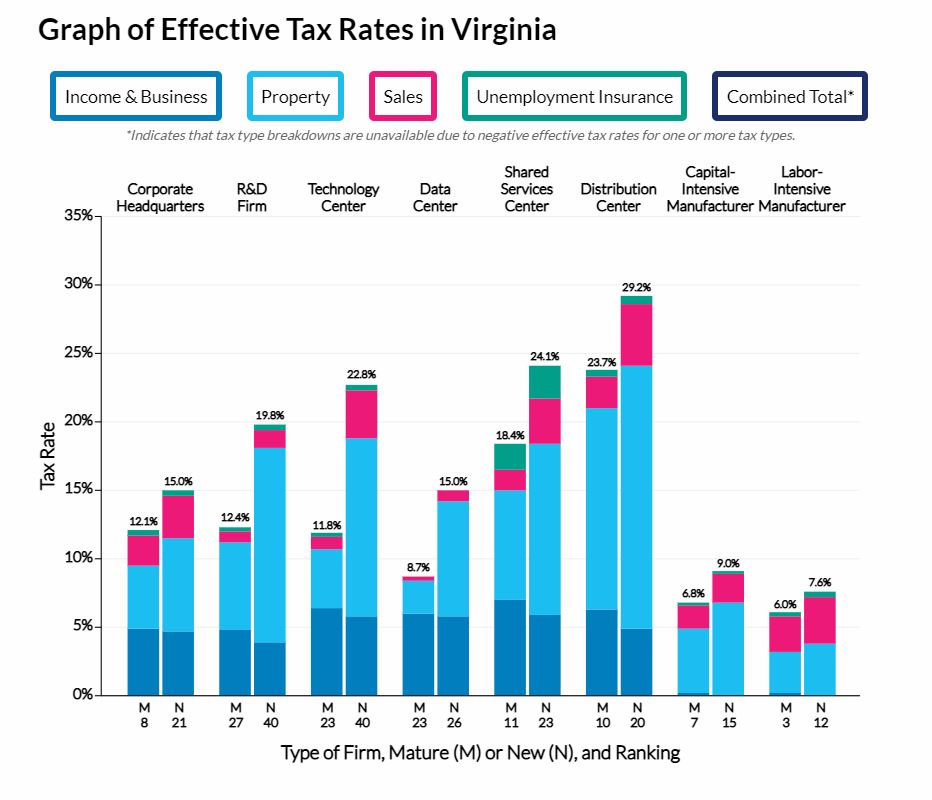
Virginia is far more tax friendly to established businesses than it is to new ones. That is one major conclusion of a major state-by-state business tax comparison released Wednesday (here) by the Tax Foundation and KPMG LLC.

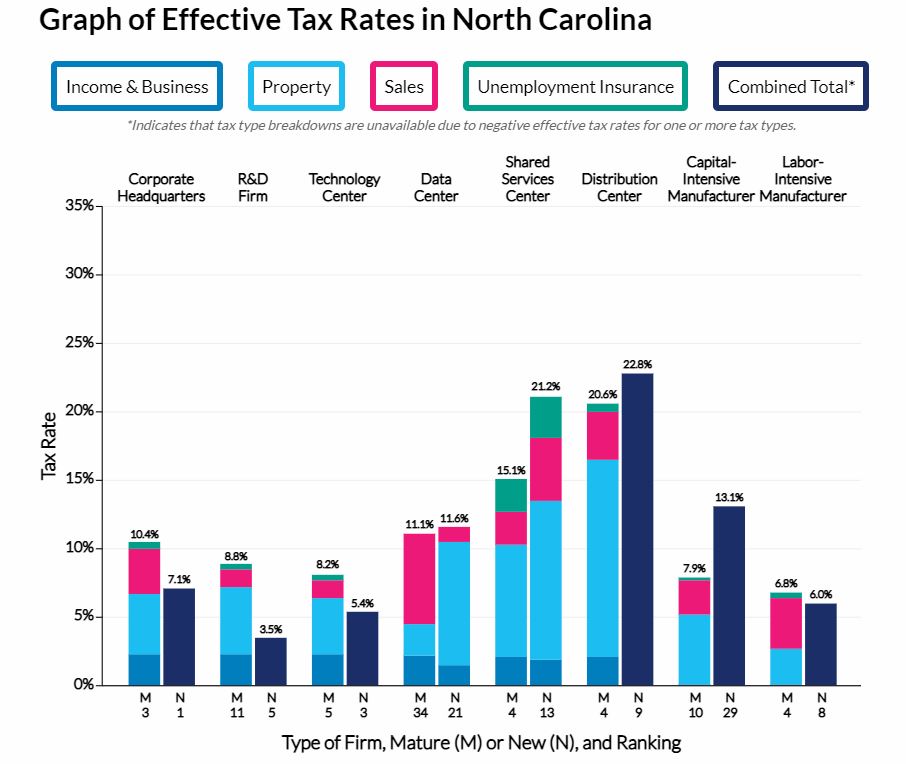
In neighboring North Carolina, on the other hand, the tax structure encourages new investment with more attractive rates for incoming businesses of several types. It has been a conscious strategy for that state’s political leaders for some time.

Instead of seeking to put an overall ranking on the state’s business tax climate, as has been done in the past or in other studies, the Tax Foundation devised eight imaginary firms in different industries and then calculated their effective tax rate in each of the fifty states. It used tax laws and incentives as they were in force January 1 of this year.

One of the principal authors is a former General Assembly legislative aide well known around our capital, Jared Walczak, now a vice president at Tax Foundation. This approach of comparing how the various states would tax a set of reasonably typical firms is a big step up from previous methods.

The lowest effective tax rates it reports in Virginia were for manufacturers, as you can see on the chart. In the case of existing manufacturing firms Virginia ranked in the ten lowest taxers among the states, but for new firms about a quarter of states had lower effective tax rates. Virginia’s manufacturers are aggressive advocates on tax issues, complaining most loudly about local machinery and tools taxes, but the data suggest they have also been effective advocates.

Virginia had among the ten lowest effective tax rates in two other business categories: Existing corporate headquarters and existing distributions centers. On the other extreme, Virginia effective tax rates were above the national median for existing or new R&D firms, new technology centers and new data centers.

That last one might surprise you as recruiting data centers has been a major Virginia emphasis, but other states are offering aggressive incentives, too. Tax policy is only one thing a company might look at when deciding whether to open a new facility or move an existing one. Major wholesale distribution centers, for example, are going to be near the import ports of entry regardless of other considerations. Data centers will follow the major Internet trunk lines, a huge Virginia advantage.

But tax policy does matter, and North Carolina provides a great demonstration. Of the 16 tax calculations made, North Carolina’s effective tax rate was in the ten best in eleven of them (compared to Virginia’s four). Several in North Carolina were in the lowest five, and it had the lowest effective tax rate for new corporate headquarters.

There are four company types in North Carolina where new firms enjoy lower effective tax rates than existing ones, and only one (capital intensive manufacturing) where they face substantially higher rates.

The study authors had to lump several tax categories together because in some cases the incoming firms enjoyed negative effective tax rates, meaning the subsidies provided net tax benefit. Is this the right approach? Should Virginia copy it? For years now we have seen this happening and ignored it.

As recently reported, Virginia’s overall tax collections are rising far faster than inflation or population, with the corporate income tax leading the way. That has been the intentional policy. Discussions of using tax reform as a jobs magnet are simply not heard in Richmond. The next big push will be to force Virginia firms with multi-state operations to file a unitary combined return, raising their taxes.

Roaming around the report, it is interesting to note that economic growth powerhouse Texas is not ranked all that well on overall tax rates, and in fact is quite high in some categories. Why isn’t that a drag on its economy? Probably because the lack of an income tax is so attractive on both a business and personal basis.

Likewise Florida, another state with strong growth, has nothing to brag about with those effective tax rates on business. Its effective tax rate on distribution centers is almost 50%, again taking advantage of the captive market provided by its many ports. The absence of an income tax and the near absence of winter weather are its magnets, same as with Texas, plus the basic economic truth that growth stimulates more growth, stagnation breeds stagnation.

Posted in Taxes | Comments Off on Virginia Tax Structure Better for Mature Firms than for Start-ups