
Digging Beyond the #1 Ranking

Share this article on:

Virginia ranks #1 in the  “Top States for Business 2021” ranking produced by the business network CNBC, but it is important to dig into the ten measurement categories. They are not weighted evenly.  Changing the former “Qualify of Life” measure to “Life, Health and Inclusion,” and adding more points to that category, sealed the deal for Virginia’s latest recognition at the top of that chart.

Virginia’s Cost of Living score remains abysmal, number 32 among the 50 states.  Cost of Doing Business, the category with the most weight, had Virginia right in the middle of the pack at number 26.  The other overweight category is Infrastructure, and again Virginia had a middling rank at number 24.

Where Virginia’s total score shot past the other top states was in the revised life, health, and inclusion score.  At number eleven, it was way ahead of the number two through number five states, North Carolina (ranked 37 in that area), Utah (27), Texas (49) and Tennessee (46).

Virginia’s best rankings, and these have buoyed us all through the history of this report, were Education (number 2) and Workforce (number 3).

Governor Ralph Northam will take and enjoy the victory lap that comes with this recognition, the fifth time Virginia has topped the list in the 14 times it has been published.  Fellow Democrat and former Governor Terry McAuliffe – now seeking another term — will try to share the spotlight, although his term produced drought years with Virginia always out of CNBC’s top five and twice out of the top ten.

Northam’s happiness is doubled by the fact that the last ranking, 2019, also had Virginia at the top.  In the intervening two years, Democratic legislative control had dramatically reshaped the regulatory, legal and tax climate in the state.  That’s why the Business Friendliness score dropped from third in 2019 to number eleven in 2021 (probably still too high…)  Yet here we are still on top of the heap.

What went wrong with North Carolina, which scored better than Virginia in Cost of Doing Business, Infrastructure, Cost of Living, Business Friendliness, and other categories?  Read this from CNBC’s online story about Virginia and the runners up:

“But as one of only five states with no statewide public accommodation law to protect nondisabled residents against discrimination according to the National Conference of State Legislatures, North Carolina falls short on Life, Health and Inclusion (No. 37), potentially enough to keep the top spot out of reach.”

Check the linked NCSL listing of anti-discrimination laws, and you see two other states with a goose egg, Texas and Georgia, who have won this CNBC ranking in past years.  Tennessee also checked far fewer of those NCSL tracking boxes than did Virginia, which missed only one out of eleven.

One thing our General Assembly has done in the past two years is pass bills against various forms of alleged discrimination, with new state enforcement teams at the ready and serious fines and damages to encourage private legal actions.  If that is what America’s business leaders want, Virginia under Northam has provided it.  Based on its video presentation, CNBC was also impressed by the recent Confederate statue removals.

In a Tuesday LinkedIn post, Richmond economist Fletcher Mangum brought up the economic concept of “revealed preferences” (actions speak louder than words), and when you look at actual data on the growth of the number of jobs, Virginia is far from number one and is barely in the top 20.

Mangum writes: “VA ranked 19th among the states for employment growth in 2019-20 and 22nd in 2018-19. If we take a longer view, VA ranked 17th among the states in both 2015-20 and 2014-19. In short, the revealed preference of actual businesses seems significantly at odds with CNBC’s rankings.”

Among all the various rankings, the CNBC version has always carried great weight and when good has been touted by candidates in both parties.  Other outlets have different results, and Chris Saxman at Virginia FREE has pointed to Chief Executive magazine’s 2021 report, based on a poll of people holding those jobs. They placed Virginia outside of the top ten.

While the Northam term CNBC scores have exceeded McAuliffe’s, his campaign message is already that he will continue down the same paths as Northam’s.  Expect Republican candidate Glenn Youngkin to focus on the less-complimentary aspects of the CNBC report seeking to overcome the “we’re number one” mantra.

But it is a chant that will be taken up and magnified by business boosters, such as the Chamber of Commerce president gloating in this Virginia Business report on the announcement.  Expect to see his quote cited again in the campaign.

If the various failed elements of the Democrats’ tax, regulatory and employee rights agenda (such as right to work repeal, a transportation carbon tax and state mandates for paid leave) come roaring back in January, CNBC’s ranking will be their number one exhibit. The 2020 and 2021 changes did no harm, they will claim, and these ideas will also be applauded on Wall Street.
Posted in Economy, Media | Comments Off on Digging Beyond the #1 Ranking

Time to Cut Taxes

Share this article on:

If Virginia ended the fiscal year June 30 with a general fund cash surplus of $2 billion, almost 10 percent of its annual budget, that means taxes are too high. Period. The debate for the 2021 political season should be how to cut taxes, and how much.

The $2 billion projection surfaced in recent legislative meetings and departing Secretary of Finance Aubrey Layne did not dispute it.  He and his staff have the best handle on state tax collections as they come in, and probably know the final amount already.  It might not be announced until August.

The $2 billion represents tax collections beyond the initial estimates and is only part of the coming surplus.  The other piece is cash not spent in the budget, and there are always programs that do not use 100 percent of their assigned funding.

The $2 billion or larger general fund surplus should not be confused with the flood of federal funding justified by COVID which is washing across state and local governments and the private economy.  The General Assembly will be back in Richmond next month with billions of COVID-related dollars to allocate.  The fate of the general fund surplus will be decided by the regular General Assembly session which begins in January.

That means there is time – and indeed a duty – to ask all the men and women running for the General Assembly and the two men running for Governor what they intend to do with the unexpected bonus cash.  Will they use it to continue to grow government or can taxes be adjusted down to fit government as it exists?

Because the truth is, this rush of extra money being pulled away from working families and businesses is not in the least unexpected.  While former Governor Mark Warner is remembered for the major tax bill he negotiated and signed more than a decade ago, that was a mere shadow of the tax increases imposed under Governor Ralph Northam.  The difference is Northam’s have been adopted in pieces, over several years, and the state reaped the greatest tax harvest through inaction.

When the final numbers are in, it is likely the core general fund taxes will have grown by more than one third under Northam, while inflation during the same four-year period was about 10 percent.

The bulk of the higher taxes Virginians are paying are income taxes, both on individuals and corporations.  The increase can be traced to 2019 General Assembly’s bipartisan decision to capture and keep most of the windfall revenue produced by President Donald Trump’s 2017 Tax Cuts and Jobs Act.

In a nutshell, Congress in that bill expanded the amount of income subject to tax but cut tax rates deeply.  The Virginia General Assembly agreed with all the expansions of income subject to tax and then refused to cut rates even a little bit.  Legislators provided a one-time election year rebate, which arrived just before Election Day (surprise, surprise) and made a modest adjustment in the standard deduction.

The General Assembly understood it was raising taxes.  Its own published analyses showed the long term result would be a bonanza of higher taxes for it to spend, which has now appeared.  The opportunity remains to do what should have been done in 2019 and end the income tax bonanza that produced most of the $2 billion surplus.

Step one is to continue to increase the state’s standard deduction.  The gap between the state’s standard deduction ($9,000 per couple) and the federal ($25,000 per couple) is the problem. Take the large federal standard deduction, and you must accept the small state one.  Reducing that gap by raising the state’s standard deduction will relieve Virginians of income tax on thousands of dollars.

Step two is to index the state’s tax brackets and deductions to inflation, all the more important now that federal deficit spending is about to spark another round of 1970s-level inflation.  Virginia imposes the maximum income tax rate starting on $17,000, which hasn’t changed since the 1970s.  The opportunity is here to end the annual creeping tax hike created by inflation.

The immediate push-back will be that the state cannot “afford” to make such substantial reductions in its future revenues.  The surplus itself proves that major reductions in revenue will have zero impact on state spending, so the real question is whether the surpluses represent permanent growth, and how much tax reform is possible.

The revenue forecast to be done later this year will explore that, but a safe prediction is:  Yes, the tax bonanza produced under Northam will be sustained.   If nothing else, the economic sugar high produced by massive federal stimulus spending in Virginia will continue for several years.

Voters, silence implies consent.

This commentary originally appeared in the July 6, 2021 edition of the Richmond Times-Dispatch.  Stephen D. Haner is Senior Fellow for the Thomas Jefferson Institute for Public Policy.  He can be reached at steve@thomasjeffersoninst.org.

Posted in State Government, Taxes | Comments Off on Time to Cut Taxes

Northam Administration Still Avoiding Discussion of TCI

Share this article on:

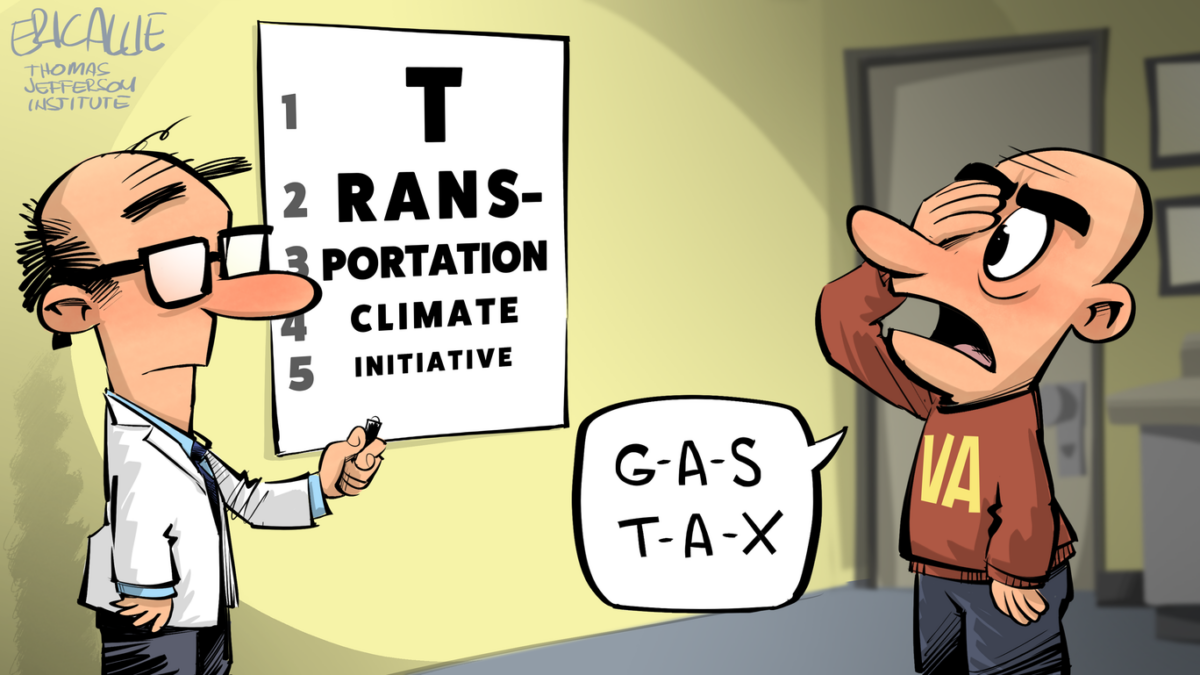
Why do Virginia’s leaders run away from the Transportation and Climate Initiative? Could it be because the first state legislature to consider it, in reliably Democratic Connecticut, just adjourned without even taking a vote on the proposed carbon tax compact, despite strong support from Democratic Governor Ned Lamont?

The Virginia Department of Environmental Quality has called a June 24 public meeting to discuss efforts to ramp down carbon dioxide emissions from transportation sources, but it made no mention of the pending TCI interstate compact. Instead it focused on the General Assembly’s approved 2045 goal of “net zero” emissions in all sectors of the economy, including transportation.

Reaching this target will help Virginia do its part to address the climate crisis, improve air quality and public health, and tackle inequities in our transportation network. The first step to these efforts will be public outreach and engagement by DEQ with support from our project facilitator AECOM. This project will inform an upcoming DEQ report that will investigate strategies to accelerate low-carbon transportation solutions and ultimately eliminate greenhouse gas pollution from the transportation sector,” DEQ wrote.

Is the stated goal of TCI, a 30 percent reduction in CO2 emissions by 2033 achieved by taxing and rationing gasoline and diesel, no longer considered sufficient by Virginia leaders seeking to avert to claimed catastrophe of climate change? Will some different “strategy” be proposed? Or are they just pretending to back away from the TCI approach for the time being? June 24 may finally bring the issue to light.

More information on TCI and its impact on Virginia can be found in this short video.

The DEQ meeting call came out the same day as the Georgetown University Climate Center was hosting another webinar on the TCI program, rolling out a new Model Rule version and a long summary of the recent round of public input, which elicited a detailed comment from the Virginia Manufacturing Association among hundreds of others.

Industry groups with an interest, pro or con, would be well served to review the new documents, which also include more details on how the state-based panels that will advise on spending the money must be controlled by environmental justice advocates, communities considered overburdened by transportation-relate pollution, and advocates for low-income residents.

Organizers resisted the push in the comment process to expand the target that 35 percent of the fuel carbon tax funds – which could be billions of dollars – be spent on those priorities. But the new documents make that 35 percent figure a floor and explicitly allow a larger percentage.

Also resisted were efforts to increase the targeted reductions beyond the stated 30 percent over ten years, although it is now mandated that will be reviewed three years in. Efforts to expand the use of carbon offsets were also not adopted, but what carbon offsets might be allowed will be left to the member states.

The new documents are now open for another round of public comment through August 13 on the TCI-P Public Input Portal.

During the 90-minute virtual meeting June 10, the June 24 DEQ meeting was referenced as a sign of Virginia’s “great conversation” over TCI, which made the DEQ announcement language harder to fathom. As the only hard proposal on the table, the discussion should continue to focus on TCI and voters should be informed about it during the coming election season.

Any proposal that seeks to wean Virginians more quickly off internal combustion engines, in cars, buses or work vehicles, is likely to produce even higher consumer cost than the considerable hit TCI would create. An analysis sponsored by Thomas Jefferson Institute put the figure at more than $700 per year for a family.

Only three states and the District of Columbia have indicated they will join the interstate compact so far. In the District and Massachusetts, legislative approval is not being sought. In Rhode Island, the issue is still in play.

Where Connecticut stands now is unclear, but its representative on the call said the Lamont administration remains committed and is exploring how it can move forward. The bill on the subject never came to an actual vote outside of the adoption of a substitute, and the analysis on the legislative website doesn’t even hint at a likely consumer cost.

The online CT Mirror account linked above is strongly pro-TCI, but gives credit for the defeat to a strong response based on the likely consumer cost:

But TCI’s legislative meltdown is clear, and it began when Connecticut Republicans, local oil industry leaders and other business groups labeled the potential gas price increase a “gas tax” that would trickle down as price hikes in everything from gas to groceries. Even though the “tax” label is inaccurate, it stuck, and TCI supporters were unable to deploy an equally effective counter-punch.

In the coming months, Virginians will decide for themselves if the “tax label is inaccurate,” unless in this state TCI continues to simmer without any news coverage or political debate.

Posted in Economy, Environment, State Government, Taxes, Transportation | Tagged , | Comments Off on Northam Administration Still Avoiding Discussion of TCI

Considering Public Sector Collective Bargaining? Here’s How to Protect Taxpayers and Workplace Freedom

Share this article on:

Twenty-eight years after Governor Doug Wilder signed it into law, the Virginia General Assembly lifted the ban on public sector collective bargaining. As of May 1st, localities in Virginia could give government unions a monopoly to represent all employees at a particular worksite.

However, the law passed in Richmond is unique from other states as it sets virtually no guidelines on what government unions can bargain over and how they can be formed. Thankfully, it also does not mandate public sector collective bargaining, allowing localities to keep the status quo that the Commonwealth has had for decades.

First and foremost, it should be pointed out that localities can reject public sector collective bargaining. There is good reason to do so, as simply administering the process is expensive. In fact, localities that are considering allowing bargaining are estimating hundreds of thousands or even seven figures for ongoing costs for negotiations and compliance. This spending will not go for better wages or benefits for current public employees or better services for citizens —it is simply to hire more employees to administer the infrastructure of bargaining.

The costs alone could be a large reason that, while the state law allows public employees to petition their local elected officials to vote on allowing bargaining, those representatives will vote no and keep the process that has worked in the Commonwealth for generations.

However, there may be some instances where a locality will allow public sector collective bargaining. For this reason the Thomas Jefferson Institute recently published “Recommendations and models for local collective bargaining in Virginia.”

While voting “no” or not voting at all if not required is the best option for Virginia localities, this “toolkit” outlines options for forming unions, protections for public employees, complying with state laws, and what topics a locality should bargain over (or not bargain over) if it must vote yes.

These include complying with Virginia’s secret ballot protection law, ensuring public employee votes to form a union are done securely and employee privacy is protected. Because unions will have a monopoly to represent all employees (even those who do not wish to join the union or be represented by it), the union should need a majority of all workers (not just those voting) to vote yes before they are given the privilege of collective bargaining.

Future employees should also not be locked into today’s decisions in perpetuity.  Unlike some other states where unions were voted in generations ago and simply remained, public employee should have the right to periodically vote on whether to keep the union at their workplace, vote it out, or select a different union.

Ordinances should also be specific about complying with the spirit and letter of Virginia’s transparency laws, ensuring that collective bargaining negotiations are conducted in the open, similar to other public meetings affecting Virginian taxpayers and citizens.

The Supreme Court has said that everything government unions do is political and public employees have a First Amendment right to choose to pay union fees or not. Public employees should be informed of these rights before any money is taken from them. Further to prevent misunderstanding or fraud, any ordinance should include language similar to a recent Indiana bill requiring public employers to confirm with the employees that they wish to pay dues before money is deducted from their paychecks. Alternatively, the locality could follow the lead of states such as Michigan which prohibit union dues being deducted from some public employees’ paychecks.

While public employees who work for the union may need to do some union business during the workday, they should not receive their taxpayer funded salaries during this time. Public employees should be allowed to use vacation time or take unpaid time off while doing union business but paying these employees to do union work on the taxpayer’s dime should be forbidden. Similarly, unions should pay fair market value for office space in public buildings or the use of government equipment.

The people’s local elected officials must have the final say over both budgetary (required by state law) and policy issues. The employer’s negotiating team and the union may agree to a tentative contract but it should not go into effect until the local elected body approves it. Similarly, arbitration, where an unelected arbitrator or arbitration panel writes the final contract, should be avoided.

Local ordinances allowing for public sector collective bargaining can also specify what unions can and cannot bargain over. The best model is Wisconsin which allows government union to bargain over wages only but limits that to inflation without a voter referendum.

If the locality must for whatever reason allow a broader scope of bargaining there are several things that should be expressly prohibited. These include:

Seniority pay systems: the ordinance should ensure that good employees can receive raises for how hard they work.  Local governments should not be constrained from compensating employees based on skill, effort and competence rather than merely “time served”;

General staffing and personnel decision: determination about who can be hired and staffing levels should be left to the employer;

Layoffs and last in first out: ordinances should prevent a collective bargaining agreement from dictating newer employees be laid off before more senior employees regardless of performance;

Ancillary services: localities should be free to do competitive bidding and should not be locked into buying services such as insurance from a specific provider because of a collective bargaining agreement;

Other issues that should be off the bargaining table include the school calendar and scheduling; discipline and grievances; pensions; performance evaluations; and school curriculum.

Many of the above issues are already prescribed by state law, especially for education employees and may not be bargained over anyway. As with any large-scale contract, local counsel should be consulted before allowing any specific subject in a collective bargaining agreement.

Allowing public sector collective bargaining will be a very difficult, time consuming, and expensive process. The easiest and most cost-effective route that protects public employees and stops a third party from coming between them and their employer is for localities to keep the status quo and vote no. If this is not possible local elected officials should first attempt to follow Wisconsin’s lead. If they must allow larger bargaining the several subjects outlined in the toolkit should be considered to be specifically taken off the table.

Posted in Government Reform, State Government | 1 Comment

Northam Regs Out of Step With Reality

Share this article on:

Despite the stunning and rapid success of the vaccines in arresting the spread of COVID-19, if you enter a Virginia workplace you go back in time to the pre-vaccine era of doubt and fear.

Virginia acted in haste in adopting permanent workplace rules related to COVID 19. Now that the Centers for Disease Control has relaxed many of its requirements and conceded that others were not backed up by evidence, the state’s employers are in limbo. The workplace regulations are now badly out of step.

There was no allowance for vaccinations in the regulations, which became permanent in January just as the population was starting to get shots.

Governor Ralph Northam was warned this would happen if the temporary COVID-19 rules were made permanent but barreled ahead to the applause of organized labor. The regulations carry the weight of law and can be enforced with severe sanctions, whether or not they are in direct conflict with the latest CDC guidance.

Outside of workplaces, Governor Northam has used an executive order to relax masking, social distancing and capacity rules effective May 28, but the underlying state of emergency remains in effect until at least June 30. At that point it could be extended. The workplace regulations cannot yet be changed.

In a joint letter, about 35 business organizations have asked the Governor to immediately lift the state of emergency that underlies the workplace regulations, and then quickly call back the state Safety and Health Codes Board which adopted the permanent regulation on a split vote. Only that board can amend the rules to reflect the current CDC advice and the success of the vaccines or repeal the regulations outright.

The joint letter, which the Thomas Jefferson Institute for Public Policy also signed, reads in part:

Now that Virginia is getting closer to fully re-opening the economy, business owners are faced with a legal predicament on whether to follow the science (CDC guidance and recent executive orders) or the permanent regulations (16 VAC25-220). There are several unanswered questions about how business owners should still operate since the COVID-19 regulations passed by the Safety and Health Codes Board are permanent. Will all of 16VAC25-220 be in place after the May 28th? Will they be in effect on or after the end of the State of Emergency on June 30, 2021?

…As the three critical pieces of the Permanent Standard – 1) social distancing, 2) wearing face protection and 3) increasing sanitation measures are expected to be removed on May 28th, there will no longer be a need for the Permanent Standard. The numerous conflicts between the changing CDC guidance, Executive Orders, and Permanent Standard are causing confusion and stress on Virginia’s employers and employees as they rebuild their businesses, as well as causing time allocation and costs on the agencies that are responsible for enforcement of the regulations.

Even before the recent collapse of the masking and other rules outside of the workplace, conflicts between the regulations, previous CDC guidance and simple common sense had sparked a massive effort by the state to respond to questions. Several answers in the “Frequently Asked Question” list seem to relax or downplay the regulations, but an FAQ written by a state bureaucrat does not override a regulation and release the employer from regulatory risk.

One FAQ answer cited by the business coalition letter seems to put a burden on an employer facing a complaint to demonstrate that employees have been vaccinated.

Our members would appreciate clarification regarding what qualifies to fulfill the “an employer can demonstrate” standard? Does an employer need to require a copy of an employee’s vaccination card? Is a written record of an employee’s status needed? Would requiring and maintaining this information place employers in violation of HIPPA rules, require small employers to institute specific security measures to protect an employee’s privacy and ensure other employees do not have access to a fellow employee’s medical history?

Lawyer and Richmond Times-Dispatch labor law columnist Karen Michaels wrote about the dilemma facing employers May 25. She quoted Richmond lawyer and Safety and Health Code Board member Courtney Malveaux, who voted against making the regulation permanent.

“The board intentionally dodged the issue of different rules between vaccinated and unvaccinated individuals, even though the vaccine was becoming available,” he said.

The state now has a standard based on the science of January in May. “From the beginning, VOSH [Virginia Occupational Safety and Health] should have embraced the science and should have required employers to follow the CDC guidance in real time. It still has an opportunity to do so now,” Malveaux said.

He recalled that an earlier draft of the standards contained a safe harbor provision providing that if the employer was complying with the CDC that the employer was in compliance with the (state) standards.

That safe harbor, which would have greatly reduced the current conflicts and confusion, was stripped out of the draft. Odds are research will continue and best practices will continue to change, and if any part of these regulations remain in force, that safe harbor should be added.

Posted in Regulation, State Government | 1 Comment