Spaced Out, Hidden, Here Come the 2020 Tax Hikes

Share this article on:

The 2020 General Assembly, with its new progressive Democratic majority, passed nearly two dozen changes in Virginia tax laws that will begin to hit individuals and businesses in a few weeks on July 1. Because of the COVID-19 economic shutdown, a few amendments were made to the implementation schedule during the reconvened session on April 22, but no tax increase was repealed.

This is a follow up on an earlier report on the sixteen tax bills that passed the regular session. Most are taxes that will be buried almost invisibly in various transactions, and their phased imposition will also keep many taxpayers from noticing them.
July 1, 2020

  • The statewide tax on gasoline increases from 16.2 cents per gallon to 21.2 cents per gallon (a 31% increase) and is no longer tied going forward to the rise or fall of wholesale cost.
  • The 7.6 cents per gallon added regional tax on gasoline, now imposed in Northern Virginia, Hampton Roads and along the I-81 corridor (see map), becomes a statewide tax. The total gasoline tax, statewide and regional, goes to 28.8 cents per gallon everywhere. That is a 21% increase where the regional tax already existed, and a 78% increase where it did not.
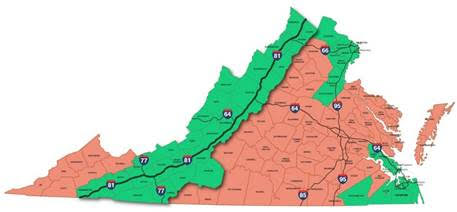
The green areas are regional transportation districts where additional fuel taxes are already being collected, 7.6 cents per gallon on gasoline and 7.7 cents per gallon on diesel. Effective July 1 those regional fuel taxes will be imposed in all the other Virginia localities. In combination with the 5 cent per gallon increase in the statewide gasoline tax, the total tax on fuel goes to 28.8 cents on gasoline and 27.9 cents on diesel.

  • The existing 7.7 cents per gallon added diesel fuel tax in those same regions is also expanded statewide. The base statewide diesel fuel tax is already 20.2 cents per gallon and does not change on July 1. So outside of the existing transportation regions, the total 27.9 cents per gallon combined tax represents a 38% increase.
  • The state tax on cigarettes rises from $3 to $6 per carton, a 100% increase.
  • The state tax on other tobacco products (snuff, pipe tobacco) rises from 10% to 20%, a 100% increase.
  • A new tax of 6.6 cents per milliliter is imposed on liquid nicotine products used for vaping.
  • Counties without a tax on prepared meals may impose one, unless rejected in a recent referendum. (The county must wait until six years after a failed referendum.) The maximum allowed tax rises from 4 to 6% (a 50% increase), so some existing meals tax rates may rise.
  • Counties may impose a local tax on admissions to movies, concerts and other amusements.
  • Additional grantor’s tax on real estate transactions is imposed in the Hampton Roads Transportation District for transportation uses.
  • Higher taxes on public utilities may be imposed to fund operations of the State Corporation Commission (taxes which eventually are passed on to consumers.)
  • A tax of $1,200 is imposed on those ubiquitous “games of skill” machines. The Assembly had originally voted to ban them, but the machines were reprieved at the reconvened session and taxed to create a fund for COVID-19 expenses.
  • Eight localities are authorized to call referendums on increasing their sales and use taxes an additional 1% to pay for school projects. They are Henry, Charlotte, Halifax, Mecklenburg, Pittsylvania, Gloucester and Northampton counties, and the City of Danville.

October 1, 2020

  • The Central Virginia Transportation Authority is created. The regional fuel taxes imposed on July 1 are diverted to its control, and an additional 0.7% general sales tax (to 6%) is imposed on that date in: Counties of New Kent, Charles City, Hanover, Henrico, Chesterfield, Powhatan and Goochland, the City of Richmond and Town of Ashland.
  • A peer-to-peer vehicle sharing tax, similar to the current vehicle rental tax, is imposed. Peer-to-peer sharing is like Airbnb for cars.

January 1, 2021

  • All localities are authorized to impose a 5-cent tax on plastic bags, by local ordinance.
  • Electricity generators begin to pay a carbon tax on emissions from fossil fuel plants, costs which will eventually be passed directly on to consumers. The amount of tax will be set by an auction.
  • All customers of the major electricity providers (Dominion Virginia Power and Appalachian Power) begin to pay a usage tax on their electric bills to fund the new Percentage of Income Payment Plan, providing subsidized electricity to certain low-income customers. The amount will be set in a State Corporation Commission proceeding.

May 1, 2021

  • Any county not yet collecting a transient occupancy tax may do so.
  • Existing transient occupancy taxes are raised in the Hampton Roads and Northern Virginia transportation regions for transportation uses, and the existing grantor’s tax for transportation is raised in Northern Virginia.

July 1, 2021

  • The tax on gasoline rises another five cents to 33.8 cents per gallon, another 17% increase.
  • The tax on diesel fuel rises another 6.8 cents to 34.7 cents per gallon, another 24% increase.
  • Any county without one may impose a local cigarette tax. Existing local tax rates are grandfathered, and new taxes limited to $2 per carton.

July 1, 2022

  • The statewide taxes on gasoline and diesel fuel begin to rise annually based on the consumer price index.

Stephen D. Haner is Senior Fellow for State and Local Tax Policy at the Thomas Jefferson Institute for Public Policy.

E-Mail this author

Posted in Taxes | Comments Off on Spaced Out, Hidden, Here Come the 2020 Tax Hikes

Climate Change Zealots Ignore Subsidence in Hampton Roads

Share this article on:


My friend, former Governor and U.S. Senator George Allen recently posted on Facebook, “While this research will annoy some dogmatic folks, it is Interesting to consider subsidence in the Hampton Roads region surrounding the mouth of the Chesapeake Bay” and linked to this article.

Former Gov. and Sen. George Allen

I applaud Mr. Allen’s recognition of the phenomena of subsidence and its prevalence in Tidewater. The article he promoted contributes to a realization that costal Virginia is not solely experiencing the sea level rising, but the fact that the land sinking. It is a trend the city of Virginia Beach has been addressing for more than five years.

His post is a valuable fact check on climate alarmists who sound a clarion call to “trust the scientists” and “follow the science”, but ignore basic scientific facts. For example, the Washington Post Magazine published an article, “Sounding the Retreat” in its April 19 edition that claimed to report on the dire impact of rising sea level on communities in Hampton Roads.

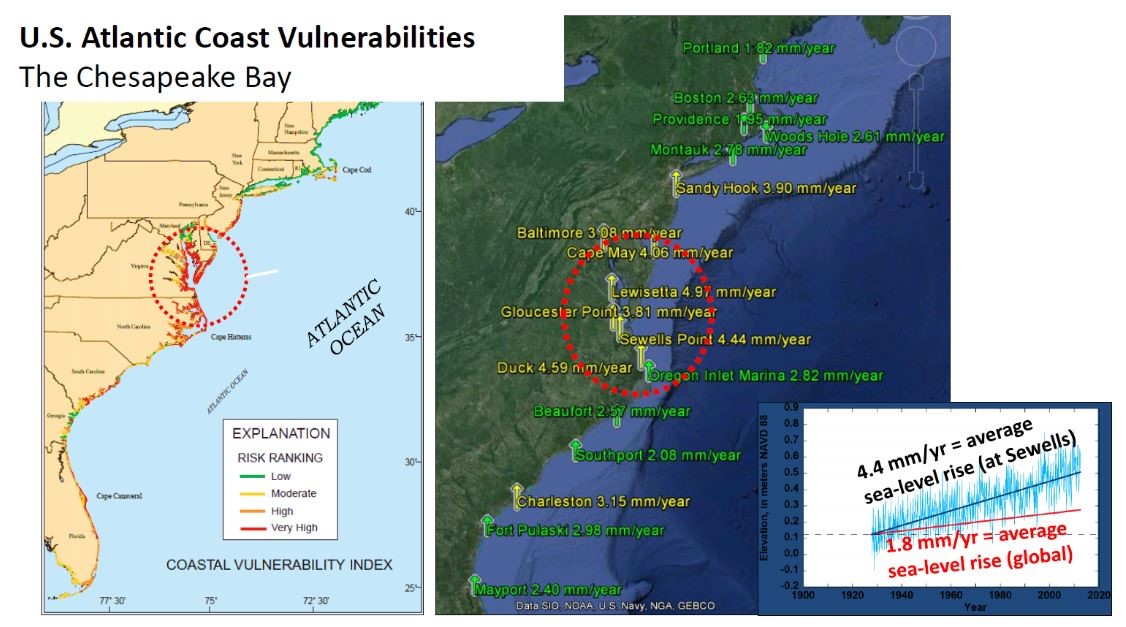
A critical word is missing from the article — “subsidence”. In all its discussion of sea level rise and climate change, the article fails to mention, let alone address, a key scientific fact – that Norfolk and the rest of the Hampton Roads region of Virginia experiences one of the highest rates of subsidence in the nation. Yes, the sea level is rising, but the ground is also sinking. The U.S. Geological Survey (USGS) found, “land subsidence has been responsible for more than half the relative sea-level rise measured in the southern Chesapeake Bay region” (Land Subsidence and Relative Sea-Level Rise in the Southern Chesapeake Bay Region). Early data collected and analyzed by NASA (NASA Finds Virginia Metro Area Is Sinking Unevenly) also found “Hampton Roads has one of the highest rates of relative sea level rise — the combined effects of sinking land and rising seas — along the U.S. East Coast”.

It is a phenomena I addressed in a surveying trade magazine in 2019.

Rep. Suzanne DelBene (D-WA) has introduced H.R.1261, National Landslide Preparedness Act, to authorize and encourage a number of activities to address landslide hazards. Her district includes the town of Oso, Washington, site of a deadly 2014 landslide. The bill, which has passed the U.S. House of Representatives and is pending before the Senate, includes a provision to make subsidence research, surveying, mapping, and identification a higher priority for the USGS. A fledgling National Land Level Change program is in its embryonic stages in USGS, and other agencies, using NASA satellite data to identify areas of the United States where subsidence is likely, so that more precise local surveys are carried out.

Subsidence is caused by a number of natural and anthropogenic activities, most commonly ground water withdrawal for irrigation. But subsidence can also be caused by natural events such as earthquakes, soil compaction, glacial isostatic adjustment, erosion, sinkhole formation, and adding water to fine soils deposited by wind (a natural process known as loess deposits). The future of existing development, as well as the planning, design, and construction of new infrastructure, are heavily reliant on accurate data on the existence and rate of subsidence. The impact can be in the trillions of dollars.

Perhaps subsidence didn’t fit a pre-ordained political agenda driving “Sounding the Retreat”. When one wonders why there are climate change skeptics, and why there is doubt about the alleged 97 percent consensus among scientists, one needs only to point to biased and poorly researched articles, such as those that fail to recognize factors such as subsidence.
E-Mail this author

Posted in Environment | Comments Off on Climate Change Zealots Ignore Subsidence in Hampton Roads

Opening Up Interstate Weigh Stations and Rest Areas: A COVID-19 Side Effect

Share this article on:

While everyone is focused on very large decreases in highway traffic, an overlooked element is the continued strength of truck traffic. Indeed, America’s truckers are among the unsung heroes of the pandemic, keeping goods flowing to the supermarkets, home-supply stores, pharmacies, and other providers of necessities while much of everything else has been shut down.
But truckers don’t work 9-to-5 jobs. Within the limits of federal hours of service (HOS) regulations, truckers may be on duty at all hours of day and night. And that raises several problems—including safe places to sleep in the cab when a driver’s hours run out and getting food on the road when restaurants are closed (and trucks often don’t fit into drive-through lanes at fast-food restaurants).

Two innovative policies have been launched on a temporary basis. Some states, such as Virginia, have opened shuttered weigh stations to be used for additional truck parking. Virginia’s Department of Motor Vehicles, in early April, announced the availability of 246 truck parking spaces at 10 of its weigh stations for as long as the weigh stations are out of service. Other states subsequently followed suit, including Arizona, Georgia, Indiana, and Missouri.

A nationwide policy change was announced by the Federal Highway Administration on April 3. For the duration of the national emergency, FHWA is waiving enforcement of the 1956 ban on commercial food services at Interstate highway rest areas—but only for food trucks. Still, this is the first known exception to that ancient ban that is kept in place by lobbying and political contributions by members of the National Association of Truck Stop Owners (NATSO). As I write, during the first week of May, I am aware of 11 states that have legalized food trucks at rest areas: Arkansas, Arizona, California, Connecticut, Florida, Idaho, Indiana, Maryland, Minnesota, Ohio, and Oklahoma. The North Carolina Trucking Association reports with dismay that its state department of transportation has declined to act.

Christian Britschgi at Reason.com reports that NCDOT wrote in an email that it “will not pursue allowing food trucks at rest areas because state law prohibits commercial activities within the right of way.” But the president of the North Carolina Trucking Association, Crystal Collins, said, “They don’t want to hinder or take business away from the truck stops that are open.”

Unfortunately, that reflects typical NATSO zero-sum thinking. There is a serious shortage of food available for purchase by truckers, and food trucks at rest areas are a welcome addition to the supply. Kudos to FHWA for changing (even just temporarily) this obsolete prohibition, and shame on the majority of state DOTs who are letting our truck drivers down.

A version of this commentary originally appeared in the May 7, 2020 edition of Surface Transportation Innovations Newsletter.

Posted in Transportation | Comments Off on Opening Up Interstate Weigh Stations and Rest Areas: A COVID-19 Side Effect

Full U.S. Recovery Could Take Two Years

Share this article on:


As the coronavirus continues to play havoc with the economy, many analysts are starting to think through how the recovery will occur.

Which industries will rebound first? Will the recovery resemble a V-shape? How long will it take to reach the previous peak of employment?

The timing and speed of the recovery is largely dependent on the public feeling safe to venture back to work and to visit stores, restaurants and other establishments that have been closed for the last several weeks.

Testing for the virus and tracing its origin in communities will certainly promote confidence among consumers. A vaccine would be a game changer.
In our economic modeling, we assume that a vaccine is successfully tested, produced and dispensed by the first quarter of 2022.

In the meantime, we see the recovery taking place in two stages.
First, the supply shock that was mainly created by closing non-essential businesses and asking citizens to stay at home ends. The second stage is the eventual recovery from the demand shock that persists because of social distancing even after all businesses are allowed to open.

The first stage of the recovery has already begun in some states that have lifted restrictions such as allowing elective surgery or opening some stores, parks and beaches. This should create growth in June employment and output, but the massive contraction that took place in April and May will swamp that modest growth in June.

Real gross domestic product — the monetary value of all final goods and services produced — is expected to contract to an annualized rate of 18.4% in the second quarter and 1.0% in the third quarter. This comes after the first quarter annualized reduction of 4.8%. Real GDP should rebound at an annualized 4.4% pace in the fourth quarter.

The second stage of the recovery starts in the third quarter for many industries and the improvements to the economy become more widespread in the fourth quarter. But it does not benefit all industries equally because social distancing continues without a vaccine.
Restaurants, many retail establishments and entertainment venues should see some recovery, but their employment levels should still be less than half of their pre-coronavirus levels throughout this year.

On the other hand, employment at utilities, professional services and company headquarters should be back to 90% of pre-coronavirus levels by the fourth quarter.
The Payroll Protection Program plays an important role in the recovery by enabling small businesses to retain and bring back employees who would otherwise have been laid off during the recession.

Over the course of next year, employment in all industries should reach about 90% or more of pre-coronavirus levels with employment reaching its previous peak in the third quarter of 2022.

But the economic shutdown put into effect to reduce the spread of the virus has already and will continue to lead to many firms filing for bankruptcy.

The widespread use of a vaccine in the first quarter of 2022 should help propel the economy forward. These forecasts will change significantly if a vaccine is available sooner or if the coronavirus continues to spread into the third quarter of this year.

A version of this commentary originally appeared in the May 10 edition of The Richmond Times-Dispatch.

Email this author

Posted in Economy | Comments Off on Full U.S. Recovery Could Take Two Years

Governor Punts on First Down

Share this article on:


Just as COVID-19 was starting its destruction of the world’s economy in early March, the Virginia General Assembly took final action on an exuberant two-year state budget within shouting distance of $140 billion. Six weeks later at the Reconvened Session, with the economic damage obvious but not yet measured, the Assembly reaffirmed the same spending plan.
Rather than substantially cut the budget, Governor Ralph Northam and his finance team proposed to delay the vast majority of the newly authorized spending and decide later whether the state can afford it. About $2.3 billion in increased spending will remain in the budget, but frozen until a new revenue forecast is presented later this year. A special session will then be called where legislators either release the freezes or approve other actions.
It was a punt on first down. It is the same tactic the Northam Administration displayed with four controversial union-backed labor law changes, all of them likely to impair the economic recovery from the COVID-19 pandemic. The spending is postponed, but not yet canceled.
In fact, fueled by new authority to issue $750 million in short-term bonds and by a new 35% tax on those ubiquitous skill game machines, every effort may probably be made to avoid any state budget cuts until absolutely necessary. When more clarity makes a new revenue forecast possible, the state may legally begin to dip into the Revenue Reserve Fund, further delaying the inevitable.
That safety net will not help for long. At the end of Fiscal Year 2007, on the eve of the last recession, Virginia had $1.2 billion in the Revenue Stabilization Fund, a.k.a. the Rainy-Day Fund. At the end of Fiscal Year 2019, with the pandemic eight months away, the balance was 75% lower, or $291 million. The combination of that plus an additional revenue reserve stood at less than $800 million, 33% lower.
That bears repeating: Going into the last recession, when Virginia’s budget was far smaller, the reserve cash balance was far higher. This has not been widely advertised.
Virtually every state revenue source is going to decline, some precipitously, perhaps for a long time. They will not be flat, they will decline. Alcohol is selling well, but even those taxes may fall below the levels seen with bars open and big events authorized. It will not be just sales and income taxes, and the accounting tricks used in the past will not work.
Also unknown is the level of federal largesse coming toward the state and Virginia’s local governments. Congress barely passes one massive bailout with borrowed money before speculation begins about the next one, probably larger. In an early response, Congress raised the federal the reimbursement level for Medicaid services, but the additional revenue for Medicaid will go out the door in new spending for that threatened population. Other federal funds coming may be tightly targeted, as well.
If the state’s leaders wait until the revenue losses and federal grants are known to make the hard decisions, Virginia’s budget hole will be far deeper than necessary. This is about cash flow. The state needs to end its current fiscal year on June 30 with the largest pile of cash it can accumulate, and then continue to keep spending below revenue. That means reduced spending now.
Virginia’s local governments, lacking cash reserves comparable to the state, are making the hard decisions to lay off staff and eliminate services now. When Richmond’s hard decisions come due, medical history tells us a second wave of COVID-19 may be taking hold, forcing yet another economic contraction and more stay-at-home orders.
Is the administration willing to cut existing spending now, before the revenue questions are answered? If that is happening, there are few signs. There were only a few actual cuts in proposed amendments April 22 and some new expenditures were allowed to proceed. The bulk of the frozen spending is in the second year of the budget, which starts in July 2021, when many must dream things will be back to normal. This is a bad time to engage in dreams.
A version of this commentary originally appeared in the May 3, 2020 edition of The Fredericksburg Free Lance-Star.


E-Mail this author

Posted in Economy, State Government | Comments Off on Governor Punts on First Down