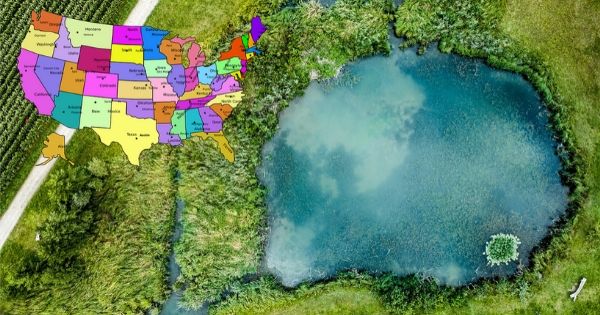
In my many efforts to unravel and explain the federal government’s sometimes baffling efforts to legally define the things that matter most to property owners, I have started by describing the government’s interpretation of a “ditch” (see here).
Now the U.S. Army Corps of Engineers (Corps) and U.S. EPA (EPA) have published a final rule describing and regulating what is a “water,” under the Clean Water Act (CWA). The new rule describes perennial, intermittent, and ephemeral streams plus tributaries, ditches, lakes’ and ponds.
Exclusions matter
If you own land used for farming or ranching in the United States, you need to know that not all waters are waters of the United States (WOTUS) — at least, not by legal definition, and the exclusions have environmental groups outraged. In fact, the agencies have an entire section entitled “Waters and Features That Are Not Waters of the United States”.
The final WOTUS rule codifies “…twelve exclusions from the definition of waters of the United States.” For example, the final rule excludes groundwater from the definition, including groundwater drained through subsurface drainage systems, reflecting the agencies’ longstanding practice.”
Since this rule was published as final the United States Supreme Court in a Hawaii case involving the County of Maui has a different take on this exclusion (more on that case here).
The agencies also create “…a new exclusion for ephemeral features, including ephemeral streams, swales, gullies, rills, and pools, and excludes diffuse stormwater run-off and directional sheet flow over upland.”
In another part of the rule agriculture is again helped by EPA. The new rule “…excludes artificially irrigated areas, including fields flooded for agricultural production, that would revert to upland should application of irrigation water to that area cease.”
Fewer silly legal actions
The new WOTUS rule also clarifies and keeps EPA and the Corps from bringing silly legal actions. The new WOTUS rule “…excludes artificial lakes and ponds, including water storage reservoirs and farm, irrigation, stock watering, and log cleaning ponds, constructed or excavated in upland or in non-jurisdictional waters…”
In another victory for agriculture, forestry, and ranching, the new rule excludes “…water-filled depressions, constructed or excavated in upland or non-jurisdictional waters incidental to mining or construction activity and pits excavated in upland or in non-jurisdictional waters for the purpose of obtaining fill, sand or gravel.”
The agencies have also excluded stormwater control features which are “…constructed or excavated in upland or in non-jurisdictional waters to convey, treat, infiltrate, or store stormwater run-off.”
In another effort to protect agriculture and others, the final rule excludes “…groundwater recharge, water reuse, and wastewater recycling structures including detention, retention, and infiltration basins and ponds constructed or excavated in upland or in non-jurisdictional waters.”
Upland defined
The term “‘upland” is also defined. This term is very important to farmers, ranchers, and foresters. It means “…any land area that under normal circumstances does not satisfy all three wetland characteristics identified in the definition of ‘wetlands’ (hydrology, hydrophytic vegetation, hydric soils) and does not lie below the ordinary high water mark or the high tide line of a jurisdictional water.”
All these definitions are tricky but very important to those in agriculture and ranching.
Environmental outrage
Many environmental groups have expressed outrage that many waters are being excluded from the definition of WOTUS. The Trump Administration has tried to follow the Clean Water Act, the Supreme Court cases’ and the legislative history of the CWA by spelling out specifically what are not waters of the United States.
It is very helpful to agriculture.
Many of these exclusions have been adhered to in the past, but often-times zealous bureaucrats and lawyers have used the courts to regulate some of these non-jurisdictional waters.
Hopefully, these definitions will keep many of you from going to court.
A version of this commentary originally appeared on June 30, 2020 in the online Farm Progress. The opinions of the author are not necessarily those of Farm Futures or Farm Progress.
Posted inAgriculture|Comments Off on Feds Define What is NOT a “Waters of the United States”
The Northam Administration’s Safety and Health Codes Board agreed June 24 that COVID-19 in the state’s workplaces demands an emergency state response, but the nature and exact wording of that response remains undecided. If adopted, formal regulations come with the potential for heavy penalties for employers cited for failures.
The vote to proceed with something came after a contentious emergency meeting where only members of the board and staff were able to speak. Three of the board’s members opposed the emergency declaration and three abstained, perhaps reflecting the broad and strong opposition the draft proposal generated from Virginia’s business community.
The Board is considering meeting next week, and the severity of the proposals should generate additional comment. While formal comment is concluded, Virginians can also contact Board members directly in the interim. A list of Board members can be found by clicking here and communications can be sent to ane.daffron@doli.virginia.gov with a request to pass them on to all Board members
If agreed upon, regulations could take effect by July 15 if Governor Ralph Northam’s signs them and will not disappear if a quick end is declared to the current emergency or the threat of the disease dissipates. With additional steps they could quickly become permanent regulations, the first in any state seeking to protect employees from this disease.
The draft rules (here) and a related 200-page briefing package (here) were first made available June 12 and then revised June 23. A window for on-line written comments closed June 22, but more than three thousand were received, with the business reaction overwhelmingly negative.
The stated goal is to prevent spread of disease in workspaces, and screening, sanitation, face coverings and social distancing are directed in detail. The focus on workplace safety follows COVID-19 outbreaks in food processing and health care settings. These proposals, however, will reach into every Virginia retail, office or manufacturing space.
To review the comments already filed visit the meeting information page (here) and scroll down to a long list of documents. Online comments are on this related page on Virginia’s Regulatory Town Hall website. The fact that so many substantive comments could not be absorbed by Wednesday’s meeting was put forward as a reason for delay. Many comments were from individuals upset with the Governor’s previous mandates for face coverings, only a small and less controversial part of this proposal.
The first-line enforcement agency will be the Department of Labor and Industry, already enjoying massive new powers and added staff granted by the 2020 General Assembly to field complaints and impose penalties related to hiring, compensation, and alleged workplace discrimination.
Included in the document are four designations of risk level, imposing somewhat different mandates on employers based on that classification. The rules also seem to change based on the perceived level of infection in a surrounding community. The rules reach into who must leave the workplace when showing symptoms or diagnosed, who may stay but under what conditions, and when employees may return after recovery.
There have always been viral and bacterial threats in workplaces, some of them potentially deadly. Specific directives related to infectious disease have not been adopted before. The existing health rules and protocols at the state or federal level, and the available remedies, are considered adequate by many of the industry groups pushing back. That is the reason the Trump Administration rejected similar proposals from the national AFL-CIO.
The Thomas Jefferson Institute added its name to a joint letter with more than two dozen general or industry-specific business associations, who asked that the regulations simply be rejected. Some of the same groups filed individual comments.
In its comments, the Virginia Poultry Federation notes it already faces penalties if members fail to provide adequate protective equipment or sanitation. They are already complying with additional COVID-driven rules or recommendations from the health and safety regulators and taking their own steps to prevent infection. “There is no scientific basis for regulating beyond what these agencies have recommended to date,” they state.
Pointing to all the other ways they are regulated, Virginia’s dentists, doctors and medical facilities have asked for an exemption from these new workplace rules. “Layering additional documentation and reporting requirements on top of extensive measures that have been instituted already would be overly burdensome and unnecessary,” the Virginia Dental Association leadership wrote.
But the advocates are also numerous. The Commonwealth Institute for Fiscal Analysis is now expert in health matters, and recommends the rules include “a presumption of teleworking ought to exist, and the employer ought to be required to justify why workers need to be back in a physical location.”
“With enforceable regulations, workers will feel more empowered to speak out for their safety in the workplace, particularly during COVID when essential workers are risking their lives to keep the economy alive and feed their families,” Jason Yarashes, an attorney with the Legal Aid Justice Center, told the Virginia Mercurylast week. The Legal Aid group had petitioned for regulations governing poultry plants. The move prompted Gov. Ralph Northam to ask labor officials to develop the more far-reaching rules now under consideration.
By “speaking out” is he referring to complaints filed with the employer or regulators? It goes further. The draft regulation concludes with prohibitions on any adverse action being taken against an employee “who raises a reasonable concern about infection control related to the SARS-CoV-2 virus and COVID-19 disease to the employer, the employer’s agent, other employees, a government agency, or to the public such as through print, online, social, or any other media. (emphasis added.)
With the General Assembly taking up policing reform in this summer’s special session, there should be at least one bill stopping a problem before it begins.
Most big problems are created by a small number of people. The same is true of police officer transgressions. Derek Chauvin was a bad cop, with 18 prior complaints in 19 years at the time he killed George Floyd. His partner, Tou Thao, has six complaints, including an open one at the point he was fired. The head of their police union, Lt. Bob Kroll, is the subject of at least 29 complaints.
Their continued presence was an insult to the more than 680,000 good law enforcement officers who are guardians of our safety, who took the job to serve the public and who put their lives on the line.
Yet, instead of eliminating a narrow source of major abuse, they were allowed to continue their abuse of Minneapolis citizenry. Why?
Increasingly, we can point to provisions commonly found in Collective Bargaining Agreements (CBAs) negotiated between governments and the police union as part of the contract process. The issue has never arisen in Virginia before, because collective bargaining was prohibited. But Governor Ralph Northam has signed into law legislation that could mean local governments and their police unions next year will negotiate the conditions of the disciplinary process against misbehavior by individual police officers.
This is a bad idea. A review of police contracts in 81 of the nation’s largest cities demonstrates a number of ways accountability over police actions is thwarted –
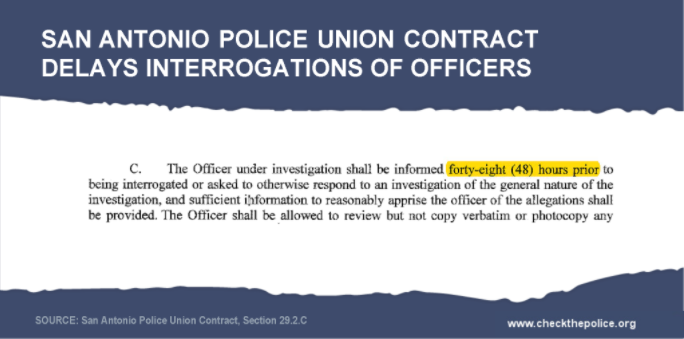
50 cities restrict interrogations by limiting how long an officer can be interrogated, who can interrogate them, the types of questions that can be asked, and when an interrogation can take place – sometimes delaying interrogations for up to 30 days.
41 cities give officers under investigation access to information that civilian suspects do not get.
64 cities limit disciplinary consequences for officers, including preventing an officer’s history of past misconduct from being considered in future cases.
43 cities erase records of misconduct, in some cases in as little time as six months.
Perhaps worst of all, 48 cities let officers appeal disciplinary decisions to an arbitrator who can reinstate that officer. This has led to cases like that of Chicago police officer Jason Van Dyke, who in 2014 killed 17-year-old Laquan McDonald by shooting him in the back as he was walking away. At the time, Van Dyke had been the subject of 20 complaints, ten of which alleged excessive use of force.
Or Oakland, California officer Hector Jimenez, who killed an unarmed man, shooting him three times in the back as he ran away – just seven months after Jimenez had shot and killed an unarmed 20-year-old. Despite killing two unarmed men and costing taxpayers $650,000 in a settlement to one of the dead men’s family, he was reinstated and given back pay.
You surely will remember Sgt. Brian Miller, a sheriff’s deputy who, as a gunman murdered 17 students inside Marjory Stoneman Douglas High School, hid behind his police cruiser and waited 10 minutes before radioing for help. Fired for “neglect of duty” he was reinstated last month with full back pay – estimated at more than $138,000.
The problem is more than anecdotal.
A 2018 University of Florida study updated last year examined the “before” and “after” effects of a 2003 Florida Supreme Court decision conferring collective bargaining rights on sheriffs’ deputies. It concluded that “collective bargaining rights led to a substantial increase in violent incidents of misconduct among Sheriffs’ offices.”
A forthcoming research study out of the University of Victoria’s economics department looked at the roll-out of collective bargaining rights for police at the state level over 30 years, and found the introduction of access to collective bargaining results in “a substantial increase in police killings of civilians over the medium to long run … of whom the overwhelming majority are non-white.”
And a 2017 Duke Law Journal article examined 178 union contracts, showing how “these agreements can frustrate police accountability efforts” by “limiting officer interrogations after alleged misconduct, mandating the destruction of disciplinary records, indemnifying officers in the event of civil suits and limiting the length of internal investigations.
Good police officers shouldn’t pay the price for bad cops. But overwhelming evidence shows that collective bargaining agreements create obstacles to holding bad cops accountable, and there is a growing national consensus among conservatives and liberals to eliminate these mechanisms.
The General Assembly has an opportunity in its special session to limit the scope of public safety officer collective bargaining to compensation and benefits. It should do so and stop the problem before it begins in Virginia.
Chris Braunlich is president of the Thomas Jefferson Institute for Public Policy. He can be reached at chris@thomasjeffersoninst.org.
Posted inGovernment Reform|Comments Off on Stop the Problem Before It Begins
The US Supreme Court recently ruled 7-2 to reverse a lower court ruling invalidating a permit for the Atlantic Coast Pipeline, which will bring West Virginia natural gas to Virginia and North Carolina, for home heating, factory power, electricity generation and manufacturing petrochemical feedstocks.
Environmentalists had claimed the US Forest Service had no authority to issue the permit, because a 0.1-mile (530-foot) segment would cross 600 feet below the 2,200-mile-long Appalachian Trail, which is administered by the National Park Service. Justice Thomas’s majority opinion scuttled that assertion.
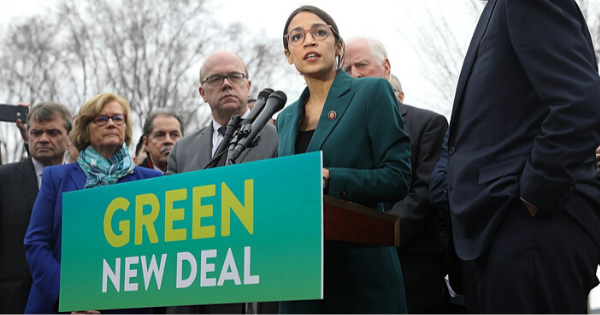
Pipeline project developers Dominion Resources and Duke Energy should receive the USFS and other permits relatively soon – and have the pipeline in operation by early 2022 – unless a Biden administration takes over in 2021 (with AOC as woke climate and energy advisor to Biden and Democrats) and imposes Green New Deal bans on drilling, fracking, pipelines, and eventually any use of natural gas, oil and coal.
Meanwhile, environmentalist groups plan more lawsuits. They insist the pipeline would put rivers and streams at risk of increased sedimentation, scar pristine landscapes, and harm sensitive species.
These plans and assertions underscore how inflexible they have become in opposing any US fossil fuel use. How incapable of recognizing or rationally discussing the far greater human and ecological impacts from energy systems they favor. How reliant on blatant double standards and mob rule, instead of on rational, cohesive, persuasive discussion.
Barely a few years ago, the Sierra Club and allied groups gladly took $187 million and more from Michael Bloomberg, natural gas producers and other financiers to wage their War on Coal. Having closed down most US coal mines and power plants, they then turned gas from a “climate friendly bridge fuel” to evil incarnate. Today they want to end fossil fuel use nationwide. Via delusion, incantation and cancellation of debate, they have convinced themselves that wind, solar, battery and biofuel “alternatives” are somehow “clean, green, renewable and sustainable.” Reality says otherwise.
The Atlantic Coast Pipeline will be underground, mostly invisible beneath a grassy right-of-way. Any sedimentation will occur during short term construction operations, when some wildlife will be scared off or displaced for a spell. Any threat to sensitive species, even in the event of a leak, will be minimal.
In stark contrast, their preferred energy systems will have massive, permanent impacts – in Virginia and far beyond its borders. Virginia solar panels will blanket more than eight times the land area of Washington, DC. Hundreds of 850-foot-tall bird-killing wind turbines will create an enormous obstacle course for whales, ships and planes off the Virginia Beach coast. Many thousands of 1,200-pound batteries will provide backup power to replace coal and solar for a sunless, windless day or two.
Hundreds of miles of new transmission lines will soar into the sky and snake across the countryside. Just bringing wind-based electricity from West Virginia to Blacksburg, Roanoke and Lynchburg, Virginia – and solar energy from all those Virginia panels to Staunton and Harrisonburg – will require several new transmission lines across the Appalachian Trail. Not 600 feet below it; right across it.
But somehow, we and our courts are supposed to believe, all these enormous industrial facilities – and the blasting, tree clearing, machinery, noise and other impacts associated with building and maintaining them – will cause no stream sedimentation, landscape scarring or harm to sensitive species.
In reality, the radical greens, utility companies and Democrats promoting these projects under the Virginia “Clean” Economy Act will simply demand that courts ignore the arguments they raised and environmental laws they cited when they raged against coal and gas power plants and the pipelines and transmission lines associated with them. They’ll demand that citizen groups opposed to these monstrous wind, solar and battery complexes be thrown out of court. They’ll want the same double standards applied nationally.
Eliminating fossil fuels would mean America would have to replace 100% of its gasoline and all its oil and natural gas feed stocks for pharmaceuticals, cosmetics, paints, synthetic fibers, fertilizers – and plastics for cell phones, computers, car bodies, packaging, wind turbine blades, solar panel films and countless other products. That would require turning some 700 million acres of food crop and habitat land (four times the land area of Texas) into biofuel corn, sugarcane and canola plantations for ethanol and biodiesel.
More extreme versions of the Green New Deal would eliminate coal, gas and nuclear electricity and backup power, gas for home heating, coal and gas for factories, and internal combustion vehicles. We’d replace it all with wind or solar – and use wind or solar on good days to generate enough extra electricity to charge batteries for seven windless, sunless days. That’s 8.5 billion megawatts – twice what we used in 2018!
We’d need some 75 billion solar panels … or 4.2 million 1.8-MW onshore wind turbines … or 320,000 10-MW offshore wind turbines … and some 3.5 billion 100-kWh backup batteries. The concrete, steel, copper, lithium, rare earth elements, aluminum, cobalt, plastic and other materials to build them would require vastly more mining and manufacturing than the world has ever seen – nearly all of it with fossil fuels.
Environmentalists oppose almost all mining anywhere in the United States, and even by US companies operating overseas under rigorous Western rules. That means essential metals and minerals get mined and processed in places like Baotou, Inner Mongolia, Bolivia, and the Democratic Republic of Congo, mostly under Chinese control, under minimal to nonexistent labor, wage, environmental, reclamation, and worker health and safety regulations. The mining and industrial areas have become vast toxic wastelands.
For cobalt alone, over 40,000 Congolese children, as young as four years old, slave away alongside their parents in mines, for a dollar a day, risking cave-ins and being exposed constantly to filthy, toxic, radioactive mud, dust, water and air. That’s today – for today’s battery, solar panel and wind turbine needs. Imagine how many would be needed to serve the Green New Deal. 400,000 perhaps? 4,000,000?
China alone will soon have 200 times more coal-fired generation than Virginia will be shutting down. During 2020, says consulting company Wood Mackenzie, Europe and the United States will close down 22,000 megawatts of coal-fired power capacity – even as Asia opens 49,000 megawatts of new coal-fired power plants, on top of those it already has and in addition to its growing fleet of gas-fired units.
China is building or financing numerous coal and gas power plants in Africa and Asia. India already has hundreds of coal-fired units and is building or planning 400 more. China and India are also building or planning hundreds of new airports, and putting millions of new cars and trucks on their roads. That (plus the Green New Deal mining, processing and manufacturing) means, even if Virginia or the entire USA eliminated all fossil fuel use tomorrow – it wouldn’t make an iota of difference for global carbon dioxide levels.
These environmental and human rights travesties can happen only under a system of rampant double standards: the same kinds that excoriate and ban religious services and funerals, anti-lockdown protests and Trump rallies – while permitting, excusing and praising Black Lives Matter marches that have too often turned into anti-police mobs, riots, looting, arson, beatings, and murders of people like David Dorn and Patrick Underwood, whose also precious black lives certainly haven’t mattered much to this crowd.
They also require that the woke Campus Cancel Culture spread its intolerant, authoritarian rule to our cities, media, social media, and even legislative bodies and courts – to instill constant anger and anarchy, and silence, defame and punish anyone who dares to offer nuanced or contrarian viewpoints. Every victory brings new demands, with no accountability for the mayhem and destruction they inflict.
Why should rural, poor, minority and working class families and communities have to accept the ecological, health and economic damages inflicted in pursuit of this pseudo-renewable energy utopia? Why should Africans, Asians and Latin Americans have to accept slave status to advance this agenda?
The situation is coming to a head. Let’s hope the now-silent majority can restore law, order, civil debate, thoughtful reflection on our complex history, and rational resolution of these thorny problems.
High school and college students are probably struggling to find summer jobs in this era of COVID-19.
Ads for some of the typical summer jobs for students have plummeted compared to a year ago, in large part, because of social distancing and the economic slump, based on Chmura’s Real Time Intelligence on job postings.
Yet there are some ads for jobs that have increased significantly from a year ago, showing just how much this pandemic is changing the way we live.
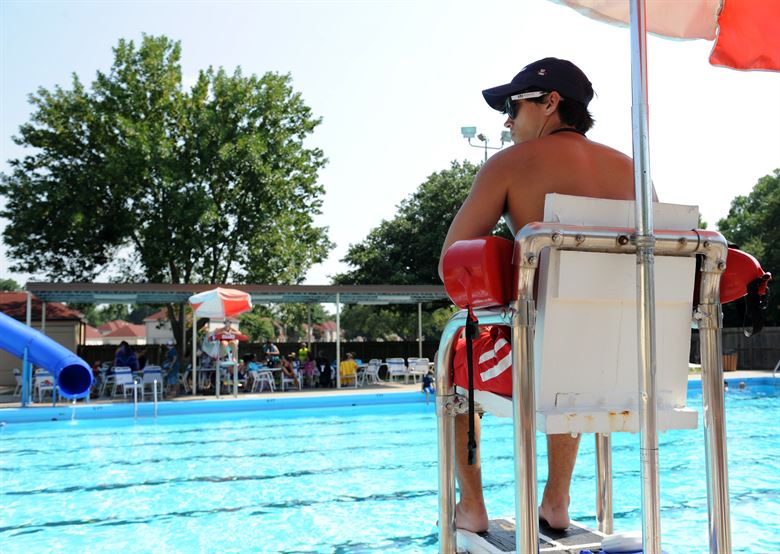
The number of ads for lifeguard jobs across the country is down considerably from a year ago. Just 264 ads were posted during the week that began March 23, which was the week a year ago that the number of ads for those positions peaked.
In Virginia, nine ads for lifeguard jobs were posted in 2020 compared with 60 in the prior year.
In the Richmond metro area, the peak for lifeguard positions occurred a little later — the week starting April 13 — with just two ads this year compared with 20 in 2019.
As of the week of May 11, job ads for lifeguards were at least 50% below a year ago in all three localities.
Ads for summer camp workers and recreation workers also are down considerably in the nation, state and metro area.
Demand for dog walkers is down, presumably because so many people can now walk their own dogs because they are working from home or are furloughed.
But some occupations have seen job postings jump considerably largely related to the pandemic.
Jobs for contact tracers skyrocketed to 1,672 ads in the United States for the week beginning May 18 from zero ads during the same week in the prior year.
Contact tracers have become important positions during the pandemic as the person is tasked with tracking down anyone who might have been infected by a person who was diagnosed with COVID-19 so those contacts can quarantine themselves and prevent further spread.
These jobs sometimes require a degree in nursing or certification in public health, but most of the ads are looking for people with good communication skills.
In Virginia, ads for contact tracers peaked at 56 during the week starting May 4 and peaked at 11 during the same week in the Richmond metro area.
These numbers are expected to rise as the Virginia Department of Health announced it is hiring 1,300 contact tracers across the state. Most of these ads came from public health departments, health care service agencies and providers, and consulting groups.
Ads for jobs containing the word temperature in the title have been climbing since mid-March and peaked at 203 the week beginning May 11. Ushers, lobby attendants, ticket takers and security guards topped the list of occupations requiring the ability to take temperatures of customers or clients at various businesses including airports, casinos and mail carrier facilities.
Fraud may be increasing during this pandemic, and it appears businesses are hiring more workers with cybersecurity skills to help combat that.
The number of cyber ads posted since the pandemic started generally outpaced the number from a year ago. In Richmond, those types of jobs jumped to 72 for the week beginning April 27 from 21 a year ago.
Capital One has by far the most ads.
A version of this commentary originally appeared in the June 8, 2020 edition of the Richmond Times-Dispatch.
Posted inGovernment Reform|Comments Off on Some Summer Jobs Might Be Hard to Find