Northam Finally Abandons Spending Hikes in Face of COVID

Share this article on:


Perhaps the most important point about Governor Ralph Northam’s latest Virginia state budget proposal is what he did not recommend. He did not recommend dipping into the state’s current cash reserves to restore spending items which had been frozen. No additional taxes are proposed.

In fact, Secretary of Finance Aubrey Layne told legislators in the budget briefing August 18th that no new budget bill is needed from this months’ special session at all, and the General Assembly could let the current document stand as approved in May until it comes back in January for the full 2021 regular session.

Whether Northam’s cautious, some would say conservative, approach will satisfy the General Assembly or spending advocates will be the story of the special session, at least on the financial front. The run up to the Assembly’s arrival was marked by escalating demands to address issues related to the COVID recession, and general complaints about poverty and income disparity in the Commonwealth.

“We have concentrated on building cash and limiting spending on recurring expenses. That is why I stated we do not need budget action from a financial standpoint. Let’s hope the General Assembly follows suit,” Layne wrote in reply to a question.

That is hardly guaranteed. The frozen spending amounts, more than $2.2 billion, represent some of the highest priorities of legislators (and the Governor himself.) Most cannot be addressed by using the federal funds provided to respond to the COVID-19 pandemic. They could be funded in part by the more than $1 billion in cash reserves, divided between the official Revenue Stabilization Fund and the more informal Revenue Reserve Fund. Northam left those alone.

Against a plan to collect and spend more than $137 billion over two years, from all sources, that is a pittance of a cash reserve. As both Governor Northam and Secretary Layne stressed in their presentations, in this current situation “cash is king” and maintaining cash is their top goal. The plan they presented Tuesday, should the revenue estimates prove accurate, would have the cash reserves total grow slightly by the time Northam leaves office.

Layne’s presentation and his commentary noted that as the economy crashed, a flood of federal spending pumped cash into family budgets and thus the state’s economy. Nationally, about $900 billion in lost personal income was replaced by more than $2 trillion in federal stimulus, a net infusion of about $1.4 trillion that sustained the economy. He also noted that wave of stimulus is history, now, and it is not clear if Congress and the White House will agree to anything further.

So, the new look at the budget, covering the period July 2020 to June 2022, takes a conservative view on revenue in the short term, cutting the forecast more than $1.3 billion in this year and next. Of all the spending he froze back in the spring, Northam recommends unfreezing about $150 million, and proposes about $25 million for the historically black universities and some “cultural” investments to promote black history.

One high priority is the unresolved question of enhanced unemployment insurance benefits. Using an executive order, President Trump has offered states a path to adding $400 per week to their underlying base benefits. But he suggested that $100 of that come from either state funds or the federal COVID funds allocated to the states. In Virginia, Layne confirmed, that will require $45 million per week and said the administration is still considering what to do.

The previous enhanced benefit of $600 expired at the end of July, a financial cliff for most of the affected families. Restoring at least two-thirds of that would go a long way to keeping rents current, reducing the arrearages on utility bills, and keeping sales tax revenues flowing.

Layne reported that state still has $1.3 billion (39%) of those federal funds not assigned to any project or category. Of the $3.3 billion sent by Congress, $200 million went straight to Fairfax County, $1.3 billion has gone to other localities in two waves, and $500 million has been spent on or allocated to lab testing, protective equipment, rental assistance, and other social spending.

The pandemic’s economic impact was focused on the final few months of Fiscal Year 2020, and the pain was blunted by the wave of federal stimulus money to businesses and individuals. Northam Administration efforts to restrain discretionary spending in those final four months saved over $500 million, which means despite a downtick in revenue, the state ended that year with cash on hand.

While the new forecast reduces projected general fund revenue by $2.5 billion over the next two years, that is compared to the 2020 budget, not to prior years. This is still a far larger budget than the state was working with just two years ago, and in fact non-general funds are expected to be higher than projected just a few months ago. It remains a $137 billion overall spending plan, compared to the original $139 billion.

Add in the federal COVID funds and overall state spending continues virtually unchanged despite the COVID recession. New planned spending is on hold, but the base budget remains. There has been a major change of focus due to COVID, but spending has not been seriously reduced.

Key Resources for Readers:

SB 5015 as introduced

Secretary Layne’s slide presentation

Planning and Budget Director Timberlake’s slide presentation

Posted in State Government | Comments Off on Northam Finally Abandons Spending Hikes in Face of COVID

The Gory Details of Levar Stoney’s Statue Contract

Share this article on:

When Richmond Mayor Levar Stoney needed help taking down the city’s Confederate statues, he turned to Devon Henry, a prominent local construction contractor who had donated $4,000 to his 2016 mayoral campaign and political action committee. No local crane & rigging company in Virginia was willing to undertake the controversial project, but Henry lined up a Connecticut firm willing to do the work.

Bypassing City of Richmond procurement procedures and city administrators on the grounds that the city was facing an “emergency” in the form of civil unrest, Stoney awarded the contract directly to Henry himself. Under the $1.8 million agreement, the city reimbursed NAH $180,000 per day for equipment, crew, and consultants.

That sum struck some observers as exorbitant. Bacon’s Rebellion could not find a Virginia rigging company willing to comment upon the contract on the record, but an individual with one firm said the job would have cost no more than $10,000 a day had it been handled by a local contractor, or $20,000 a day for an out-of-state contractor who had to pay for transportation, food and lodging for its crew. He was astonished that anyone could get away with charging $180,000 per day for the job.

Stoney spokesman Jim Nolan declined to respond to Bacon’s Rebellion questions asking how Stoney selected Henry for the lucrative contract. Likewise, Henry declined to respond to questions posed by Bacon’s Rebellion.

Whether favoritism was involved or not, efforts have been made to keep Henry’s identity secret. The attorney filing the State Corporation Commission registration for NAH, LLC, the legal entity granted the contract, declined to list the name of the company’s principal or principals, as is commonly done though not required. The attorney who filed the registration declined to answer a Bacon’s Rebellion request for the principal’s name. Likewise, in responding to a Freedom of Information request filed by a Virginia state employee, the city provided a copy of the contract that included Stoney’s signature but a blank space where Henry’s would have gone. Stoney spokesman Nolan also declined to respond to a Bacon’s Rebellion request for the principal’s identity.

Bacon’s Rebellion has partnered in this investigation with a concerned citizen who filed the FOIA requests. Based on the first round of documents released by FOIA, we published, “Who Is Behind NAH, LLC?” Our collaborator, who does construction procurement for a state agency but asked to remain unnamed, filed a follow-up request. That query revealed NAH LLC’s principal’s identity to be Devon Henry, a resident of western Henrico County, president and CEO of Newport News-based Team Henry Enterprises, and a Stoney contributor.

The legality of Stoney’s order to remove the monuments has been challenged in a lawsuit filed by Monument Avenue residents living in the vicinity of the affected statues. The mayor’s actions, states the lawsuit, “exceeded his authority under the City Charter, the laws of the Commonwealth, and the emergency ordinance adopted by City Council and, therefore, was ultra vires, illegal and invalid.” The lawsuit argued that the mayor did not obtain authorization from City Council and failed to comply with the city code which requires holding a properly publicized public hearing.

Stoney’s bypassing of the city’s procurement procedures raises more questions about the legality of his action. Additionally, the revelation that he awarded a lucrative contract to a campaign contributor opens the mayor, who is running for re-election this year, to charges of cronyism.

Civil unrest

In 2018 Stoney backed the recommendations of a Monument Avenue commission to take down the Jefferson Davis statue but keep the other Civil War memorials and add signage that would explain the historical context in which they were erected. The killing of George Floyd in Minneapolis this May, which ignited a wave of Black Lives Matter protests across the country, changed the political calculus.

On May 31, Governor Ralph Northam issued an emergency order declaring a state of civil unrest. The order directed state and local governments “to render appropriate assistance to prepare for and respond to this situation, to alleviate any conditions resulting from the situation, and to … return impacted areas to pre-event conditions as much as possible.” The Governor also put the City of Richmond under an 8 p.m.-to-6 a.m. curfew.

On June 3 Stoney declared his solidarity with the BLM movement and its demands to remove the Confederate statues. “George Floyd’s death may have happened in Minnesota,” he said, “but the shock waves are bringing very valid pain to the surface in our city. Last night, Richmond told me to channel our city’s pain into reform.” He promised to introduce an ordinance to remove all Confederate monuments on city land effective July 1, the day new state legislation gave local governments the authority over the fate of monuments on their land.

The protest movement in Richmond became increasingly violent with each passing day in June, however. Militants first spray painted statues around the city with graffiti. Then, suffering few consequences from law enforcement, protesters proceeded to pull down statue of Jefferson Davis, a statue of Christopher Columbus, and a memorial to the First Virginia Infantry regiment formed before the Revolutionary War. The efforts culminated with an unsuccessful attempt to use a rope to pull down a statue of J.E.B. Stuart on Monument Avenue.

Declaring an unlawful assembly, Richmond police fired pepper spray and flash bangs to disperse the crowd. Protesters were furious, claiming there was no justification for such forceful measures. Stoney fired the police chief. The chief’s temporary successor resigned soon after, and a third chief would not be hired until June 26.

As the situation careened out of control, Stoney informed City Council on June 22 he was seeking a legal avenue to remove the statues. Marion and Greg Werkheiser, Richmond attorneys specializing in cultural heritage, provided the mayor a way to do it: Invoke the emergency powers granted to him by Governor Ralph Northam and affirmed by City Council. Interim City Attorney Haskell Brown warned that the act would run the risk of violating state law and triggering felony charges, but Stoney proclaimed that he was prepared to take the risk.

Stoney had a big problem, however. No one wanted the job. The owners of most, if not all, rigging companies in Virginia fell into a white, blue-collar, old-Virginia demographic that, to be charitable, was not sympathetic to removing the Confederate statues. As an individual with one company told Bacon’s Rebellion, tearing down the statues would ruin their reputation in the business.

That reality had come to light earlier in the month when the Northam administration looked into removing the the statue of Robert E. Lee, which stands on state-owned land. Chief of Staff Clark Mercer told the Washington Post that it was so confident in its legal case that the administration “tried to take down the statue quietly. But the administration could find no takers. “It was pretty disappointing,” Mercer said. “We got a lot of colorful comments.” At one company, he added, the younger generation was willing but the older owners threatened to disown them if they went ahead.

By July 1, Stoney had signed the deal with NAH to remove the statues, and his allies on City Council sought the Council’s formal backing. Declaring that the presence of the statues “creates a public safety concern,” Resolution 2020-R041 would authorize Stoney, in his capacity as Director of Emergency Management, to order “the temporary removal and storage of certain statues in the City of Richmond.” City Council approval was not forthcoming, however. Council kicked the decision over to the finance committee.

Unwilling to wait, Stoney gave the co-ahead to NAH on his own authority.

The contract

The first inkling in the public record that Stoney was planning something  occurred June 22, when Diana Lyn C. MGraw, an attorney in the Tysons office of the Fox Rothschild law firm, filed the organization papers for NAH, LLC. The filing declined to list the identity of the principal or principals of the firm. Documentation of Henry’s role would not surface until a month later with the filing of a vendor registration form.
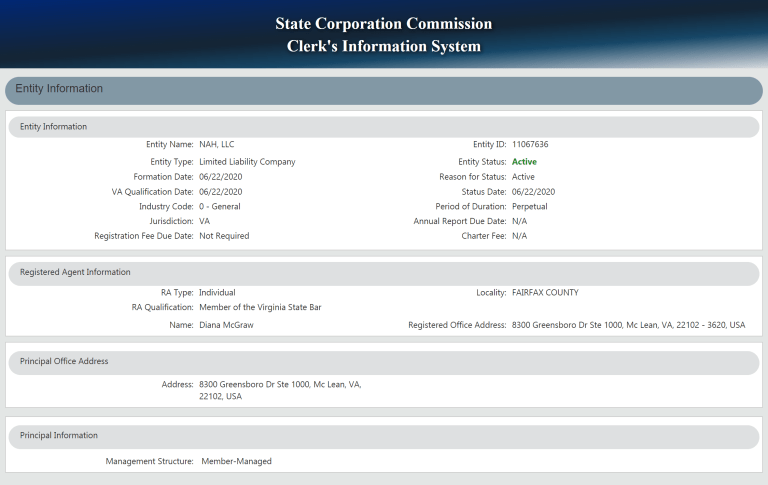
The same day that NAH was filing its SCC registration, Stoney told City Council he was seeking a legal avenue to remove the statues. That was the day that interim City Attorney Brown warned that such an action would run the risk of violating state law, which could result in felony charges.

“I’m willing to take that risk,” Stoney said. “If I had Superman strength and could go and arrive at Monument Avenue and remove them myself and get slapped with a class 6 felony, I would have done that yesterday.”

document dated July 1 laid out NAH’s plan for relocating up to 11 sculptures and cannons owned by the City of Richmond. The proposal noted that the sculptures were to be removed from the base, and for the stone or concrete plinths to remain in place. The sculptures were to be delivered to a location selected by the city. “NAH LLC ,” said the proposal, “has assembled a world-class team of riggers, operators, fabricators, and artists who specialize in the preservation, handling and replacement of one-of-a-kind art pieces to assist in the completion of the project.”

NAH would “mobilize the necessary men and equipment to the City of Richmond” for the price of $900,000. The proposal anticipated that the actual work would take five days and another $900,000. Regardless of how many days it actually took, the city would pay a total of $1.8 million for service rendered.

The contract proposal did not appear out of the blue. Stoney spokesman Nolan indicated in his response to our FOIA request that there had been extensive communications between Stoney and “a representative of NAH LLC” regarding the statues — 75 records in all. However, the records were being withheld as the mayor’s “working papers and correspondence.”

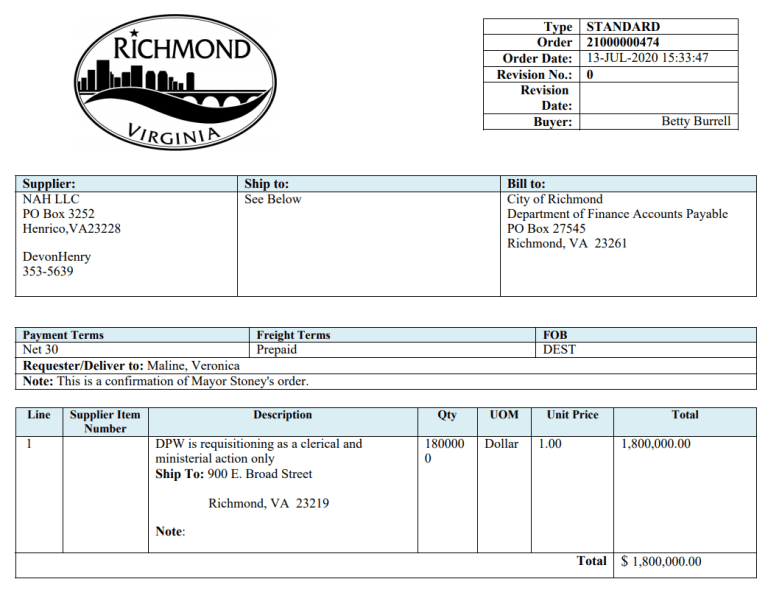
Two documents confirm the identify of Devon Henry as the “representative of NAH LLC” whom Nolan was referring to. One document was a July 10, 2020, vendor registration form listing Henry as the Managing Member of NAH LLC. The second is a requisition form dated July 13, 2020 (shown below).
The job

Henry’s professional background is construction contracting. One of the fields of expertise highlighted on the Team Henry Enterprises website is “construction management.”

As we reconstruct his activities from evidence contained in the public record, Henry engaged Diana McGraw, a Northern Virginia attorney, to register NAH. It is possible that they had a pre-existing business relationship. Her law firm biography lists the following areas of expertise: managing small business/minority enterprise subcontracting plans and “drafting joint venture and teaming agreements.”

To handle the heavy work of removing and transporting the statues, Henry sub-contracted Smedley Crane and Rigging, a family-owned company based in Banford, Conn. The company dispatched a crew, a work truck, a larger flat-bed truck, and a crane — possibly two, one orange and one blue, judging by photographs taken of the statue dismantlings. The company declined to respond to a Bacon’s Rebellion request for information about its involvement in the project.

NAH also hired Paul DiPasquale, a Richmond sculptor best known as creator of the Arthur Ashe statue on Monument Avenue and of the 34-foot-tall King Neptune statue in Virginia Beach. DiPasquale and welder/collaborator Jillian Holland were tasked, according to a news report, “with assisting the city and a local minority-owned contractor with removing all of the remaining Confederate statues.” It is not clear from press accounts exactly what they did, but they were on the scene.

Although large crowds and the media watched the dismantling of the statues, the jobs proceeded without incident. The structural integrity of the statues was preserved. The statues were transported to the city waste-treatment facility for storage.

Listing Mayor Stoney as the primary point of contact, NAH submitted its first invoice July 3 for work performed, and a second invoice July 10.

Who is Devon Henry?

Although Henry declined a Bacon’s Rebellion request for an interview, a fair amount of information about him is available on the Internet. He is active civically and a rising figure in the black business community. He is involved on the periphery of politics as a donor, though I could uncover no evidence that he is a partisan activist.

A native of Newport News, Henry graduated from Norfolk State University in 1999. According to his LinkedIn account, he worked five years as a project manager and then sales engineer for GE Infrastructure, and he attended a series of executive management programs at UNC Kenan-Flagler Business School, the Tuck School of Business and Northwestern University.

In 2006, Henry acquired the Silty Lady, a firm that specialized in erosion and sediment control, to form Team Henry Enterprises. As a small, minority-owned enterprise, Team Henry built an impressive roster of federal government clients, including the Department of the Army, the Naval Facilities Engineering Command, the U.S. Army Corps of Engineers, the U.S. Marine Corps, FEMA, the U.S. Coast Guard and the Department of the Interior. Private sector clients include Elizabeth River Crossing and Bon Secours.

The company has garnered numerous awards and recognitions, including two by the Initiative for Competitive Inner City as one of the top 100 fastest-growing inner-city firms in the country.

Although Team Henry maintains its headquarters in Newport News, Henry lives in western Henrico County, where the company has a field office.

Henry is actively engaged in the community. He serves on the board of visitors of his alma mater, Norfolk State. He is also has a leadership position with his fraternity, Phi Beta Sigma, a African-American Greek organization. Phi Beta Sigma engages in business networking, generational wealth building, and community engagement. He is president of the PBS East Foundation, founded in 2018. On his Facebook page, Henry describes his participation in a Phi Beta Sigma trip to Ghana where he toured slave-trading castles, visited with a fraternal school, gave away school supplies, and met with government officials and chiefs to discuss “how Sigma can make a difference.”

He also serves on the board of Venture Richmond, an organization dedicated to advancing downtown Richmond through economic development, marketing, promotion, advocacy and events. As mayor, Stoney is president of the organization.

Phi Beta Sigma is another possible point of contact between Stoney and Henry. The fraternity has a chapter on the James Madison University campus, Stoney’s alma mater, although I could not confirm from online research whether he belonged to it. An internet search did reveal this photo, posted on the fraternity website, of Stoney posing with a Phi Beta Sigma brother at George Washington Carver Elementary School. If Stoney has been involved with the organization, this is the only evidence of it that I could find.

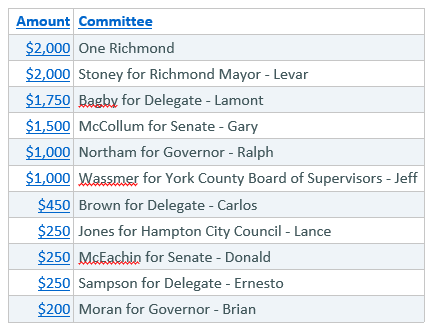
What is certain is that Henry has helped advance Stoney’s political ambitions. According to the Virginia Public Access Project, he has made $10,650 in Virginia political contributions over the years, including $2,000 to Stoney’s 2016 election campaign and $2,000 to his One Richmond political action committee.
There is no record yet of Henry donating to Stoney’s re-election campaign this year.

Justification

Other than pointing to Governor Northam’s executive order declaring a state of emergency, Stoney has offered no justification for ignoring the City of Richmond’s procurement policies. Under normal circumstances, the city must acquire services through competitive, sealed bids. However , the city code states (my bold):

In an emergency the Director [of Procurement Services] may authorize or order the expenditure of funds for emergency purchases of supplies, materials, equipment and contractual services for the using agencies without competitive sealed bidding or competitive negotiation; however, such procurement shall be made with such competition as is practicable under the circumstances. A written determination of the basis for the emergency shall be included in the contract file. 

The city code does allow “emergency purchases” when “a dangerous condition has developed” and action is deemed “essential to protect and preserve the interests of the City and its inhabitants,” a condition that most some would contend existed July 1 when Stoney signed the contract. However, there was no document detailing “the basis for the emergency” included among the documents we received in response to our FOIA request.

The city code is clear about one other point: “No official, elected or appointed or any employee shall purchase or contract for any good, services, insurance or construction … other than by and through the Director.”

Mayor Stoney is not director of procurement. That office is held by Betty Burrell, a senior government official who previously served as the city’s deputy director of finance. She also has held senior executive positions in Fort Lauderdale, Fla., and Albemarle County. Burrell’s name appears on the requisition form displayed above, which pointedly stated that “This is a confirmation of Mayor Stoney’s order” and that the DPW (Department of Public Works) was issuing the requisition “as a clerical and ministerial action only.” These notes in the requisition order suggest that city administrators were fully aware that Stoney was enlisting the services of NAH LLC outside the normal procurement procedures. The transaction was recorded for accounting purposes only.

In July and August, the City of Richmond has issued two other emergency awards: one to the Greater Richmond Chamber of Commerce for “materials and professional services for critical information and PPE resources to small businesses … in response to the COVID-19 pandemic,” and one to Pure Consultants, LLC, of Midlothian for “facility disinfecting.” Unlike the NAH LLC document, both were co-signed by Burrell and a contract specialist.

Was $1.8 million an exorbitant sum to take down the statues? Given the fact that no Virginia rigging contractor was willing to perform the job, it was not unreasonable to look outside the state, nor was it unreasonable to cover additional transportation, board and lodging expenses that the firm would incur. However, it is a legitimate question whether $180,000 was excessive, as at least one local rigger thinks it was.

In yet another potential irregularity, Stoney signed the contract July 1. In the contract, NAH stated that it anticipated that mobilization of the work crew would “begin on or about June 26, 2020 and be complete on or about June 27, 2020.” The contract called for keeping the necessary manpower and equipment “on standby in, or very near, the City of Richmond, ready to work at the direction of the City.” Given the fact that work on the statues began July 2, as called for in the contract, one might inquire if Stoney gave the OK to mobilize the work crew several days before signing the contract.

In sum, Stoney’s signing of the contract raises at least four issues:

  • He acted entirely on his own rather than going through the director of procurement.
  • He failed to submit a written determination of the basis of the emergency for inclusion in the contract file. (If he did write such a document, the mayor’s office did not release it under our FOIA request.)
  • He provided a $1.8 million no-bid contract to a contractor who happened to be a campaign donor and political supporter.
  • He may have authorized NAH to mobilize the rigging team several days before he actually signed the contract.

The issues here are not about the rightness of wrongness of taking down Richmond’s Confederate statues. They’re about following the law in order to do so. At the very least Stoney’s actions appear highly irregular.

Thanks to Carol J. Bova for researching City of Richmond procurement policies.

The Richmond Times Dispatch did a story on this today and the Stoney Administration responded.  So Jim has asked that we include the following at the bottom of his piece:

Addendum:  The Stoney administration answered questions raised in this post posed by the Richmond Times-Dispatch in a subsequent news story.  You can read Bacon’s follow-up blog post here.  In addition, Mr. Bacon has further written a story indicating Mayor Stoney violated state procurement provisions as well.  You can find that story here.

This commentary was originally published on August 17, 2020  in the online Bacon’s Rebellion.

Posted in Government Reform | 2 Comments

BE HEARD Act would harm small business and Virginia’s business climate

Share this article on:

Small businesses in Virginia could face a very different business climate next year, due to Joe Biden’s support for laws like the BE HEARD Act.

Under the BE HEARD Act, even the tiniest employers with only one or two employees will face unlimited liability in lawsuits, for things like discrimination, or harassment committed by an employee. It would also make confusing changes to the legal definition of sexual harassment that could lead to small businesses being liable for trivial acts by an employee. These small employers would also be liable for attorneys fees that could dwarf what they end up paying workers who sue them.

Right now, small businesses in Virginia aren’t covered by most federal discrimination laws like Title VII, unless they have at least 15 employees. This doesn’t mean they can get away with being racist. If they intentionally discriminate based on race, they can be sued under a federal race discrimination law that covers even the smallest employers, 42 U.S.C. 1981. And if they fire someone for a non-race-based reason — such as because of their sex, age, or religion — they can be sued under Virginia state law, if they have more than five employees. Under the 2020 Virginia Values Act, they can be ordered to pay such employees lost wages; emotional-distress damages; and up to $350,000 in punitive damages. (As originally introduced, the Virginia Values Act removed limits on punitive damages, but the final version of the law leaves in place the general $350,000 limit contained in Virginia state law).

But businesses with fewer than 15 employees aren’t covered by federal laws against unintentional discrimination, or non-racial discrimination.

But the “BE HEARD” Act, which Biden has repeatedly touted, would change this. It treats small business just like big businesses, by subjecting them to unlimited damages in lawsuits. It does that by first subjecting even the tiniest employers to federal law (Title VII) — and then by abolishing the limits on compensatory and punitive damages. Right now, federal law doesn’t limit the amount of lost wages workers can collect in a lawsuit. But it does limit the amount of punitive and compensatory damages that the business has to pay for things like emotional distress. Such punitive and compensatory damages are typically capped at levels that vary based on the size of the employer ($300,000 for the largest employers. See 42 U.S.C. 1981a(b)(3)).

The BE HEARD Act would abolish those caps for every employer, including the tiniest. So they would be subject to liability without limit.

But the biggest problem small business would have as a result would not be those damages, but lawyers’ bills. Every time an employer loses a federal discrimination lawsuit, it has to pay the attorneys’ fees of the workers’ lawyer. But if the employer wins, it typically doesn’t recover any of its attorneys’ fees from the worker. This means the employer always ends up paying a bundle when it is sued for discrimination.

Big businesses can afford to pay hundreds of thousands or millions in attorneys fees. Small businesses can’t, and can go broke due to a single protracted discrimination lawsuit.

Those attorneys’ fees are often much bigger than the amount of money the worker gets from suing the employer — meaning that it is lawyers, not workers, who are the primary beneficiaries of federal antidiscrimination laws. That can encourage lawyers to sue businesses over minor violations. For example, a court awarded a worker over $40,000 in attorney fees against her employer, even though she suffered only $1 in damages in Brandau v. State of Kansas (1999).

And that doesn’t cover a business’s own legal costs. Remember, it has to pay its own lawyer, too. Years ago, it was estimated to cost $25,000 for an employer to get a very weak discrimination lawsuit against it dismissed at the earliest phase of litigation (“motion to dismiss”), $75,000 to get it dismissed at a later phrase (“summary judgment”) and $250,000 to defeat a discrimination lawsuit that makes it all the way to a trial.

The BE HEARD Act would also allow businesses to be sued long after memories have faded, making it hard to defend themselves. It extends the statute of limitations from 180 days to 4 years. It classifies commonplace hiring criteria as “discrimination,” by expanding the legal definition of unintentional discrimination to put the “burdens of production and persuasion” on employers in disparate-impact lawsuits. It also holds employers liable for certain unintended pay disparities by incorporating the Paycheck Fairness Act, which is discussed at this link.

It holds employers strictly liable for harassment committed by supervisors in violation of company policy. It defines people as supervisors, even when they really aren’t, because they lack the authority to hire, fire, or promote anyone. It allows not just employees, but also interns and independent contractors, to sue employers.

It also redefines sexual harassment and discriminatory harassment in ways that will be confusing to jurors and may lead them to find an innocent employer guilty.

For example, it says conduct can be “workplace harassment” even if “the conduct occurred outside the workplace.” It gives a long long list of things that typically are not true of workplace harassment, and then says that conduct may be harassment “regardless” of them. It states:

conduct may be workplace harassment regardless of whether, for example—

“(A) the complaining party is not the individual being harassed;

“(B) the complaining party acquiesced or otherwise submitted to, or participated in, the conduct;

“(C) the conduct is also experienced by others outside the protected class involved;…

“(F) the conduct occurred outside of the workplace.”

But according to court rulings, all these things logically weigh against a finding of workplace harassment. If conduct occurs outside the workplace, it is less likely to be workplace harassment. (See Alvey v. Rayovac Corp. (1996)).

If conduct is not even aimed at you, it is less likely to harass or intimidate you. (Gleason v. Mesirow Financial).

If you participated in the conduct without being pressured to do so, it wasn’t sexual harassment. (Scusa v. Nestle USA (1998)).

If conduct is experienced by both men and women, it is less likely to be sexual harassment. (See Holman v. Indiana (2000)).

So it is foolish and misleading to suggest that conduct is “harassment regardless” of these factors.

Telling juries they don’t matter could lead to confused juries finding a small business liable for harassment based on trivial things that aren’t harassing, such as speech about racial, sexual, or religious issues.

The BE HEARD Act also fosters confusion and ambiguity in other ways. Under current Supreme Court precedent, conduct has to be more than trivial — “severe or pervasive” — to constitute sexual or discriminatory harassment. (See Clark County School District v. Breeden (2001)).

So employers don’t need to ban harmless joking. The bill complains that “some lower court decisions have treated ‘severe or pervasive’ as a threshold for liability.” But that’s exactly what the Supreme Court did in its Breeden decision.

By eroding the “severe or pervasive” limit, the bill will pressure institutions to restrict speech about sexual, religious, or racial issues that is not severe or pervasive, leading to First Amendment violations: Courts have overturned campus sexual harassment policies that prohibited speech that was not severe or pervasive. (See Saxe v. State College Area School District (2001); DeJohn v. Temple University (2008)). A college lost a First Amendment lawsuit after it punished a professor for a sexual metaphor that mildly offended listeners. (See Silva v. University of New Hampshire (1994)).

Similarly, judges have also questioned the constitutionality of religious harassment rules that penalize workplace speech about religion that does not really harm the complainant. (See Meltebeke v. Bureau of Labor & Industries, 903 P.2d 351 (Or. 1995) (Unis, J., concurring)).

The BE HEARD Act ignores those court rulings.

It declares that several well-known court rulings contain an “erroneous analysis” about what constitutes sexual harassment — such as “Black v. Zaring Homes.”

But there was nothing wrong or odd about that 1997 federal appeals court decision, which was written by a female judge, and issued by a mostly-female panel of judges appointed by both Democratic and Republican presidents. It dismissed a sexual harassment lawsuit because the plaintiff had sued over relatively trivial things, like a worker joking about liking “sticky buns,” while reaching for a pastry.

By rejecting sensible court rulings clarifying what does — and doesn’t — constitute “harassment,” the BE HEARD Act could lead to sexual harassment law being unconstitutionally vague and overbroad.

The definition of sexual harassment is already rather vague. A court ruled that a standard college sexual harassment policy was unconstitutionally vague as applied to a professor’s longstanding sexually-oriented lectures, because it lacked detailed guidance clarifying and fleshing out its meaning. (See Cohen v. San Bernardino Valley College (1996)).

By classifying more speech as harassment, the BE HEARD Act will lead to censorship. Its many provisions hostile to employers will harm the business climate and make it harder for businesses to thrive and create jobs.

A version of this commentary was originally published on August 4, 2020 in the online Liberty Unyielding.

Posted in Economy | Comments Off on BE HEARD Act would harm small business and Virginia’s business climate

Little for Farmers in Dem Party Platform

Share this article on:

The Democratic party released its draft platform for 2020 this month with 10 sections, and not one is on agriculture!

The platform has sections on “Building a Stronger, Fairer Economy”; “Achieving Universal Affordable Quality Healthcare”; “Combatting the Climate Crisis and Pursuing Environmental Justice”; “Providing a World-Class Education in Every Zip Code” and “Renewing American Leadership”.

There are other sections, but none mention agriculture.

There is plenty in the platform about securing reproductive health rights and justice, and of course we must end the epidemic of gun violence, guarantee self-determination for Puerto Rico, achieve racial justice and equity, and reduce health care costs.

Enormous amounts of ink are spent on the COVID-19 issue. In fact, the Democrat platform declares “America must never again be left vulnerable to a global pandemic.” This from a party who opposed President Trump shutting down travel from China and Europe, and party leaders attacked him for doing so.

Ag’s first mention

The first mention of agriculture is under a section “Investing in the Engines of Job Creation”. On page 17 of the draft Democrat platform there is finally a reference to agriculture. It is “Democrats will invest in the American heartland and rural economies.” The platform recognizes there has been a history of racial discrimination at USDA and that the new Democrat administration will “…take a more proactive approach to supporting training and resources for families of color.”

One interesting plank is “Democrats believe farmers should have the right to repair their own farming equipment, rather than being forced to rely on large corporations for even the simplest fixes.” Sounds like the ‘Right-to-repair’ folks got in someone’s ear.

“Democrats will partner with America’s farmers, ranchers, and forest landowners to make the U.S. agriculture sector the first in the world to achieve net-zero emissions…” Another plank is to support E15 blends by supporting more research on this and other advanced biofuels.

A third paragraph on agriculture states “America’s farmworkers are essential to our economy, our communities, and our security. We will enforce labor and environmental protections for farmworkers, including overtime and safety rules protecting the workers from exposure to pesticides and extreme heat, …”

One final plank in the platform assures all in agriculture that Democrats will tackle market concentration in the packing house industry by strengthening efforts to enforce the Packers and Stockyards Act.

The Vilsack connection

At the end of last week a story was published indicating Friends of the Earth had sent several recommendations regarding agriculture to former Agriculture Secretary Tom Vilsack. Vilsack, a Democrat, is alleged to receive over $1 million a year as CEO of the U.S. Dairy Export Council. He is on the Democrat Party platform committee representing agriculture, but indicated he never received any of the Friends of the Earth recommendations.

The letter signed by Friends of the Earth, Family Farm Action, Iowa Citizens for Community Improvement, and The Land Stewardship Action Fund and Peoples Action, among others, suggests several additions to the Democrat platform. The Democrat platform committee will be urged to:

  • transition away from carbon intensive animal agriculture and monoculture;
  • start a moratorium on new concentrated animal feeding operations;
  • grow demand for low-carbon diversified and humanely raised foods;
  • direct the USDA to ensure fair prices and access to land and credit for Black Indigenous, and immigrant producers of color;
  • pass a National Right to Repair law;
  • help farmers to reduce pesticide and chemical fertilizers, and BAN chemicals such as chlorpyrifos, neonicotinoids, glyphosate, and dicamba;
  • support food waste reduction programs;
  • end exploitation of incarcerated people for food production; and
  • end the privatization of meat inspection.


Former Secretary Vilsack said of these recommendations that he thinks the agriculture community will tackle many of these issues and believes the net zero language “…will resolve a number of concerns folks have expressed about farming today.”

Vilsack, as CEO of U.S. Dairy Export Council, faces a membership where 83% of the dairy producers say his million-dollar salary was “inappropriate”. No concern was voiced by Vilsack in the Democrat Platform that over 200,000 dairy farms closed over the last ten years.

A version of this commentary originally appeared on August 4, 2020 in the online Farm Futures.

Posted in Agriculture | Comments Off on Little for Farmers in Dem Party Platform

Job Recovery Will Be Slow

Share this article on:

Employment figures for regions and localities across Virginia for June came out last week, showing that the economy is trying to dig its way out of a deep hole.

But it is going to be a slow recovery as long as social distancing and fear of contracting the virus continue.

Firms in the Richmond metro area employed 633,700 people in June. That’s down by 58,000 when compared to February’s pre-coronavirus level.

After hitting a low point in April, employment increased in May and June here and across the nation. Employment in the Richmond region dropped by a whopping 70,000 between February and April — that loss is the equivalent to wiping out every job in the Harrisonburg area.

Employment in the state fell by 429,000 people from February to April and employers have since added 86,000 workers back to their payrolls.

The leisure and hospitality sector is one that has been hit hardest in the Richmond area and across the nation.

Forty percent of jobs lost in the Richmond area from February to April, or about 28,000, were in this sector. During the same time period, leisure and hospitality firms in Virginia laid off 189,000 people.

But the number of people laid off is more when considering the ripple effect. Businesses laying off workers are not buying as many supplies as before while the laid off employees don’t have a paycheck to spend in the region.

The multiplier for leisure and hospitality is 0.25. Every one job lost in leisure and hospitality causes an additional 0.25 people to lose their jobs.

So, for the 28,000 jobs lost in the Richmond region, it causes a ripple effect of having another 7,000 job loss.

The sheer size of the employment losses in the region and around the nation provides a better understanding of why federal, state and local governments have put together programs to support the firms and employees that have been adversely affected by the pandemic.<

The wide distribution of a vaccine also is critical to the economic recovery. For that reason, there are three scenarios to consider with vastly different views on when employment in the nation returns to pre-COVID levels.

On the optimistic side, if a vaccine is widely distributed in the first quarter of 2021, employment should reach pre-coronavirus levels in the second quarter of 2021.

In the most-likely scenario, with a vaccine widely dispersed in the fourth quarter of 2021, employment could reach levels seen before pandemic hit two or three quarters later.

In the pessimistic scenario, the infection remains heightened and we don’t see a widely distributed vaccine until the first or second quarter of 2023. Then employment would not reach pre-COVID levels until at least three quarters later.

A version of this commentary originally appeared in the August 2, 2020 edition of The Richmond Times-Dispatch.

Posted in Economy | Comments Off on Job Recovery Will Be Slow