
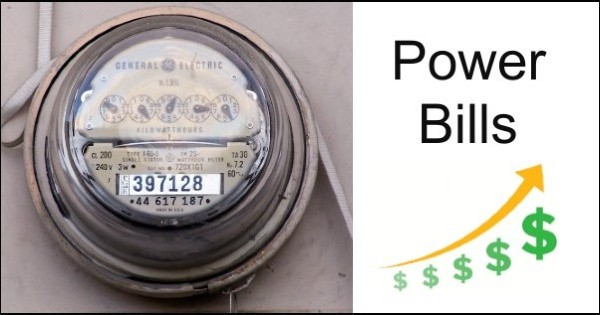
How Discount Power For Poor Will Raise Your Bill

Share this article on:

Virginia’s two major electric utilities estimate that as many as 150,000 of their poorest residential customers will see their monthly bills reduced next year using money extracted from all their other customers on their own power bills.

Appalachian Power Company projects about 30,000 of its low income customers will receive subsidies of $500-$600 per year. Dominion Energy Virginia projects bill subsidies to about 120,000 households of about $750 per year.

Both companies told the State Corporation Commission recently that to pay for this, about $1.12 will be added to the cost of every 1,000 kWh of electricity used by homes, businesses, and industries in Virginia. The cost per kWh is the same for all customer classes, and thus represents a larger percentage price increase for the commercial and industrial users.

Neither utility is sure that $1.12 or so is going to be the correct amount, but once the process starts annual adjustments can be made, just as with other costs collected through rate adjustment “riders”. A similar Ohio program costs customers three times as much, about $3.7 per 1,000 kWh, APCo reported. It is fair to expect Virginia costs will also rise.

This is the promised Percentage of Income Payment Plan, or PIPP, mandated by the 2020 Virginia General Assembly as part of its massive energy revisions earlier this year. The SCC has opened dockets for both utilities to determine the correct amount of “universal service fee” (actually a tax) to apply on bills starting in 2021. Once the various stakeholders finish with reports and interrogatories, hearings will be held in October.

Home energy is a major part of every household budget, of course, and represents a higher percentage of income for those with less cash. A Charlottesville-based advocacy group recently issued a report setting 6% of income as the definition of “energy burden,” and went around the city detailing where close to 5,000 such households exist, how many are using electricity or gas, and how many would benefit from efficiency measures to reduce demand.

That spending level – 6% — is also used in the PIPP statute, setting that as the highest percentage of income a household should need to pay to the utility if it does not use electricity as its main heating source. If the residence does use electricity for heat, the bill is capped at 10% of household income.  A family with $2,500 per month in income would thus pay no more than $150-250 per month for power depending on the heat source.

A huge number of administrative details remain to be hashed out, and the General Assembly ducked many key questions. Eligibility is not directly tied to income, but to participation in other well-known assistance programs, such as the existing Low Income Home Energy Assistance Program (LIHEAP), SNAP food benefits or Medicaid.What counts as “income” for the PIPP cap determination is yet to be determined.

The existing energy assistance program (LIHEAP), which is based on income, subsidized energy bills for almost 140,000 Virginia households last year. It is funded by the federal government, with about $95 million allocated for Virginia this fiscal year. It extends beyond the customers of the two large power companies and applies to rural electric cooperative customers, natural gas users and even assists with firewood.

How will the existing LIHEAP program, managed through the social services departments, coordinate with PIPP? Which should the customer turn to first, and is a customer eligible for assistance from both? So far, that issue is not addressed by either utility proposal. And in describing the challenges in Charlottesville, the advocacy group simply ignores LIHEAP and other assistance. One must look elsewhere to learn LIHEAP provided cash for energy bills to more than 700 Charlottesville families and another 950 in surrounding Albemarle County.

Both Dominion and APCo also have internal charitable arms, using company funds and outside donations to pay customer bills. Dominion Energy Share’s recent report claims almost 68,000 families or individuals received help with their bills, most of those funds of course reducing the company’s own accounts receivable. Some level of write-offs for unpaid bills is also already assumed in existing rates. Will the move to PIPP mean utilities get closer to full payment from all customers with no losses?

In the middle of all the other debates over energy six months ago, PIPP received almost no attention. The General Assembly majority simply decided that Virginians should not have to pay more than 6% or 10% of their “income” for electricity and sent the bill for the balance to other customers. It did this only for the major power company customers, setting a precedent that – in the name of equity – will be followed for rural electric cooperatives, natural gas, and propane providers.

The big question mark, both Dominion and APCo tell the SCC, is whether everybody eligible will actually take advantage of this. APCo assumed one half would, and Dominion provided estimates for different percentages, up to 100% participation. Frankly, until this starts it is largely guesswork.

There is one additional wrinkle, which Dominion did nod to in its filing. Every Dominion customer eligible for PIPP, whether or not they enroll, will be exempt from the coming tidal wave of capital costs for Dominion’s offshore wind development. That will lower their bills significantly, and raise others noticeably, for several decades as billions are collected for those turbines and the related profits.

The utilities also suggested that even the PIPP beneficiaries should pay the PIPP tax on their bills. Since their ultimate bill is capped anyway, it won’t change the amount they owe. (Except, of course, for any lower income customer who just missed the cut off or chooses not to use PIPP.)

A version of this commentary originally appeared August 3, 2020 in the online Bacon’s Rebellion.

Posted in Energy | Tagged | 1 Comment

Can We Talk Common Sense Yet?

Share this article on:

We are now a little over 4 months into dealing with covid-19 in Virginia and it’s time to take stock of where we are. Let me start by saying that, while I did not like the shutdown of businesses, I understood why it was happening. We had little to no knowledge of the disease. We didn’t know how contagious it was. We didn’t know how deadly it was. We didn’t know how easily it could spread. We still don’t have a vaccine and we still have a lot of questions that need to be answered. Also, lest we forget, businesses and churches were closing BEFORE the Governor issued his Emergency Order to close non-essential businesses. Nearly all professional and college sports were closed down before any governmental orders. My church shut its doors before Gov. Northam’s EO was issued as well.
The shutdown has been painful for businesses all over Virginia, just as the virus has been painful for all of the people who have contracted the disease or lost a loved one to it. There has been quite a lot of controversy surrounding the measures taken to combat this virus, just as there has been conflicting information about the virus itself.

Over four months have gone by since we started dealing with this virus, and we have a lot more knowledge than we used to, and a lot more data. Consider the following:

In just over four months the number of confirmed covid-19 cases in Virginia has reached nearly 89,000. Of those confirmed cases, a little over 2,100 people have died. We can argue about inflated death numbers or under-counted people who have the virus but have never been tested all we want, but all of that is pure speculation, and cannot be quantified or counted. People who feel sick are getting tested. If you don’t feel sick and you test positive for the antibodies, do you really qualify as a victim of a disease you never knew you had? For now, let’s just deal with confirmed numbers.

Virginia has a population of about 8.536 million people. Based on the confirmed numbers listed above, only about 1% of the population of Virginia has contracted this virus, and 0.024% of the population of Virginia has died from it.

Virginia hit its highest number of daily reported cases on May 25th of this year at 1,439. When we once again compare that to our population of 8.536 million people, that means the greatest chance anyone had of contracting this disease on any given day is about 0.01%.

Let me assure you that I am not trying to discount anyone who has gotten sick, died, or lost a loved one. This disease is not a hoax and it is worse than the flu, but we are also not talking about the bubonic plague here. The mortality rate of the seasonal flu is about 0.1%. When all is said and done, scientists are predicting the mortality rate of covid-19 will be somewhere between 0.2 and 0.4%. That is anywhere from 2 to 4 times worse than the flu. But through this entire time of chaos and confusion, only 1% of the population of Virginia has been affected, and that is not just the results for VA.

The confirmed infection rate in the United States is just a little over 1% of the population.

According to Worldometers, the total cases per 1 million population in the United States as of July 31st, 2020 is 14,006. That is a 1.4% infection rate. The 5 states with the highest rates of infection are (in order) Louisiana (2.4%), Arizona (2.3%), New York (2.27%), Florida (2.1%), and New Jersey (2.1%).

The worst hit states in America have an infection rate at only a little over 2%.

Do these numbers justify the level of disruption that is continuing to occur in people’s lives?

So what do we do now?

When Governor Northam issues orders to close businesses and mandate masks he is exercising powers delegated for an emergency situation. The law defines an emergency as:

any occurrence, or threat thereof, whether natural or man-made, which results or may result in substantial injury or harm to the population or substantial damage to or loss of property or natural resources and may involve governmental action beyond that authorized or contemplated by existing law because governmental inaction for the period required to amend the law to meet the exigency would work immediate and irrevocable harm upon the citizens or the environment of the Commonwealth or some clearly defined portion or portions thereof.

These powers have typically been interpreted to be quite broad at the beginning of a crisis, but those powers fade as time goes by and the immediacy of any threat fades.

While forced shutdowns may have seemed prudent at the outset of this outbreak, there doesn’t seem to be much justification for them now. The trend chart of daily infections in Virginia during the lock down is strikingly similar to the daily infection rate as we have moved through the different phases of opening. It means that we are seeing on average the same number of daily infections while we were locked down and while we are opening up, so the idea of more lock-downs doesn’t seem to make much sense.

We also need to consider the fact that this disease is not just going away. Many people are saying the earliest we can realistically expect a vaccine is sometime in mid to late 2021. Furthermore, there is some discussion that the antibodies gained by fighting off covid-19 may fade away after a couple of months. If true, that means we are most likely looking at a new, seasonal virus that will be with us for years.

In the face of this kind of news, doesn’t the idea of an “emergency” seem to disappear? Does it sound like our Governor should continue to wield the kind of authority he has been using up until now? If Virginia is going to be facing this virus for years, then there is plenty of time for our elected legislature to take action and allow the people to judge those actions at the ballot box in 2021. After all, we don’t shut down the economy for the seasonal flu, and we didn’t shut down the economy for SARS or H1N1 either.

The emergency powers of the Governor were designed to allow immediate action when current law was insufficient and a legislative remedy was not available. That is not the world we are living in anymore, and those powers should no longer reside in the hands of one man. The Governor either needs to relinquish his grip on total power or the courts need to take it away from him.

In my opinion the best way forward is to use our common sense. Virginians need to see our lives get back to normal again, but we need to do it with a mixture of personal responsibility and grace. People can take this virus seriously while still going to work, going to school, shopping, and gathering for entertainment and sporting events. Most people I know don’t invade the personal space of strangers when they are out and about. Following common sense guidelines should continue to protect the 98.9% percent of Virginians that have not caught this virus. If you simply follow the same steps you would to avoid getting a cold or the flu, you will be just fine avoiding covid-19. After all, the advice being given to us by all the experts is the exact same advice they would give you to avoid the flu or the common cold.

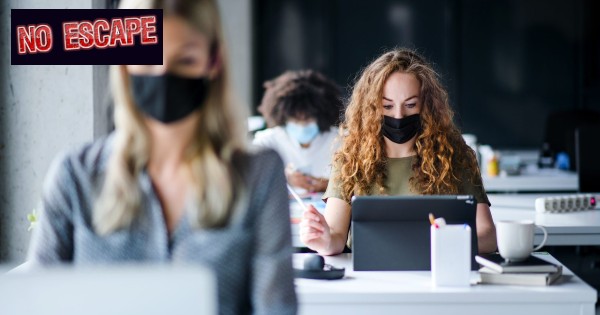
We should also understand that we don’t know the personal situation of everyone we see on the street. We should not assume that everyone we see wearing a mask is as afraid of the virus as the guy modeling the latest in post-apocalyptic active gear in the picture above. They may have a family member that is particularly susceptible to the virus, or they may be trying to take an abundance of caution. Likewise, we should not assume that people who are not wearing a mask are psychotic ogres that hate everyone and want to spread the disease. There are enough loopholes for who doesn’t have to wear a mask in the Governor’s EO (and when you don’t need to wear one) that should legally nullify the order as arbitrary and capricious. A little more concern for our fellow man and a lot less nagging will help everyone get through this time in much better shape.

Our knowledge of the virus also means that our hospitals are much better equipped to deal with the new cases to come, and there will be new cases no matter what we do. More importantly, the knowledge we have gained and continue to gain should help dispel some of the fear that has gripped so many people since this all started, and that fear is really the biggest enemy we face in this ordeal. We all want life to get back to normal, and that is only going to happen when a majority of people feel safe enough to do so. That means everyone needs to work a lot harder to turn down the heat and use some common sense. Take the virus seriously, but don’t let fear control your life.

A version of this commentary originally appeared on July 31, 2020 in the online The Bull Elephant.

Posted in Economy, Health Care | 3 Comments

Time to Fix a Broken System

Share this article on:

Do you trust politicians to do what’s right?

If you’re like the vast majority of Virginia voters, the answer is likely a resigned ‘no.’ Democrats and Republicans spend so much time fighting each other to score points that they seldom compromise and do the right thing.

And for the most part, there’s nothing the average citizen can do about it. Until now, that is.

This November, voters will have a once-in-a-decade chance to take power away from both Republicans and Democrats in Richmond, and put it into the hands of a bipartisan commission — the power to draw the district lines for the House of Delegates, Virginia Senate, and Virginia’s eleven seats in the U.S. Congress.

Politicians have shown time and time again they can’t be trusted to draw their own lines. When they do, we wind up with districts like the “Southside Whirlpool,” and the “Fairfax Onion Slice.” I wish I was kidding – but if you check out a map of our districts, you’ll see what I mean.

We’ve gotten those un-natural, misfit districts because we’ve let politicians pick their voters – and not the other way around. That cynical practice would end under this amendment on the ballot this November 3rd. If redistricting reform is adopted by the voters, a bipartisan panel of Republicans and Democrats, evenly divided between lawmakers and regular, non-political Virginia citizens, would sit down and hash out the maps for the next decade. This process will put people in districts based on where they live, not on whom they vote for.

The best news is that the hard part is over. In 2019, Republicans brought the redistricting amendment to the floor and it passed. In 2020, Democrats brought it to the floor for a second time. It passed again. It took a bipartisan coalition both times, and it ticked off a lot of political kingmakers, but the reform survived.

Now it’s up to the voters to fix this broken system. The good news is that nearly 3 out of 4 Virginia voters support this redistricting reform measure. They’ve had enough of the far left and far right drawing the lines. They want a more honest process – and districts that make sense.

Unfortunately, Virginia Democrats have done a 180 on the amendment. When control of the General Assembly was in doubt in 2019, both sides supported the compromise which would leave no one with the upper hand.

Now, the Democratic Party of Virginia has taken an official stance against the amendment, encouraging their voters to vote no. It’s not hard to see why. With Democrats in charge of the House, Senate, Governor’s Mansion and Attorney General’s office, unencumbered Democrats could draw Republicans into oblivion.

To be clear, I’m not a recent convert on the desperate need for bipartisan redistricting reform. When my own party had a thirty-plus seat majority in the House of Delegates, I was one of the few who defied my party’s leadership and voted in favor of redistricting legislation.
All the reasons that caused me to vote for redistricting reform in 2017 were true then and remain true today.

Voters should be able to pick their elected leaders, and not politicians using partisan gerrymandering that has benefited elected leaders and hurt smart, accountable government.

The good news is that the most recent poll of voters found that 80 percent of self identified Democrats in the Commonwealth support the amendment, even though the party leaders cravenly oppose it.

Polarization can end in Virginia. Reasonable people in the vast middle of Virginia can bring sanity back to our Commonwealth this year. And all it takes is your YES vote for the Redistricting Reform Amendment on November 3rd.

Let’s give voters a voice and fix a broken system.

Posted in Government Reform | Comments Off on Time to Fix a Broken System

New Rules for Employers: There Is No Escape

Share this article on:

The first thing every employer in Virginia needs to understand about the state’s new COVID-19 temporary workplace standard (here) is it is universal.  It applies to every workplace, public and private, for-profit and non-profit, with 10,000 workers or two.  The rules are the same, “one size fits all,” without regard to the nature of the industry.

The second thing every employer in Virginia needs to understand about the standard is that it is only temporarily temporary.  The goal, and work will begin quickly, is to convert the set of requirements into a permanent regulation, with a permanent burden on employers going forward to protect their employees from a disease circulating widely outside their establishments. 

The third thing every employer in Virginia needs to understand about the standard is that complying with federal standards or specific industry standards may not protect you from state complaints or fines.  Efforts to create a regulatory “safe harbor” for those who met similar federal standards was initially accepted, but in the end watered down under vast union pressure, peaking in this story in Virginia Mercury the day of the final meeting. 

The “loophole” (Mercury’s loaded word) created by relying on compliance with the Center for Disease Control’s recommendations was closed, and such compliance only provides protection if the CDC approach “provides equivalent or greater protection than provided by a provision of this standard.”  If you can’t prove it does to the satisfaction of the state, you may be fined.  What you’ve been doing to date, no matter how well it has worked, may not match these new standards. 

Only Virginia’s public and private schools of higher education, and public and private K-12 schools, can rely on re-opening plans cleared by the state rather than this standard.  But, again, those plans must “provide equivalent or greater levels of employee protection than a provision of this standard.”  It is not really an exemption.

For the other estimated 300,000 work locations around the Commonwealth, the new paperwork, the costs of compliance and the consequences of violation are unavoidable.   Any case involving an employee or somebody else in the workplace must be reported to the Department of Health, and three cases within fourteen days must be reported to the Department of Labor and Industry. 

The July 15 approval by the Virginia Safety and Health Codes Board, after four contentious meetings marked by close internal votes, is being cheered by labor unions as a victory with national repercussions, and Governor Ralph Northam has been happy to take a deep bow.  They claim it will lead to more economic activity, but there is reason to fear it will add costs and uncertainty that impede re-openings and hiring.  People will ultimately pay for compliance twice, as a customer or as a taxpayer. 

The full 35-page text of the standard with all the changes incorporated was released July 17 and should be published in a Richmond newspaper within a week or so.  Once published, it is in effect for six months, or until Governor Northam lifts his emergency declaration, or until a permanent version is adopted. 

These rules must be viewed in connection with the other shoe which may drop, an effort to make COVID-19 a recognized workplace disease covered by workers compensation benefits.  Unlike with traditional occupational diseases, no job or workplace activity causes COVID-19.  People can catch and spread it anywhere.

All Virginia employers – even those with only a few employees and perhaps even the self-employed – must begin to assess and rank every job, job task and facility for their level of risk to viral spread, screen all employees and suppliers entering, begin to keep detailed records on employees showing symptoms or testing positive, conduct contact notifications within their workplaces, and prevent the return of known or suspected sick employees until medically cleared.

That clearance could include two negative test results, taken 24 hours apart, but given the backlog of testing in recent weeks that may greatly extend the employee’s absence.  Getting medical clearance after a period of three days with no symptoms may prove quicker.  Any employee who tests positive but shows no symptoms will also be unable to enter for at least ten days.  Employers must pay for tests.

Every employer with ten or more workers has 60 days to prepare a written disease prevention and response plan.  Within 30 days they must conduct extensive training with all employees, geared to the risk level of their jobs.  If the employee then behaves as if the training didn’t stick, another round must be provided, as must be the case if the company’s plan is amended or the understanding of the disease changes. 

The initial draft of this was published in mid-June, with only a few days allowed for public comment.  Thousands poured in anyway during that short period, including the most impressive and near unanimous outcry from the business community in recent memory.  Only a few changes were made to accommodate those employer concerns, although a minority on the board put up a spirited resistance in close votes.  Ex-officio votes controlled by Northam cabinet officers were often crucial in overriding amendments.

One of the final debates July 15 involved protection for employees who complain of workplace violations, not just to regulators or their fellow employees, but also to outside news media or on social media platforms.  Even if false or posted in malice, Facebook comments accusing your employer on this issue cannot lead to any internal disciplinary action.

Following a pattern on other controversial elements over this process, a motion to remove the part about outside media was defeated on a 5 to 5 vote, with various abstentions and absences.   Five of fourteen board members imposed that standard.  The final adoption by only 9 of the 14 members was the final indication that this was not a consensus product and is likely to meet continued resistance.

Stephen D. Haner is Senior Fellow for State and Local Tax Policy at the Thomas Jefferson Institute for Public Policy.  He may be reached at steve@thomasjeffersoninst.org.

Posted in Economy, State Government | 1 Comment

The Great Virginia Pipeline Swindle

Share this article on:

If by 2040, the Old Dominion has completed its transition into a federal annex fringed by Berkshire-owned feudatories and horse farms, July 5, 2020 will go down in history as the moment the power balance shifted decisively toward the new oligarchs.

The Atlantic Coast Pipeline is dead. Democrats in the statehouse have run out the clock and Dominion Power, having sunk billions into the project, is cutting its losses. And on Sunday, the Wall Street Journal reported that, “[Dominion] will almost entirely exit from its gas-transmission business with the sale of its pipeline and storage assets to Berkshire Hathaway Energy.”

If the pipeline had been finished, Norfolk would probably have become a natural gas exporting terminal. As it stands, the mid-Atlantic’s only liquid natural gas exporting terminal is the Dominion facility in Cove Point, Maryland, of which Berkshire now owns a share. So, the big winners in the pipeline cancellation are: Berkshire Hathaway, the State of Maryland, and a cabal of rich progressives in Charlottesville.

The big losers are likely to be Dominion’s union workers. Berkshire has a record of union-busting, including a recent incident in New Jersey when truckers and warehouse workers who tried to organize were laid off and replaced with contractors. The union representing Dominion’s gas workers in several mid-Atlantic and Appalachian states seems to be worried, with good reason. “At this time we fully realize there are many unanswered questions and the Leadership is scheduling meetings with Labor Relations as well as the Company officials to transition employees and benefits over the next few months,” United Local Gas Workers Local 69 posted to their Facebook page on Sunday.

Berkshire also owned most of the newspapers in western and central Virginia until March, including the Richmond Times-Dispatch, the Free Lance-Star, the Culpeper Times-Exponent, the Daily Progress in Charlottesville, the News Virginian in Waynesboro, and the Roanoke Times, giving them almost complete control of the pipeline narrative in the parts of the state where it mattered. Lee Enterprises paid $140 million for all Berkshire’s papers nationwide in March, not just the ones in Virginia, and Berkshire now owns all of Lee’s debt. Unlike Berkshire’s  New Jersey workers, the Roanoke Times has been allowed to unionize as of this April, right after they got rid of it.

The value of BH’s Virginia newspapers is peanuts compared to the $9.7 billion Dominion deal, but it is nevertheless worth noting that during the contentious debate over the pipeline, most of the newspapers in Virginia were owned by a company that is now going to acquire Dominion’s natural gas operations. Today Berkshire does not own the papers, but they are the sole creditor to the company that does, which means they retain a non-trivial amount of influence, and much less of the risk.

It was not simply regulatory roadblocks that killed the pipeline; in fact there were several important victories on that front. The Supreme Court ruled in June that the pipeline could be cut underneath the Appalachian Trail, overturning an earlier verdict that the Forest Service didn’t have the authority to grant a permit. No, it was political opposition, not regulatory hurdles, that killed the pipeline. That opposition came in the form of astroturf groups funded by people connected to Berkshire figures, and Democratic politicians who received donations from people connected to the company (the largest single donor to the Democratic Party of Virginia in 2015 was the son of Buffett partner Charles Munger, Jr, whose money supplied more than half of their funds for statehouse races that year). The defeat of the pipeline was also enabled by the near-complete collapse of the Republican Party of Virginia, which failed to run candidates in nearly a third of state legislative districts in 2019.

There are also a fair number of astroturf groups that played an important role, whose funding sources remain unclear. One should point out that Ted Weschler, a top investment manager at Berkshire Hathaway, is a Charlottesvillian, who joined the company in 2012 and is frequently discussed as a potential successor to Buffett. Weschler is a former business partner of billionaire Charlottesville resident Michael Bills, who used to manage the UVA endowment and was the prime political mover in the anti-Dominion campaign. Bills is the chairman of the board of Clean Virginia, and two years ago famously offered to replace any Dominion campaign donations to statehouse candidates with his own money. Clean Virginia was run by Tom Perriello until he took a job in 2018 running the U.S. programs of George Soros’s Open Society Foundations. Its current executive director is Brennan Gilmore, a former State Department employee who, among other things, filmed the Charlottesville car attack in 2017.

Then there is the Virginia Mercury, a dark money-funded nonprofit journalism outlet that covers primarily environmental issues. The Virginia Mercury was initially funded through the Hopewell Fund, a 501c3 managed by Arabella Advisors, an institution that is a good example of how, though conservatives got a big win in Citizens United, progressives have figured out how to use the new rules better than any conservatives have. The largest single donor to the Hopewell Fund, and the foundation that provided its seed funding, was the Buffett Foundation, according to CRC. We don’t know who the specific donors for the Virginia Mercury are, but given the various Buffett-connected interests involved here, one has to wonder. The Mercury has also profiled Michael Bills’ counter-Dominion campaign, and one can peruse their coverage of the Atlantic Coast Pipeline to get a sense of their views on the subject. Editor-in-Chief Robert Zullo’s column after the death of the pipeline details his own changing views on the subject, which may or may not be related to his new set of patrons. (Update: A PR representative for States Newsroom, of which the Mercury is a part, comments: “States Newsroom is a stand-alone 501(c)(3) and has not had an affiliation with the Hopewell fund for some time.”)

What is beyond dispute is the death of the Atlantic Coast Pipeline has now resulted in a substantial acquisition for Berkshire Hathaway, after various people connected to the company have worked to kill it. Anybody who claims it’s a victory for social justice should pay very close attention to how many union jobs the sale is likely to kill, and also to the private equity creeps behind the curtain. The natural gas operations in Virginia hated by environmental activists haven’t gone away, they’re just owned by their allies now. And the state once called the Mother of Presidents is now managed from Nebraska, via a branch office in Charlottesville.

A version of this commentary originally appeared in the July 8, 202 edition of The American Conservative.

Posted in Energy | Comments Off on The Great Virginia Pipeline Swindle