
The Case for WMATA ‘Bankruptcy’

Share this article on:

Yesterday, the Washington Metropolitan Area Transit Authority (WMATA) warned that without substantially greater subsidies from DC, Maryland, and Virginia, they would be facing a $750 million annual shortfall that would require draconian cuts in services, including closing 10 stations, cutting 67 bus lines, and laying off 2,000 employees.  They would also freeze salaries, raise fares and parking fees, reduce bus and train frequency, and close all stations at 10 p.m.

The threat of such cuts was meant to be a bargaining chip for more funding rather than a true plan to save WMATA, as any such cuts would just accelerate, not slow, the demise of WMATA.  It is time for Governor Youngkin and the two other regional funders, all of whom are facing reduced federal aid in their own budgets, to seriously consider forcing WMATA into bankruptcy.  And if WMATA’s unique structure as a bi-state compact agency makes it ineligible for Chapter 9 bankruptcy — a complete restructuring and rethinking of WMATA along a similar line as Chapter 9 bankruptcy are in order.

The truth is that bankruptcy is not a new idea.  In 2016, WMATA hired one of the nation’s top bankruptcy lawyers, Kevyn D. Orr, to advise the agency on fixing its troubled finances.  At the time, WMATA had a $1.8 billion operating deficit (a loss of over 200 percent of operating revenue) with $917 million in long-term debt (not counting pension and other benefit liabilities).  The hope was that Mr. Orr’s expertise, short of bankruptcy, would help WMATA restructure its debt, take a tougher line on labor negotiations, and wrest more money from the three Washington-area funding jurisdictions.  Sadly, whatever reforms were implemented have had little, if any, impact on WMATA’s financial situation today.

Even before the pandemic, WMATA continued to run massive operating deficits.  In 2019, the year before the pandemic, WMATA’s deficit had ballooned to 291 percent of operating revenue and revenue from passengers had dropped to 25.1 percent of total revenue.  Ridership had dropped in seven of the eight years before the pandemic.  Then came Covid-19.
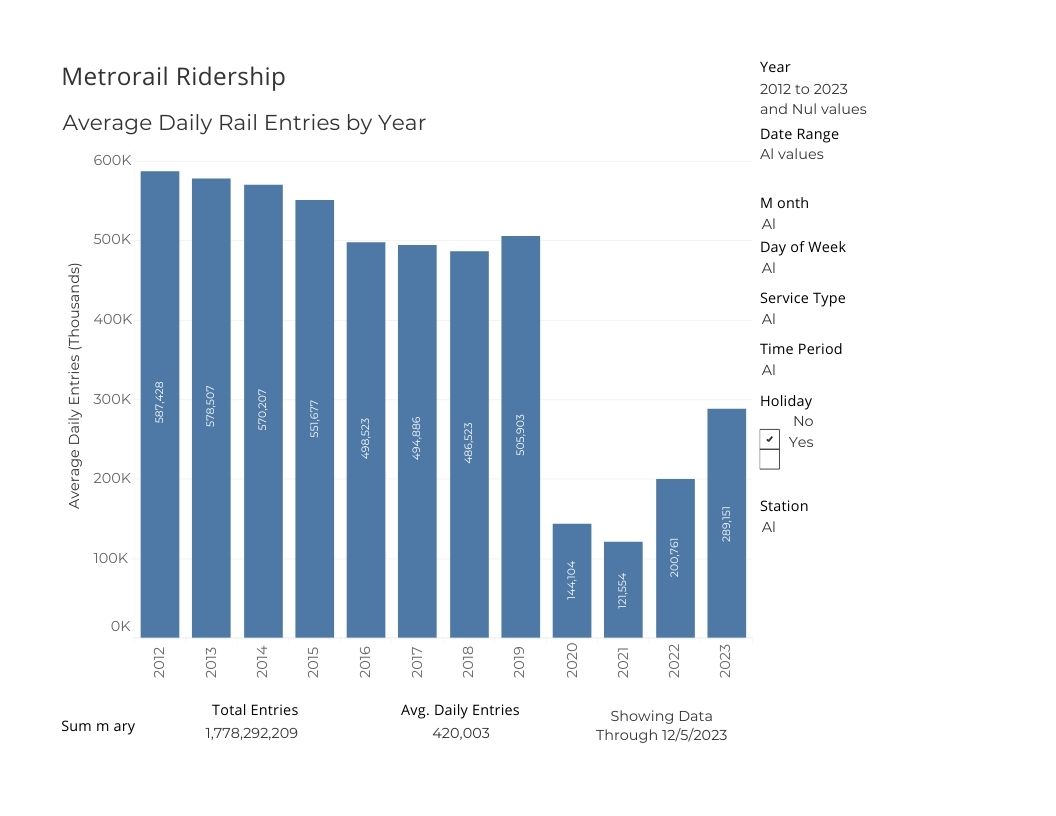
WMATA rail ridership dropped from 505,903 average daily rail entries in 2019 to a low of 121,544 in 2021.  While WMATA brags that 2023 rail ridership more than doubled from the pandemic low, it is still only 289,151 daily entries now.  For perspective, passenger revenue (both rail and busses) now only accounts for 4.8 percent of total revenue of $364 million with expenses of $3.7 billion.  Annual operating losses are now $3.3 billion or 916 percent of operating revenue.  Debt has risen to $3 billion, again, before counting pension and benefit liabilities.  This is not just unsustainable — it is a bankruptcy-level failure.

Of course, operating revenue is only a small part of WMATA’s finances.  The vast majority of WMATA revenue comes from state and local subsidies.  The best way to understand this is to look at a chart in WMATA’s planning document.
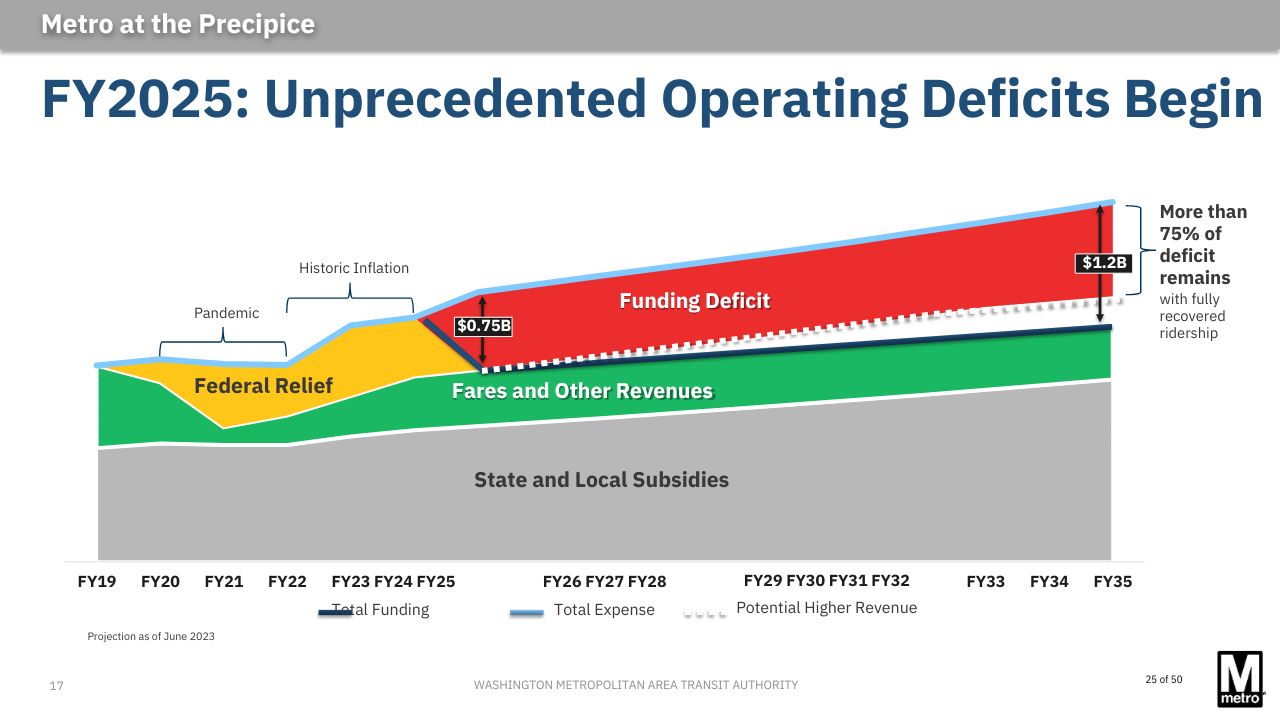
As you can see, WMATA’s operations have always relied on a growing base of government subsidies — subsidies that grew substantially during the pandemic (yellow Federal Relief on the above chart, plus the grey base).  More interesting, is that expenses barely went down during the pandemic, despite ridership collapsing.  Worse, as the chart shows, due to the historic inflation of the last two years, labor costs (which under union contracts rise with inflation and currently make up 48 percent of WMATA expenses), grew by 20 percent over the last two years.  This growth in wages will drive up expenses, as seen in the chart, and will carry forward indefinitely.

While Governor Youngkin and others have urged the Office of Personnel Management to issue a “return to work” order for Federal employees in hopes of driving ridership back up, as this chart shows, even if ridership returns to prepandemic levels, 75 percent of WMATA’s deficit will remain.  In fact, you could double prepandemic ridership and WMATA would still be in financial deficit.  Ridership was trending down before the pandemic, and realistically, the world today is far different.  The odds of ridership hitting 2019 levels are very low.  If you drew a trend line from the prior 8 years of pre-pandemic ridership, the 2023 level is only slightly lower than would have been expected absent the pandemic.  It is also important to know that the miles of rail in WMATA have increased with the addition of phase two of the Silver Line, meaning ridership per station or per mile of track has tanked.  WMATA has yet to learn they can’t build themselves out of financial collapse.

Setting aside the growing issues of fare jumpingcrimebroken 7000-series train cars, and resigning Inspector Generals — the issues with WMATA are far deeper than can be explained by those headline-grabbing problems.  The Washington Metropolitan Area Transit Authority is a failing institution in need of a bankruptcy filing if possible, or, at a minimum a total restructuring.

At a minimum,

  1. WMATA must find authority to restructure its debts and negotiate new labor contracts which account for almost half of all their expenses;
  2. WMATA must shed its old management and start over with new leadership;
  3. WMATA must free up resources for greater innovation and restructuring in line with the post-pandemic transportation needs of the region (more buses, less trains?);
  4. WMATA must halt all expansion plans, like the tunnel to Georgetown and the Blue Loop that were designed for a different time.
  5. WMATA must take time to value its assets and ensure it is maximizing income from both operating and non-operating income.
  6. Any investments in expensive and unreliable electric buses and charging stations must be put on hold until the system can sustain the buses it has (it is a curious fact that the most recent study of Metrorail showed that its carbon-reducing benefits were outweighed substantially by the carbon expended to run the system. Metro stopped producing this statistic after the pandemic, as I am sure Metro’s carbon reduction estimates have crashed with reduced ridership).

Governor Youngkin, with his background in private equity, surely understands the power of bankruptcy as a means of saving important businesses.  Let’s hope he applies this wisdom to WMATA before it is too late.
Posted in Transportation | Comments Off on The Case for WMATA ‘Bankruptcy’

Who Paid for the Abortion Ads? Green Energy

Share this article on:

You may think the recent Virginia election was about abortion, but follow the money. The wave of advertising on that issue was largely bankrolled by the renewable energy industry. This election was about energy and delivered to those special interests the legislature they needed to stay in control of that agenda.

Dominion Energy Virginia increased its donations to Virginia state politicians six-fold in just four years. The other major donors in the energy regulation arena, Clean Virginia Fund, and its founder, have done much the same. They are donating five times more in the 2023 election cycle than they did in the similar 2019 cycle.

The two political behemoths have donated about $23 million between them, compared to about $4 million four years ago. The totals really won’t be known until the final reports are due in the coming weeks. Throw in another $2 million from the League of Conservation Voters for good measure. Then the spouse of the Clean Virginia founder directly donated another $4.5 million in her own name.

While Dominion and Clean Virginia often disagree over regulatory issues, on many issues they are closely aligned. If any serious effort is put forward now to repeal or amend the Virginia Clean Economy Act, both will lobby against ending the net-zero targets. Both are keen for electric vehicles and will work to protect that mandate. Both strongly support Dominion’s offshore wind development and rapidly growing fleet of solar farms.

Virginia’s election laws are so porous, that the real spending amount may never be clear. In the last weekend, another round of mailings in favor of various candidates appeared from an advocacy group called Power for Tomorrow. It sent similar mailings out just before the June primary.

Reporting at that time noted that Dominion had provided funding for Power for Tomorrow, which basically is praising candidates who had voted for Dominion’s 2023 regulatory bill, which had its good and bad points. There is every reason to believe it is acting at Dominion’s behest and no question these mailers are intended to promote the candidates.

The Power for Tomorrow mailer appeared just one day after the State Corporation Commission implemented part of that bill, allowing Dominion to convert two years of unpaid fuel bills into a bond, and then make its ratepayers pay off the bond over 7 years.

Depending on the final interest rates on the deal, that will cost Virginians hundreds of millions of dollars in interest they otherwise would not owe. It removes a pesky $1.3 billion debt from the company’s balance sheet and replaces it with a quick infusion of free cash flow.

Keep those sums in mind as it helps explain what you will read next.

The Virginia Public Access Project’s most recent compilation shows Dominion’s 2022-23 total for donations at $12.8 million. Four years ago, when the House of Delegates and Virginia Senate were last both on the line, the total donated was a mere $2 million and change.

Clean Virginia was founded with the express mission of weaning Virginia politicians off of Dominion money. Its issue advocacy has included campaign finance reform, but it is also a lobbying group pushing wind, solar, and battery electricity generation and fighting to end fossil fuels. On the election reform front, it has merely started a bidding war for influence.

In this cycle, its total donations are up to $10 million and change. Four years ago, it donated less than $400,000. But its principal donor and leader is wealthy Charlottesville hedge fund founder Michael Bills, and in 2019 he mainly gave his money directly to candidates. Between them, the total was about $2 million, so the figure four years later is five times that amount.

This is equally astounding: four years ago, the largest sum Dominion gave to any individual candidate was $82,500. This time around, so far, 15 candidates have received more than $250,000, and the highest amount donated is almost $700,000. That went to an unopposed Democrat who may now be the new Speaker of the House. Clean Virginia’s largest donations exceed $600,000, including to two Democrats who won two of the most watched Senate seats.

Dominion’s money is fairly evenly divided between Republicans and Democrats. Clean Virginia over its years of giving has provided 98% to Democrats. So Dominion did fund some of the Republican messaging in response to the abortion attacks. In doing so, however, it cemented it relationship with those Republicans. Usually the Democrat in those cases was getting major Clean Virginia money so that nobody would vote against the joint agenda items. All bets were covered.

Four years ago, there was no Virginia Clean Economy Act, no mandatory renewable energy percentages, and no mandate to stop the sale of new gasoline vehicles. Four years ago, the $9.8 billion (or more) wind project was still in the planning stages and hadn’t filed for regulatory approval. Now the massive project is underway, one of the few in the U.S. still on track entirely due to its favorable regulatory environment. Those favorable rules were provided by these very same legislators.

A $23 million investment in keeping the legislature compliant and obedient makes perfect sense once you realize the billions and billions of dollars the transition to wind, solar, and battery will extract from Virginia’s residential and business ratepayers over the next decade. Dominion and Clean Virginia both understand return on investment.

This is the biggest mistake offshore wind developers in New Jersey and New York made, the ones that in recent weeks have backed out of various offshore wind deals. They failed to take the additional step of buying themselves a friendly legislature to write the procurement rules. Of course, those states both have campaign contribution limits in their laws, an inconvenience not faced by Dominion Energy or Clean Virginia.

A similar version of this was published before the election on Bacon’s Rebellion, but in light of the results it takes on additional importance.

Posted in Energy, Environment, State Government | Comments Off on Who Paid for the Abortion Ads? Green Energy

Tomorrow’s Ballot Question: Will Virginia Become Illinois?

Share this article on:

It was reported this week that billionaire Illinois Governor J.B. Pritzker had made substantial campaign contributions totaling $250,000 to four liberal Democrats running for Virginia State Senate and the Democratic Party of Virginia.  These donations, made through Governor Pritzker’s “Think Big America” organization, are the clearest sign yet that the left wants to turn the Commonwealth of Virginia into an Illinois of the East.

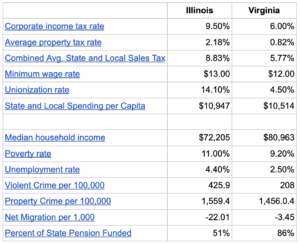
Truthfully, the governing philosophies in Illinois and Virginia could not be more different.  State and local government spending per capita in Illinois is higher than in Virginia.  Illinois has a higher overall tax burden than Virginia, and Illinois has a substantially higher unionization rate than Virginia.  In fact, about one in seven workers in Illinois are unionized, while only one in 22 workers in Virginia are unionized.  Illinois also has a higher minimum wage than Virginia.  So, what does Illinois get with its higher taxes, higher spending, higher minimum wage, and higher unionization?  A worse state.

In fact, Illinois has a higher poverty rate and higher unemployment rate than Virginia.  Illinois also has a higher violent crime rate and higher property crime rate than Virginia.  Illinois doesn’t fully fund its pensions and thus has the highest unfunded state pension liability in the country ($210b), while Virginia has one of the lowest unfunded liabilities ($18.5b).  Illinois has only funded about half of its pension obligations, while Virginia has funded almost 90 percent of its obligations.  Illinois is notorious for its political corruption and it regularly sends its governors to prison.  Not surprisingly, Illinois also has one of the highest net migration rates to other states.  This means that Illinois loses 22 out of every 1,000 people every year when they leave for a better state, compared to only 3.45 per thousand who leave Virginia.

Under Governors Northam and McAuliffe, Virginia was well on its way to becoming Illinois.  With their passage of collective bargaining for public employees, the passage of draconian and impossible-to-reach carbon targets, and an increased minimum wage, the left was getting its wish.  Fortunately, the Commonwealth put a stop to this drift with the election of Governor Youngkin — who in just two years has cut more taxes ($5b) than the previous two governors combined, has led Virginia to one of the highest job growths in the country, and is battling to reverse the economic impacts of the green extremists.

Tomorrow’s election offers voters a clear choice:  Voters can choose a Virginia sustained by the enduring vision of Governor Youngkin’s “Spirit of (a free) Virginia”, or a pale imitation of Illinois Governor Pritzker’s “Think Big (government) America.  The stakes are high and which way they choose will decide the course of Virginia’s economy for the next decade, at least.

Posted in State Government, Taxes | Comments Off on Tomorrow’s Ballot Question: Will Virginia Become Illinois?

Dominion’s Wind Towers Arrive Just Before Federal Approval Does

Share this article on:

The Biden Administration’s Bureau of Ocean Energy Management (BOEM) has issued final approval for the construction of Dominion Energy Virginia’s Coastal Virginia Offshore Wind project. Here is the release. A few more review steps remain and should be completed by late January, according to BOEM.

There was no suspense around this, as Dominion has already committed billions of dollars to the project with its ratepayers now paying monthly installments on it. The announcement followed by a few days the arrival of the first set of gigantic monopiles, the first eight of the 176 structures Dominion will build about 27 miles or more off Virginia Beach. Many more will be stored on the Portsmouth waterfront before the final permits are issued.

The tubes are surprisingly similar in size to the hull structures of the Virginia Class nuclear submarines built on the other bank of Hampton Roads at Newport News Shipbuilding, or tubes for traffic tunnels. For many, the sheer size of these planned 15-megawatt turbines may finally become clear.

Coverage of their arrival was provided by The Virginian-Pilot but got little attention outside Hampton Roads. Governor Glenn Youngkin (R) attended and has praised the project all along. The paper provided only an indirect quote from his remarks:

The project is also at the heart of Virginia’s all-of-the-above approach to energy production, which aims to make energy cheap and plentiful by employing fossil fuels, nuclear and growing green energy, said Gov. Glenn Youngkin, who attended the event.

No communication on the event has been issued from the Governor’s Office, which normally chronicles his public events and comments on economically important issues. The Pilot story, worth reading if you can get past the firewall, quotes Dominion CEO Robert Blue extensively on how this project – unlike most others on the East Coast – is still proceeding on time and on budget.

Blue has been repeating those remarks elsewhere now that the BOEM announcement made national news, including the New York Times and CNBC. Dominion’s project, with a claimed energy output of 2,600 megawatts, is the largest single project of all those touted by Biden. The news of its approval drowned out bad news from New Jersey, where energy developer Orsted announced it was backing out of two projects, starting a hissing match with that state’s governor.

In New York, the state is scrambling to issue new requests for proposals on wind projects after contractors there also backed out. The wind developers were seeking higher payments through the regulatory process. Now the higher prices will show up in the next round of contracts instead.

Many East Coast Democratic governors are probably envious of Republican Youngkin, who is likely to have construction well along during his term. But having downplayed his part in the monopile arrival ceremony, his office also put out no public or private announcements about the Oct. 30 BOEM approval. Even so, his strong public support has probably prevented arguments about the wisdom of offshore wind from surfacing in the legislative campaigns. It is an issue in New Jersey.

The figure of $9.8 billion is usually mentioned as the capital cost for Dominion’s European-built turbines and all the added equipment to bring the electricity ashore and connect to the grid. But when the Virginia State Corporation Commission approved the financial investment more than a year ago, the possibility of costs as high as almost $14 billion was recognized in the final order.

Usually forgotten in news coverage is that this project is just the first of two in Dominion plans. Its integrated resource plan and renewable energy compliance plans both call for a second tranche of turbines just as extensive as the first, built a bit further out in the ocean. If indeed Dominion’s first wave has avoided the cost crisis now hitting the industry, nobody is pushing hard on the question of what the second wave might cost.

Official publication of this “record of decision” is the point at which any opponents seeking to challenge BOEM’s decision or related permits have a chance to file a lawsuit. Suits are pending in other states, but the first to reach a decision went against the opponents.

The most common point of attack in the lawsuits is concern over the adequacy and impartiality of the environmental review process. Opponents also raise issues about the impact of the projects on the view of the ocean, both their personal dislike of seeing the wind field and their concerns it will discourage tourism. In some cases, the fishing industry has complained of adverse impacts, but in Dominion’s case a settlement for potential compensation has already been reached with the fishing industry. Those funds will also come from ratepayers.

The potential impact on marine life, especially the truly endangered Atlantic Right Whale, has garnered the most media attention. BOEM and Dominion claim that mitigation efforts built into the construction plan, including the times of year work can or cannot proceed, will provide adequate protections. The whales could not be reached for comment.

Posted in Government Reform | Comments Off on Dominion’s Wind Towers Arrive Just Before Federal Approval Does

Will The Left Repudiate This Evil?

Share this article on:

“You dance with the one who brung ya” goes one of the oldest sayings in politics.

It means that when elected officials get into public office, they vote with those who helped put them there.

The deadly Hamas attack on Israel, an event slaughtering 1,400 Israelis that Hamas political bureau member Ghazi Hamad called “our message to the world,” has exposed divisions up and down the Biden liberal-left coalition – and sent a warning signal about those who power that coalition.

Polling data demonstrates the split among Democrats, fueled largely by the young and the Left.   It has already caused President Biden to shift his tone, and a recent Reuters report noted that “Biden, 80, has evolved in the face of a challenging 2024 reelection bid, (and) threats by some would-be supporters to withhold their votes over his lack of backing for Palestinians …”

Four hundred congressional staffers have signed a letter to their bosses opposing the Administration’s current approach.  Two-hundred each among the former volunteers of presidential candidates Bernie Sanders and Elizabeth Warren have done the same.  Groups supporting Biden are disbanding.

The divide, and the pressure to move leftward comes from every level of the party, from college campuses to elected officials, and is as evident here in Virginia as anywhere —

  • Virginia Delegate Sam Rasoul typifies the younger element pushing the Democratic Party further left.    His tweet blaming Israel for a hospital explosion in Gaza remains posted and inflaming voters, after even the New York Times apologized for making the same charge because it was Hamas propaganda.  No apologies from Delegate Rasoul.
  • Fairfax County School Board member Abrar Omeish even objected to a moment of silence for the murdered Israelis.  She similarly spoke out against a moment of silence memorializing the victims of 9/11 and while discussing the battle of Iwo Jima.

Such actions have ramifications for elected Democrats and those who support them, and have left many Jews feeling abandoned by those they once trusted.  Were a conservative to engage in such conduct, the charge of anti-Semitism would be deservedly loud and clear.  But conservatives have already repudiated such anti-Semitism.  On the Left, not so much.

The essence of the progressive argument is that Israel’s treatment of Palestinians in Gaza has regularly violated human rights through such means as forcible transfer, administrative detention and the denial of basic rights.  It is a legitimate criticism.

But it does not justify terrorism, a condemnation of which the Left seeks to avoid or at least suggest some sort of moral equivalence between Israel and Hamas.  The issue is not “do they support Israel,” so much as “how can they not condemn Hamas?”

Videos of the attack, now verified by Human Rights Watch, affirm the brutality of Hamas.  To accept the Left’s argument as justification for the slaughter of festival-goers, the offer of $10,000 and an apartment for every hostage brought back to Gaza, young children shot and burned, and assassinating people in their homes is not unlike accepting the notion that Hitler’s regime might perhaps be justified by abuses in the Treaty of Versailles.   It is nonsense.

Ignored is the fact that before 2005, Israel occupied Gaza and pulled out when the people of Gaza chose their own political leadership.  They elected Hamas which openly sought and continues to seek the “obliteration” of Israel in its Founding Charter.  Ignored, too, is that Gaza has been sealed off since 2005 by both Israel and Egypt over fears of attacks.  Since then, there have been more than 22,000 rocket attacks into a country the size of New Jersey.  Does a nation have the right to protect its people?

Instead, the American Left has gaslit Israel and blamed the victim, an approach bubbling up from college campuses, among academics and in the news media – precisely the sources of sustenance for Mr. Biden’s party.  Which is what makes it hard for some elected officials:  These are the ones who brung them.

Political parties are already being pushed to their polar opposites, but leadership unable to condemn the slaughter of innocents because of political dependency abdicates the title of leader.

In the time ahead, the issue may not be who they dance with, but rather who is calling the tune.

Posted in Politics | Comments Off on Will The Left Repudiate This Evil?