Virginia’s Scholarship Tax Credits: An Educational Beacon of Hope

Share this article on:

There is more to love about education in Virginia thanks to the budget Governor Glenn Youngkin signed into law on June 22, 2022. It contains the largest education budget in Virginia history at $3.2 billion, $900 million for Historically Black Colleges and Universities, a 10 percent teacher raise, and a statewide literacy initiative. Youngkin’s budget also maintained a $25 million cap for the Education Improvement Scholarships Tax Credits Program (EISTCP), successfully fighting off an attempt to cut the EISTCP cap from $25 million to $12 million.

Established in 2012 by Governor Bob McDonnell, EISTCP provides scholarships to Virginia families with a household income up to 300 percent of the federal poverty guideline (400 percent for students with special needs) for use at private schools. According to a 2021 report, 38 scholarship foundations approved 4,674 awards worth $12.8 million.

I was Virginia Secretary of Education when EISTCP was under consideration, and I encouraged supporters to remember Virginia’s role in Massive Resistance and its use of taxpayer money to fund the creation of private white flight academies during the 1950s and 1960s. Why? To learn lessons from previous policy agendas, and to move our public conversation from a fear-based notion of choice to a freedom-based notion of choice.

Ten years later people committed to opposing EISTCP are again using a fear-based notion of choice, either directly or semiotically. A July 11, 2022 article paints a very dark picture of EISTCP by exploiting a real tragedy Prince Edward County families experienced during the fear-based era of choice to justify painting Jim Crow above the door of private schools that receive public money from scholarship foundations today.

The article warrants a reality check in three ways.

EISTCP is not your grandparents’ segregationist academies: The authors’ overview of segregation in Virginia, the role scholarship foundations played in the creation of white-only private academies, and public school closures in defiance to the Brown v. Board of Education decisions is important history. However, the author’s subtle innuendo that a publicly funded private school program in Virginia in 2022 is analogous to a fear-based choice ideology from the 1950s is uncreative fiction.

For starters, EISTCP requires scholarship foundations to comply with Title VI of the Civil Rights Act of 1964, which is a legislative instrument not available during the early years of the fear-based choice movement in Virginia. Secondly, if EISTCP is an expansion of the white segregation academies of the past, someone forgot to tell this to the Anna Julia Cooper School and Cristo Rey High School which overwhelmingly benefit students of color, or schools with an integrated student body.

Religious schools should benefit from public support: The author identifies St. Andrew’s School, the Elijah House Academy, and the Catholic school-focused McMahon Parater Scholarship Foundation as religious schools that receive public funds from EISTCP, or as one person referenced in the article calls it “taking money that they would otherwise owe in taxes.”

Long before the creation of EISTCP a decade ago, the Congress understood the public benefit provided by religious schools, authorizing public funding and tax benefits to support them. Examples include federal Title I and Title II funds, and a federal charitable income tax deduction for contributing to nonprofit religious organizations.

For many years, federal and state governments have used tax incentives that can be used to support private and public initiatives through: the Coverdell education savings accounts; the New Markets Tax Credits program supporting economic development of distressed communities; the Neighborhood Assistance Act Tax Credit Program for Education supporting nonprofit organizations that provide an education to low-income students in public, religious, and afterschool programs; and the Communities of Opportunity Tax Credit supporting access to housing in higher income areas for lower-income families.

Similar to these programs, supporting access to private education for lower- and middle-income Virginians through EISTCP improves their chances for economic and social mobility. 

Wealthy donors matter: According to the author, it is an issue that “98% of contributions to the program claimed on tax returns during the past six years have been from individuals with six-figure incomes or above.”

It should not be a surprise that wealthy people are the biggest donors to 501(c)3 organizations that provide scholarships to students in Virginia. Wealthy people are essential stakeholders in Pre-K–12 education across the United States. According to one report, nearly 90 percent of affluent families donated to charities focusing donations on basic needs, religion, and education. While high-net worth households account for 3.1 percent of the population, they account for nearly one-third of all charity in the nation. They give four times more in donations to education organizations than the US population (21.6 to 5.0 percent). Rich donors matter.

In closing, EISTCP expands the freedom that families have to choose a school. EISTCP is not perfect, nor is it a choice for all families. Nevertheless, it remains an educational beacon of hope in Virginia.

A version of this commentary was originally published on July 15, 2022 by the American Enterprise Institute.  Gerard Robinson is a member of the Board of Directors for the Thomas Jefferson Institute for Public Policy, a former Virginia Secretary of Education, and an Adjunct Fellow at the American Enterprise Institute. E-Mail this author.


Posted in Education, Government Reform, Taxes | Comments Off on Virginia’s Scholarship Tax Credits: An Educational Beacon of Hope

Bringing New Ideas to Education

Share this article on:

One of the challenges in public education – in any bureaucracy, public or private — is the tendency to establish an “echo chamber” of ideas.

In public schools, this reinforces the loudest voices and makes it hard for creative educators or an informed citizenry to burst through with new ideas.

In recent years, the Virginia Board of Education typified that problem. With five of nine members having spent most, if not all, of their careers in the public education echo chamber – as teachers, principals, professors, or superintendents – it typified Terry McAuliffe’s offensive declaration in the 2021 campaign that parents shouldn’t have a voice in their child’s education.

But it wasn’t always that way. When I served on the Board of Education, only two appointees had spent their entire careers as public-school employees … and that assumes you include an engineering professor at a state university. Previous Boards also included a diverse group.

In an era of pandemic shutdowns and declining standards, the tie has come for the Board to give new approaches a serious look. The appointment of five new members of the State Board of Education by Governor Glenn Youngkin starts a return in balance to previous compositions, and his appointees are a diverse group of thought leaders.

They are former Bill Clinton Education Advisor Andy Rotherham and former George W. Bush Deputy Secretary of Education Bill Hansen; Former Virginia Association of School Superintendents president Alan Seibert and Executive Director of the Virginia Council for Private Education (and early childhood education expert) Grace Creasey.

Republicans and Democrats; public education and private education.

Add to it Suparna Dutta, a Technology Architect who helped start a parents’ group demanding higher standards at Fairfax County’s renowned Thomas Jefferson High School for Science and Technology, and you have the beginning of a dynamic Board working to ensure Virginia’s classrooms prepare all learners for career and life.

In full disclosure, I know and have worked with two of them in the past.

Rotherham, first appointed to the Board by Governor Mark Warner, is a one-man think tank with whom I had several exchanges both during and before my own Board service. We shared frustrations about education, agreed on some things and disagreed on others (which was a difficult thing, because he usually won the argument). Author and co-author of more than 450 pieces on education (including four books), he co-founded Bellwether Education Partners, a national nonprofit focused on improving education for systemically marginalized young people and their communities.

Or consider Grace Creasey: After teaching ten years in public school systems, she went on to become Executive Director of the Virginia Council for Private Education, authorized by the Code of Virginia to accredit private schools (from nursery to secondary). There she worked to strengthen accreditation standards and procedures – and help private schools deal with an influx of parents looking for alternatives as their child’s public school closed in the pandemic. Along the way, she took a special interest in Early Childhood Education and worked to improve the Education Improvement Scholarship Tax Credit, designed to provide additional options for low-income students.

What they – and most likely the other appointees — share are four things:

First, a strong belief that children who live in educationally underserved communities deserve the same opportunities for excellence in the form of motivating and challenging schools as those born in wealthier zip codes.

Second, their history reflects a healthy skepticism about whether those opportunities are sufficiently offered if standards degrade in a one-size-fits all bureaucratic system.

Third, their backgrounds are not limited to one profession, in one system — a limitation nearly always a prescription for dampening ideas that might work better.

And fourth, they likely agree with the notion that education will work best if we create genuine partnerships with all stakeholders – public and private, teacher and parent – for the benefit of every child.

This is Youngkin’s first chance to make his mark on the Board of Education – a body through which every public education regulation must pass.

And it is a group that will independently recognize problems, ask questions, and work to create real solutions that build better learning opportunities for children to become healthier, safer, and more productive members of our society.

Posted in Education | Comments Off on Bringing New Ideas to Education

SCC Asked to Put Wind Failure Risk on Dominion, Not Customers

Share this article on:

In promoting its proposed Coastal Virginia Offshore Wind (CVOW) project, Dominion Energy Virginia has made many specific projections about its costs and performance.   The State Corporation Commission is now being advised to convert one or more of them into binding promises, with financial consequences for the utility and its shareholders if the 176 turbines fail to meet expectations.

As noted in previous discussions, including part one yesterday, Dominion’s 2.6 million Virginia customers are fully exposed to any additional costs created if the construction schedule falters, if material costs explode, tax credits disappear or if the amount of energy provided over the next 25-30 years fails to meet targets.  As also previously reported, no other similar project on the U.S. east coast is structured to put full risk on customers.

Virginia’s General Assembly created it that way.  Many of the groups now offering advice on protecting consumers were supporting the bill at the time.  But under the “better late than never” rule, their ideas now are worth exploring.  The Commission had asked for this advice and got several responses in briefs filed June 24.

The most common suggestion is to create a performance guarantee built around what is called the capacity factor.  Even the best power plants do not operate at full capacity 24/7/365. The actual power output divided by the full potential produces a percentage “capacity factor.”  In its application and in hearing testimony, Dominion stated its two-turbine CVOW demonstration project achieved 47% capacity factor.  For this much larger project and longer time period the company projected 42%.

Make that mean something, put some teeth behind that, advised the Consumer Counsel to Attorney General Jason Miyares, a coalition of environmental groups who filed as a team, Clean Virginia and retail giant Walmart.   Wrote a member of Miyares’ staff on his behalf:

Consumer Counsel recommends that for the life of the CVOW Project’s commercial operation and beginning three years after February 4, 2027, customers be held harmless from any incremental cost and diminished benefit incurred due to any shortfall in energy production (and associated tax credits and renewable energy certificates) below an annual net capacity factor of 42% based on the CVOW Project’s combined nominal capacity rating of 2,587 MW (AC), with reasonable adjustment for energy losses, and as calculated on a three-year rolling average basis.

From Walmart, after recounting all the promises in Dominion’s paper filings and testimony, all under oath:

These representations by the Company should be more than words on paper, but a promised level of future performance that customers can rely upon. A performance guarantee provides that promise to customers, and it helps mitigate the risks of both construction and ultimate project performance. Accordingly, for the life of CVOW’s commercial operation and beginning three years after February 4, 2027, the anticipated date for the last turbine installation, the Commission should impose a performance guarantee based on a 42 percent capacity factor as calculated on a three-year rolling average.

In testimony filed by the SCC staff, also charged with thinking about consumer protection, a similar provision was proposed but at a lower capacity factor, more than 10% lower.  It suggested financial consequences if capacity drops below 37% over a sustained period of time.  In urging rejection of that low performance mandate, Walmart noted:

This (staff) proposal is based on the absolute lowest potential capacity factor modeled by Dominion in its levelized cost of energy analysis (38%), discounted further based on the estimated turbine availability factor.

A requirement for a 37% capacity factor rather than 42% represents about 3,000 megawatt hours (MWh) less guaranteed power production per day, 1.1 million MWh less per year, and about 28 million MWh less over the 25-year life of the project.  Even if Dominion builds the project on budget, the lost value of 30 million megawatts of output is measured in billions of dollars.

The “availability factor” mentioned above measures how often during that 24/7/365 year of service some or more of the turbines are offline due to maintenance or equipment issues.  Dominion’s promise there is 97% over all those years, something else that could be tied to a performance requirement.

Despite its own suggestion, the staff of the State Corporation Commission signed a stipulation with Dominion Energy and backed off a hard performance guarantee.  It agreed that it would be sufficient to make the company report cost overruns or performance failings and then let the Commission deal with them at the time.  Here is staff’s brief.  No firm performance guarantee is in the stipulation, which the Attorney General and environment respondents did not sign.

The other frequent (but less unanimous) suggestion was to try to place a hard cap on the construction costs for the turbines and related transmission lines, onshore and off.  Dominion’s official cost projection has ticked down to about $9.65 billion, which includes a $300 million contingency and allowances for currency fluctuations.

The problem here is that long standing utility law promises investors will recoup their reasonable and prudent expenses, and it is already the case that cost overruns (if any) will have to come to the Commission for review and approval.  Legally it is unlikely the SCC could force the company to eat construction cost overruns.

Will the Commission kill a project over costs once construction is well advanced?  Unlikely.  More practical are suggestions that the SCC set some hard requirements that Dominion immediately report setbacks or issues.  The stipulation doesn’t do that.  But if the bad news comes quickly enough, perhaps the Commission could pull the plug.

From the environmental respondent’s joint brief:

The V.C. Summer nuclear debacle is a cautionary tale. There, even after South Carolina Electric & Gas (“SCE&G”) abandoned the project, it still claimed it could charge its customers about $3.33 billion in unrecovered construction costs.  Even after Dominion sweetened the pot with various adjustments, South Carolinians are still paying roughly $2.77 billion for a project that will never deliver them a single kilowatt of electricity.  Had the South Carolina Commission forced SCE&G into abandoning the project earlier (by denying recovery of unreasonable cost overruns), it could have saved ratepayers billions of dollars. Ratepayers deserve mandatory, rapid review of cost overruns, which Dominion refuses to give them in this case.

In its 95-page brief (about the length of three others combined) Dominion fiercely resisted a firm guarantee built upon the capacity factor, whether 42% or the lower 37%.  It claimed the reporting requirements in the stipulation are sufficient and the SCC can deal with setbacks if and when they arise.  It wrote:

As noted in the evidence, capacity factors (defined as the percentage of hours in the year of actual generation by the Project) for a wind or solar facility are influenced significantly by the weather. While the Company believes that the projected capacity factor for the Project is well-grounded and reasonable, future weather patterns, as well as certain other operational factors obviously are beyond the Company’s control. Any average capacity factor projection is also on a “life of facility” basis, which will vary annually…

Well, exactly.  That is the risk in a nutshell.  Sometimes there is no wind and sometimes too much. (A word search of all briefs found one mention of hurricanes, in the staff document.)  But Dominion dismissed the proposals to shift the costs away from consumers:

… In terms of the calls for “doing more” in order to mitigate risk for customers, there is simply an absence of substantive recommendations and associated evidence in the record, beyond the terms of the Stipulation, which are permissible, appropriate, and justified for this Project.

As noted in the previous column, the real question is what steps two judges will take faced with a legislative mandate that showed no concern for ratepayer risk, reinforced by the defeat of a reform bill earlier this year?  Will it do what the General Assembly refused to do?

Posted in Energy | Comments Off on SCC Asked to Put Wind Failure Risk on Dominion, Not Customers

SCC Is Reminded: Ratepayers Bear All Risk of Dominion Wind Turbines

Share this article on:

First of Two Articles
By Stephen D. Haner

Virginia’s State Corporation Commission has now received a series of legal briefs offering opinions on what steps, under the law, it can take to protect Dominion Energy Virginia consumers from the massive risks facing its proposed offshore wind facility.  Those risks range from cost overruns to poor energy output to failure.

All the parties asked responded that the SCC did have some authority to act and somewhat shift the risk. The utility had a more limited view. But the legal question is truly secondary, and the real question is will two judges take actions to protect consumers when their elected representatives left the customers so openly and knowingly exposed.

It is not even a full panel of judges, with one seat remaining vacant due to the political polarization of the General Assembly.  The Assembly is remaining in perpetual session this year in part to prevent Governor Glenn Youngkin (R) from making a recess appointment to that crucial post.  In that environment, will the two remaining judges be bold?

Or will they follow the law narrowly and let the elected political leaders who are behind this project, now evidently including Governor Youngkin, carry the political risk of delays, cost overruns, disappointing energy performance, or even failure in a major ocean storm?

Today’s column provides a discussion of the risks.  Tomorrow a second column will address   what consumer protections have been proposed.  Named by the company Coastal Virginia Offshore Wind (CVOW), the project calls for 176 turbines, each 14.7 megawatts of potential generation, and related transmission connections, at a now-projected cost of $9.65 billion.

To read the briefs, most of them filed June 24, is to understand the scope of what the General Assembly majority that approved the 2020 Virginia Clean Economy Act did to its constituents.  The environmental advocates have some stark descriptions of the risk.

This is from advocacy group Clean Virginia, in its brief signed by attorney Will Reisinger:

The CVOW Project presents additional risks based on Dominion’s decision to act as its own engineering, procurement, and design contractor, to own 100% of the equity of the completed facility, and to pass 100% of the risk of cost overruns to ratepayers…

The CVOW Project will also result in one of the largest single rate increases in the history of the Company. According to Dominion, Rider OSW in 2027 will result in a peak monthly bill increase of $14.21 for a residential customer using 1,000 kWh per month. Dominion estimates Rider OSW will result in an average bill impact, over the life of the project, of $4.72.7 8This is several times the rate impact of any other currently approved generation rider. Any cost overruns, construction delays, damage from extreme weather, or other performance issues could increase capital costs and consumer rate impacts…

As Clean Virginia witness (Maximillian) Chang testified, (see here for previous story), all other states pursuing large-scale offshore wind are doing so through power purchase agreements (“PPAs”) or other third-party financing mechanisms. In each of the major offshore wind projects to date, the developer owns the project and therefore bears the risk. The Commission noted the risks associated with utility ownership when approving the CVOW Pilot Project.

Clean Virginia also cites a Dominion executive who testified under oath about the company’s decision to be its own EPC (engineering, procurement and construction) contractor on the deal.  That witness:

…agreed that EPC (engineering, procurement and construction) contracts mitigate risks such as materials, labor, and schedule risk. But according to Dominion Witness Mitchell, the Company determined the CVOW Project will be so large that no single EPC contractor could provide adequate financial assurance.

So the ratepayers are providing that assurance, with the blessing of the General Assembly and now the Youngkin administration.

The argument provided by retail giant Walmart, while including the usual corporate obedience toward the need to use wind power to protect the world from climate catastrophe, is also quite blunt:

As discussed further below, there is ample record evidence that: (1) the Company is well aware of the potential risks of the CVOW Project; (2) risks are inherent, particularly in a project of this size; and (3) despite these known risks, the Company only included a $300 million contingency in the total estimated project cost of $9.65 billion.  

Walmart lists several known risks which are on the record:

  • Although the Company touts the fact that “80.2% of Project costs are fixed” this is not entirely accurate. Even these allegedly “fixed price” contracts provide for the submission of change orders, which the Company admits can increase costs from those set forth in the contract.
  • The SGRE turbine being used for CVOW has never been deployed in an offshore wind project. There is a single prototype turbine on land in Denmark.
  • The designs for the various components, including the monopile and the transition pieces, have yet to be finalized.
  • Dominion has recently experienced delays and cost overruns on two recent transmission projects. Transmission will be a significant component of CVOW.
  • The Charybdis, the only required Jones Act compliant vessel in the United States, is scheduled to be in use on two projects prior to being available for CVOW, which could delay its use on the CVOW Project.

Then, unlike the other respondents, it includes several lines of redacted discussion of risks which have not been made public.  Quite a bit of the record remains sealed and available only to those who sign a secrecy agreement.  The risks not disclosed should concern Dominion ratepayers the most.

Briefs from both the Office of the Attorney General and a coalition of environmental groups also stress that 100% of the cost of the project will be extracted from customers, one way or another.  The Consumer Counsel for the AG also notes that all other U.S. wind proposals in other states provide far more consumer protection.  If the project runs over budget due to construction issues or delays, or fails to perform as promised, forcing additional energy costs, those too are passed to customers.  Their briefs will figure more prominently in tomorrow’s second part, discussing possible mitigations the SCC should consider.

None of these groups opposed the passage of VCEA in 2020 (recall it was a Democrat, Mark Herring, serving as attorney general at that time) and only the Office of Attorney General (now under Republican Miyares) supported 2022 legislative efforts to restore Commission discretion.  The assumption through all the briefs is the SCC must approve this application.

Stephen D. Haner is Senior Fellow with the Thomas Jefferson Institute for Public Policy.  He may be reached at steve@thomasjeffersoninst.org

Posted in Energy, Environment, State Government | Comments Off on SCC Is Reminded: Ratepayers Bear All Risk of Dominion Wind Turbines

The Increased Gas Taxes You Didn’t Know You Were Paying

Share this article on:

Virginia’s gasoline and diesel taxes will rise 7% on July 1, about three more cents per gallon when all the elements of the tax are combined. This is the inflation-driven cost of living adjustment which Governor Glenn Youngkin (R) and most legislative Republicans tried to short circuit, but which was preserved by a vote in the Virginia Senate last week.

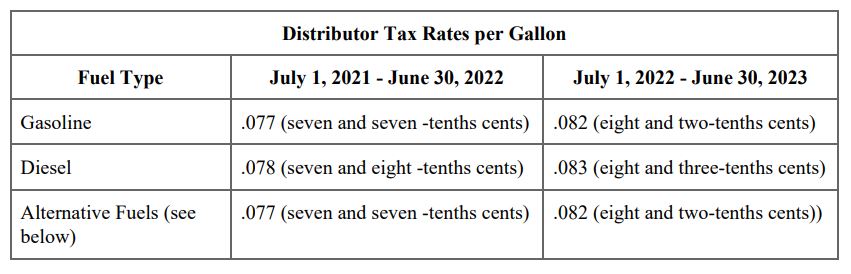
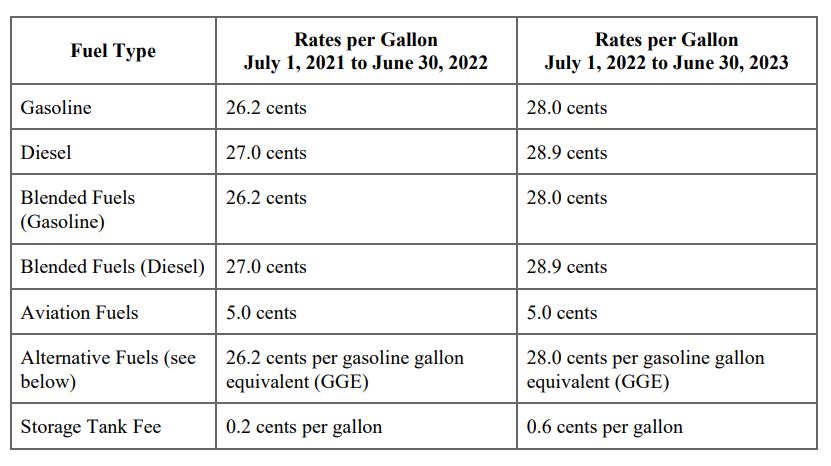
The new gasoline tax will be 28 cents retail, 8.2 cents wholesale plus another 0.6 cents per gallon to fund a program for removing old underground tanks safely. That’s a combined tax of 36.8 cents per gallon. The taxes on diesel will be 28.9 cents retail, 8.3 cents wholesale plus the same tank fee, a total of 37.8 cents per gallon.

Most of the attention on Youngkin’s proposal focused on his effort to suspend the retail (but not the wholesale or underground tank) portion of the tax for 90 days. But both his regular session bill and the version he offered as a late budget amendment also reduced the coming inflation adjustment, or indexing, of the tax as of July 1. The version rejected last week capped the increase at 2%, well below the current levels of inflation.

When opponents complained of major financial impacts from the change, they were really talking about the revenue that would disappear without the indexing provision, which will be cumulative over the years. Inflation and then compounded inflation are powerful revenue enhancers for government at all levels, a tax all by itself.

Many in the Assembly were reluctant to give it up, just as they refuse to index income tax provisions that would lower family tax bills (such as the standard deduction or tax brackets). Inflation is a wonderful thing if your goal is to collect ever more taxes.

The new gas tax numbers below were shared by the Virginia Petroleum and Convenience Marketing Association, which just notified its members and encouraged them to be sure customers got the word. The tax is actually collected from the wholesale distributors who bring the fuels to the gas stations and convenience stores, not imposed at the pump.

The tables reproduced in its announcement came from the Division of Motor Vehicles, which has nothing about this on its website yet.

New retail tax rates, provided by Virginia Petroleum and Convenience Marketers Association, citing Virginia DMV. Note: This table is in cent per gallon.

The wholesale tax rate, also provided by VPCMA, citing DMV. It puts the tax in dollars per gallon, moving the decimal two places to the left.

New retail tax rates, provided by Virginia Petroleum and Convenience Marketers Association, citing Virginia DMV. Note: This table is in cent per gallon.

Caption for Wholesale gas tax table: The wholesale tax rate, also provided by VPCMA, citing DMV. It puts the tax in dollars per gallon, moving the decimal two places to the left.

The DMV, up to its old tricks, is still playing games with the numbers. A chart on the retail tax is presented in cents per gallon, but the wholesale tax table is presented in dollars per gallon. That moves the decimal two places and makes it look like the wholesale tax is way smaller than the retail tax. The illusion is probably not an accident.

And it is probably not an accident that no effort is made inform motorists of the total tax, which has been a subject of deception for years now. Democrats playing these games was bad enough. It is time for the new Republican administration to direct DMV to come clean and clearly communicate the total tax hit.

The video record of last week’s votes indicates all 20 Senate Democrats present and one Republican voted to kill Youngkin’s amendment. Here is how the House voted, with a few Democrats supporting the Governor’s proposal.

Perhaps that smattering of House Democrats sensed that their party’s leader, President Joe Biden, was about to side with Youngkin and against the majority of Virginia’s Democratic legislators. Wednesday Biden came out for a 90-day gas tax holiday, and not just at the federal level. He pushed states to do the same. He was one week late to help Virginia motorists.

Ironically, at the federal level quite a few Republicans are pooh-poohing the idea using exactly the same rhetoric that Democrats employed in Richmond. Voter confusion is assured. But there is one difference: The federal tax is not and has never been indexed to increase annually for inflation.

Come the 2023 election season, because of the indexing provision, those nays on Youngkin’s proposal may be (correctly) portrayed as votes to raise the state gas tax in the middle of a gasoline price inflation storm. And the state tax will rise again next July 1, just before the election, unless a future Assembly changes that rule.

A version of this commentary originally appeared on June 22, 2022 in the online Bacon’s Rebellion. Stephen D. Haner is Senior Fellow with the Thomas Jefferson Institute for Public Policy. He may be reached at steve@thomasjeffersoninst.org.

Posted in Government Reform | Comments Off on The Increased Gas Taxes You Didn’t Know You Were Paying