
Most of $3.2 Billion State Surplus Already Spent

Share this article on:

Does last week’s glowing report on Virginia’s state tax collections presage additional tax relief for struggling families? The first question is, was the news really glowing?

Less than 18 months ago, in April 2021, the Virginia General Assembly and then Governor Ralph Northam (D) agreed upon a set of revenue assumptions and spending plans and adopted a budget for the coming two fiscal years. As of June 30 of this year, ending the first of those two years, tax revenues turned out to be $6.2 billion higher than that projection.

How much of that $6.2 billion is coming back to Virginia taxpayers? Less than 20 percent of it, about $1 billion, in rebates due in a few weeks. In reality, that $1 billion was pulled from the surplus from the prior fiscal year. The additional, unexpected $6.2 billion for Fiscal Year 2022 has been spent, will be spent, or is being parked in the state’s reserve funds to sustain future spending.
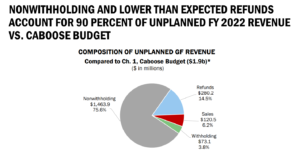
The massive explosion in state revenue has mainly resulted in additional state spending. Yes, the 2022 General Assembly agreed to several future tax reductions, reducing future revenues, but it did so assuming that the new, higher level of state spending would still be protected. If Virginians really want to pay less in taxes, slowing down the spending growth is the first goal.

Every August the legislators come to Richmond to hear the Governor, now Republican Glenn Youngkin, announce the financial results from the fiscal year just ended and outline plans for the coming months. The underlying data follows a set format, but each administration can change focus or emphasis and it can be interesting to see how things are packaged.

A key point to remember: This discussion focuses on the general fund, fed by state taxes. With one exception there is no mention of the non-general Fund side of the budget, which has exploded even faster due to grants and transfers from the various federal COVID packages and could be producing surpluses as well.

The April 2021 budget mentioned above was then adjusted by the 2022 General Assembly, which could see the revenue wave starting. Even that adjustment, approved just three months ago, proved to substantially underestimate tax revenues and transfers by $2 billion.

Governor Youngkin also revealed, and not all governors mention this, that another $1.2 billion allocated to the various agencies of government had not been spent by June 30. He added it to the unexpected revenue. From his prepared remarks on August 19:

But I am incredibly proud to share – and hope Virginians will be proud to hear – that our state government spent roughly $1.2 billion less than was appropriated by the General Assembly. And the combination of the roughly $2 billion in unplanned revenue and the $1.2 billion dollars of unspent appropriations resulted in a $3.2 billion dollar cash surplus at year end.

He then went on to explain, for those listening closely, that most of the surplus was already appropriated before he ever got to that podium. (You can read his prepared remarks here.)

The $1.2 billion the agencies didn’t spend is already reappropriated, “carried over” for the new fiscal year (one reason many governors don’t count that when they announce a “surplus”). Another $900 million is earmarked for the constitutional reserves. Almost $600 million will go to items the General Assembly approved contingent upon a surplus being achieved.

If that $600 million was spent in advance, should it even have been included in any claimed “surplus” or “unplanned revenue?”

A real surplus – what in the business world might be called free cash flow – is almost impossible. This is a situation legislators and governors from both parties have created. Legislation and constitutional provisions automatically earmark unexpected revenue. That is all the more reason Governor Youngkin’s decision to set aside $400 million for future tax relief is noteworthy. That might actually count as a real surplus, but the other $2.8 million is already gone.

Whether there is any additional tax relief next year will depend first on how the economy is faring six months from now, and there are signs in Secretary of Finance Stephen Cumming’s presentation (the slides are here) that inflation and the Federal Reserve’s efforts to crush it are dampening Virginia’s prospects.

Last year, when Governor Northam announced that general fund surplus, he also noted a large amount of extra revenue collected by the separate Commonwealth Transportation Fund. Not so this year. The state tax sources that fund the non-general fund transportation activities missed their most recent revenue projections by $32 million. Neither Governor Youngkin nor Secretary Cummings mentioned that shortfall, which is mainly due to lower fuel consumption, a possible recession signal.

Back on the general fund ledger, other tax sources which are economic bellwethers are stagnant. Recordation taxes went down in 2022 compared to 2021. One category of taxes on alcohol consumption shrank while another grew, but barely, at a rate far lower than inflation. The sales tax growth of 9 percent reflects mainly inflation, so good news for the state there is bad news for consumers looking at higher prices (which also hit government, remember.)

The categories where revenue has exploded beyond expectations include the corporate income tax (up 110 percent in three years) and those elements of the personal income tax where business income is reported and taxed for individuals. Business owners, including investors, do not have tax withheld on income but make quarterly payments. Those non-withholding collections were up 71 percent between 2019 and 2022.

Secretary Cummings reported that of the final $1.9 billion spurt of unexpected tax revenue in the most recent months, 75 percent was due to non-withholding payments. Another 15 percent was due to smaller refunds being paid on previous years’ taxes, and those refunds also tend to be larger with the non-withholding taxpayers.

Non-withholding revenue, refunds and corporate income taxes are the most sensitive to the business climate, the most likely to actually take a dive in a recession, and the most likely to be trimmed if the recent Congressional tax increases tighten business profits.

One good thing about unexpected revenue is that it is unexpected. Therefore it is not baked into the next year’s revenue assumptions, creating a new floor. Yes, the 2022 General Assembly pre-spent $600 million of it, but on one-time expenses, not base budget items. The fiscal year we are in now, which ends June 30, 2023, assumes basically the same level of General Fund revenue $24.8 billion) as was collected in Fiscal Year 2021.

The current politically divided General Assembly will only consider additional tax relief if the revenue needed for the spending side is assured, probably with a healthy adjustment for additional inflation. That will come first, and a realistic assessment of the state’s business climate indicates even that could be a challenge.
Posted in Economy, State Government | Comments Off on Most of $3.2 Billion State Surplus Already Spent

SCC Approves Dominion Wind Project, Cites “Will of the General Assembly”

Share this article on:

Rejecting an agreement that its own staff reached with Dominion Energy Virginia, the State Corporation Commission has imposed at least some level of financial risk on the utility’s shareholders should its $10 billion offshore wind project fail to match the company’s promised performance.

Lest you think that means the ratepayers can relax, the long final order issued August 5 once again highlights all the things that could go wrong with the Coastal Virginia Offshore Wind (CVOW), scheduled to fully operational by 2027.  The regulators also wash their hands of any responsibility and record for posterity that the Virginia General Assembly made them approve this.

The project, which still faces federal reviews, but which is beloved of the Biden Administration, calls for 176 turbines and three substations to be constructed 27 miles off Virginia Beach.  Generated electricity will then come ashore, and 17 miles of major transmission upgrades will be built to feed it into the grid.  The nameplate value is almost 2,600 megawatts but that is misleading, as the company is only promising a 42% capacity factor – less than 1,100 megawatt of average output over time.

As previously discussed, several parties to the case urged the commission to convert that promised 42% capacity factor into a firm commitment, with possible financial penalties.  The idea was fleshed out by an expert witness retained by Attorney General Jason Miyares (R), who cited a previous Virginia case where a performance requirement was imposed on a Dominion solar deal and similar agreements in other states dealing with onshore wind.

Miyares and other parties, including environmental advocates otherwise very supportive of wind energy, refused to join a stipulation between Dominion and the SCC’s own technical staff in part because it lacked such a performance agreement.  Before abandoning the idea in the stipulation, the staff had also called for a performance agreement, but at a much lower (and easier to meet) 37% capacity factor.

The Commission’s rejection of that stipulation is the secondary headline here.  It also ignored the staff’s stipulation and imposed more stringent notice requirements – 30 days – if the utility faces construction or other problems that are going to raise the ultimate cost to consumers.

In its own media release on the decision, Dominion noted it is evaluating the performance agreement and that the order “does not outline the details surrounding that requirement.”  Everybody is being very cagey so far, but a motion for reconsideration might follow, and the utility has a right to appeal to the Supreme Court of Virginia.

Here is what the order does say about the performance standard:

“Specifically, beginning with commercial operation and extending for the life of the Project, customers shall be held harmless for any shortfall in energy production below an annual net capacity factor of 42%, as measured on a three-year rolling average.  As noted by the parties requesting such, this performance standard does not prevent the Company from collecting its reasonably and prudently incurred costs. Rather, it protects consumers from the risk of additional costs for procuring replacement energy if the average 42% net capacity factor upon which the Company bases this Project is not met.

“Dominion, nonetheless, asserts that it would be inappropriate for the Company to be put at risk if it fails to meet the capacity factor upon which it has justified and supported this Project. We disagree.”

“Additional costs for procuring replacement energy” is the operative phrase.  If a few years from now the facility is operating at 35-40% capacity, and the rest of Dominion’s system is chugging along, there likely will not be substantial “additional costs,” if any.  On the other hand, a catastrophic failure bringing a three-year period down to minimal or no output, and Dominion could be on the regional market buying quite a bit of very expensive “replacement energy.”

Before this does much good for consumers, there will be more courtroom disputes, more high-fee expert accountants and witnesses and tap dancing lawyers, and even appeals.  This never gets simpler.

The decision creates yet another stand-alone rate adjustment clause on Dominion bills, this one to be Rider OSW.  It should appear in September and start to grow in the next few years, peaking at more than $14 per 1,000 kilowatt hours of usage in 2027.  Then it tapers off but remains for decades. Many moving and unpredictable parts will determine the future charge to customers, as discussed here.

Assuming it qualifies for the massive federal tax credits, only a portion (about $7.4 billion) of the initial capital cost will be paid by customers.  However the order warns:

“To be clear, total Project costs, including financing costs, less investment tax credits, are estimated to be approximately $21.5 billion on a Virginia-jurisdictional basis, assuming such costs are reasonable and prudent. And all of these costs, not just $7.38 billion, will find their way into ratepayers’ electric bills in some manner.” (Emphasis added.)

Only two of the three seats on the Commission are filled, by former Virginia Attorney General Judith Jagdmann and former Federal Energy Regulatory Commission staffer Jehmal Hudson.  As she has done before, Judge Jagdmann added her own thoughts in a concurrence, focusing again on how the Commission’s hands were tied by the General Assembly’s actions.  Beginning on page 40 of the order she wrote:

“…the statute clearly establishes that this Project represents the will of the General Assembly. Almost four years ago, this Commission approved Dominion’s Coastal Virginia Offshore Wind demonstration project, which consists of two 6 MW wind turbine generators located approximately 24 nautical miles off the coast of Virginia Beach. approving that project, which was estimated to cost approximately $300 million (excluding financing costs), the Commission – noting the high cost per MWh and the risk being placed on ratepayers- expressly found that such approval did not foreclose rejection of future projects (such as the instant one) if the Commission found the project to be imprudent.

“Thus, it is instructive that in subsequently enacting legislation for this Project, the General Assembly expressly set forth particular circumstances under which costs for such project must be presumed to be reasonable and prudent.”

She calls on the General Assembly to revisit the project, which will take years to build and many more years to pay for, “to determine if additional steps are warranted to reduce the economic burden that will be placed on Dominion’s customers as the Project proceeds.”  Perhaps some General Fund cash could be applied, or the proceeds from the “consumer-funded” Regional Greenhouse Gas Initiative, she suggests.

The order and Jadgmann’s additional comment also focus on how the risk is being placed entirely on captive ratepayers, something else the Assembly could revisit and change, if not for this project, then for any future one.  They could insist Dominion do what other states are doing, letting non-utility firms actually build and own the turbines and sign power purchase deals with utilities.

It will matter.  Dominion’s published plans have called for a second tranche of turbines next door to this project, and the Biden Administration and Congressional Democrats are now placing most of their energy eggs and financial incentives in the offshore wind basket.

Posted in Energy | Comments Off on SCC Approves Dominion Wind Project, Cites “Will of the General Assembly”

No MVP in this Trading Deal?

Share this article on:

And now, from our “I’ll believe it when I see it” department, comes the expectation that passage of President Joe Biden’s new corporate tax hike and green energy incentives package will be followed by a smooth path to completion for the Mountain Valley Pipeline (MVP) for natural gas.

The topic is everywhere today because Senator Joe Manchin, D-W.Va., included it as a deal point on a summary of what he sees as agreed outcomes from his decision to support the package. But the massive bill does not (and could not) include blanket approval of the pipeline among its provisions.

Instead, there is reportedly a side agreement, and future legislation and administrative actions are expected to smooth federal permitting processes for energy projects, including the fossil fuel projects hated by the climate- catastrophe priesthood. A key element would remove the Fourth Circuit Court of Appeals from hearing the multitude of pipeline lawsuits and move them to the District of Columbia Court of Appeals.

The 303-mile pipeline stretching from gas fields in West Virginia to Chatham, Virginia, where it ties into an existing natural gas trunk line, is largely complete but is still fighting for permits to cross various wetlands and federal properties. Already about four years behind schedule, the developers are asking for another four years to get the job done.

The Wall Street Journal editorial page is skeptical that any such deal will hold once Manchin has actually voted to pass the tax hike and tax credit package, which as a budget reconciliation bill is exempt from the filibuster rules. The editors wrote:

What’s needed is a wholesale reform of environmental laws that fossil-fuel opponents have weaponized. Perhaps they should be forced to pay the costs of their obstruction if project developers prevail, as two pipelines did at the Supreme Court in recent years only to be scrapped by investors amid more lawsuits. The incentives have to change.

Will Democrats agree to legislation that stops their allies’ legal barrage against fossil fuels? Unless they do, Mr. Manchin’s reforms will do as much to save fossil fuels as the League of Nations did to stop World War II.

A second bill dealing with energy regulation would be subject to filibuster, thus needing at least ten Democratic votes along with the 50 Republican votes to pass the Senate. Then there is the House, where Democrats hold a stronger majority and may not dare to inflame the environmentalist voters before the November mid-terms.

As a report in today’s Virginia Mercury makes clear, those who believe natural gas is satanic are struggling to balance their hatred for the MVP project with their lust for the huge tax incentives baked into the bill for future renewable energy projects. But some have taken a strong stance:

“We firmly oppose any approach by Congress that sacrifices frontline communities as part of a political bargain,” said Jessica Sims, Virginia field coordinator for environmental and economic development nonprofit Appalachian Voices, in a statement. The group’s North Carolina field coordinator, Ridge Graham, called any legislation requiring completion of Mountain Valley “unacceptable.” 

Mercury also reports that Virginia Democratic Senator Tim Kaine is open to new legislation on federal permitting, but it includes no information on how he would feel about the deal Manchin is seeking to immediately smooth the MVP’s current path. Even in this current world-wide energy crisis, Kaine is still questioning whether there was or is any need for the pipeline.

Dwayne Yancey at Cardinal News, its region at the heart of the controversy, seems to accept that the deal is done, that Manchin has succeeded in getting the “Biden administration and top congressional Democrats to back the pipeline.” Yancey is into the political side of the story, the trade-offs, but doesn’t see much benefit to Virginia if the MVP is completed.

His column is clearly an effort to sell the deal to MVP opponents. He starts with an early premise that President Biden is not really an opponent of the “fracking” drilling techniques to release massively more natural gas from the ground and seems to blame Biden’s wishy-washy stance as a reason he almost lost. He sees his region as being sacrificed. He writes:

It’s easier to make tough deals involving somebody else’s sacrifice. Would Schumer have been so keen for this deal if the Mountain Valley Pipeline ran through New York? Would Pelosi have gone along if it went through San Francisco? Probably not, right? It’s a lot easier for those at the national level to be more dispassionate about the deal than those who are closer to the actual pipeline. The Washington Post quoted some on the left who seemed OK with the Mountain Valley-Pipeline-for-Manchin’s vote deal. “We must pass the Inflation Reduction Act if we want to get on track to cutting carbon pollution in half by a decade,” said one California-based energy expert. “Without this legislation we don’t have a pathway to get there; with it, we have a fighting chance….”

There is no fighting chance. Carbon emissions will not, repeat not, be cut in half in our lifetimes, let alone a decade. This coming winter will demonstrate to all that reliance on wind and solar will doom a modern economy to failure unless Putin the Merciless relents and turns on the natural gas taps for Europe. More wind and solar will indeed be built in the U.S. if this bill passes, more electric vehicles sold, but despite the sugar high of the taxpayer-financed subsidies, there will still be days when the sun doesn’t shine, the wind doesn’t blow, and those of us with gas furnaces, propane grills and internal combustion vehicles sigh with relief.

As to getting the Biden Administration or Virginia’s key Democrats to back the Mountain Valley Pipeline, I’ll believe that when I see it. Manchin better get that vote on the board first.

A version of this commentary originally appeared August 3, 2022 in the online Bacon’s Rebellion.  Steve Haner is Senior Fellow with the Thomas Jefferson Institute for Public Policy.  He may be reached at Steve@thomasjeffersoninst.org.

Posted in Energy, Government Reform, Taxes | Comments Off on No MVP in this Trading Deal?

Solar installations hasten loss of Virginia farmland

Share this article on:

Virginia lost about 2,000 acres of productive farmland per week in 2021, according to data released in February by the U.S. Department of Agriculture.  There are many reasons why farmers sell off their land, including development pressures, lack of interest by younger members of farming families, and the difficulties of turning a profit in the face of ever-changing market and weather conditions.

But there is now a new threat to Virginia’s agricultural base, which has a $70 billion economic impact on the commonwealth annually, according to the Virginia Farm Bureau.

In 2015, there were no utility-sized solar “farms” in Virginia. Now there are 44, with more on the drawing boards.

That’s because in­­ 2020, the Virginia General Assembly passed, and then Gov. Ralph Northam signed, the Virginia Clean Economy Act, which requires the two largest electric utilities in the state, Dominion Energy and Appalachian Power, to become “carbon free” by 2045 and 2050 respectively. The law sparked a flurry of multi-million-dollar investments in solar installations throughout the commonwealth.

But has this rapid rush to install solar panels on thousands of acres of Virginia countryside been wise, given the fact that Virginia’s population is growing, solar facilities require a huge amount of rural land that could be used for agriculture, and due to a variety of factors including drought,  military incursions overseas and supply chain failures, even President Joe Biden has said that the United States is now facing a potential food shortage?

Only three states had more solar energy installations than Virginia in 2021, according to Bill Shobe, energy economist at the University of Virginia. But it’s still a fraction of the total electricity used by Virginians.

According to the U.S. Energy Information Administration, as of January 2022, natural gas accounted for nearly half (48 percent) of all utility-scale electricity generation in Virginia, followed by nuclear (33 percent), coal (10 percent) and renewables (8 percent) – of which solar accounted for only 4 percent. So the real-life effects of a massive switch to solar energy has yet to be felt by most Virginians living in urban and suburban areas.

But rural Virginians are already seeing the effects of allowing industrial-size solar “farms” to replace real farms.

Not surprisingly, the vast majority of these new solar installations are being built in rural communities, particularly in Southside and Central Virginia where land is more plentiful than money and local public officials often struggle to pay the bills.

According to the Virginia Solar Initiative, a statewide survey released in April by U.Va.’s Weldon Cooper Center and the Virginia Department of Energy,  51 local governmental authorities have been approached for permission to erect large-scale solar installations in their jurisdictions, and 44 have already approved such applications.

The latest was the Charlotte County Board of Supervisors’ approval in July of a conditional use permit to allow a gigantic 877-megawatt solar installation to be erected on 21,000 acres, which will be one of the largest such facilities east of the Mississippi River. Dominion Energy, which plans on purchasing the solar farm from Reston-based Randolph Solar after it’s built, sweetened the deal by promising the county that it would accelerate its $1 million payment for a previously approved solar project.

A 1,330-acre solar “farm” got the green light in King William County, as did a smaller 268-acre solar facility approved by the Henry County Board of Zoning Appeals.

Rural officials are being courted by solar developers, many from out of state, who offer financial incentives if they vote for special use permits to allow these industrial facilities to be built on land zoned for agriculture. In fact, one of the Virgina Solar Initiative survey participants wrote that local leaders “are keenly aware that solar energy production is highly land-consumptive and that solar energy providers want the lower cost farmland with no development improvements” – in other words, land that is already producing food or could quickly be converted to crop production.

“Once the facility is built, it’s paying into the tax base without making any substantial demands on local services,” Shobe told Virginia Public Radio. “For localities rich in land resources, this can be a very substantial contribution.”

But when local officials focus on the short-term financial benefits without thinking about the future ramifications of allowing these industrial power plants on land that is supposed to be reserved for agriculture, they may be trading one form of environmental degradation for another.

For example, Dr. Rattan Lal, Distinguished Professor of Soil Science at Ohio State University, points out that soil sequesters more than three times the amount of carbon locked in all the plants and animals on Earth. Yet construction and maintenance of industrial-size solar facilities prevents the natural process of soil replenishment from occurring.

And as the Essex County Conservation Alliance points out, “farmland lost is farmland lost forever.”

So ironically, the legislature’s requirement that the largest utilities in Virginia become “carbon free” in less than 25 years means that there will be a lot more carbon-sequestering farmland lost in the commonwealth.

How much? Solar farms require as much as six to eight acres to produce just one megawatt of electricity. Up to 104,000 acres of forest/farmland would have to be sheathed in solar panels made of glass and highly toxic metals like lead and cadmium telluride to produce about 13,000 megawatts of electricity.  And that’s only when the sun shines.

Soil degradation is not the only problem. Denuded landscape is more prone to erosion, meaning that nutrients are more likely to be washed into the watershed and wind up in Chesapeake Bay, which the commonwealth is already spending millions of dollars to prevent. In March, the Virginia Department of Environmental Quality announced that starting in 2025, solar panels would be considered “unconnected impervious areas when performing post-development water quality calculations” of stormwater runoff, which will likely increase the cost of these installations.

Earlier this year, Gov. Glenn Youngkin signed  House Bill 206, which says that if the DEQ finds a potential “significant adverse impact on wildlife, historic resources, prime agricultural soils, or forest lands,” the solar facility in question would be required to submit a mitigation plan for public comment. The bill states that disturbing more than 10 acres of prime agricultural land, 50 acres of contiguous forest, and registered forest land automatically requires a mitigation plan.

These mitigation efforts will raise the price of solar-generated power for Virginia consumers even though the cost of the solar panels themselves, most of which are now made in China, have come down in recent years.

Michael Shellenberger, author of “Apocalypse Never,” told the Thomas Jefferson Institute’s Virginia Energy Consumer Conference last October that solar panels are cheaper now due to multi-billion-dollar subsidies by the Chinese government, which uses dirty coal and forced labor to produce them. He also noted that “there is no plan” to deal with the huge amount of hazardous waste from obsolete solar panels once they have reached the end of their 15-to-25-year life span.

That means that some solar farms erected in Virginia in 2021 will start becoming hazardous waste sites in 2036, even before the Virginia Clean Economy Act’s “carbon free” mandates kick in.

“Once you deal with the cost of the waste, electricity from solar ends up being four times higher than they had anticipated,” Shellenberger, TIME Magazine’s 2008 “Hero of the Environment, pointed out. “I changed my mind about renewables when I understood that they require significantly more land,” he added. “Princeton University just confirmed about 300 times more land on average to generate the same amount of electricity from a wind farm or a solar farm as from a natural gas or nuclear plant.”

Thanks to the General Assembly, Virginia is on track to lose a massive amount of food-growing and carbon-sequestering farmland for an inefficient and intermittent technology that could quadruple electricity prices and create thousands of acres of toxic waste.

Local officials who are thinking about approving special use permits to allow more industrial-sized solar facilities to be built on agricultural land in their jurisdictions owe it to their constituents to tally up all of the potential future costs – especially the loss of irreplaceable farmland – as well as the benefits before signing off on this supposedly “free” form of energy production.

Posted in Agriculture, Energy, Environment | Comments Off on Solar installations hasten loss of Virginia farmland

Five Reasons To Reject Offshore Wind Project (The video shows Number Five)

Share this article on:

Researchers at the University of Virginia are part of an ongoing effort to redesign wind turbines to be both more efficient and better protected from storm-scale winds, as described in this video you can find on a university website.

What is the problem to be addressed? Says one of the engineers:

As you get these larger wind turbines, your blades end up becoming more flexible and if you’re upwind then when the wind comes in and hits those blades, they can curve backwards and then it can hit that tower and destroy the entire turbine.

You can see an example of that happening on the video. It is not just theory.

So, great idea.  Hurricane resistant turbines with flexible blades facing downwind. Is that what Dominion Energy Virginia is about to build off Virginia’s shores, the cost billed entirely to its captive ratepayers?  Well, no, actually.  It is the old design.  But no problem – it won’t cost the company any money if a storm replicates that damage you see in that video. We customers will pay.

Dominion Energy Virginia’s Coastal Virginia Offshore Wind project is an epic mistake for Virginia.  Yet thanks to the Virginia General Assembly the regulators at the State Corporation Commission are most likely going to approve it because the Assembly stripped them of their traditional oversight role with the 2020 Virginia Clean Economy Act (VCEA).  Virginia’s Republican governor appears to be among the cheerleaders.

The wind project’s application process and subsequent review have developed a large amount of information about the project, but little news coverage, so most Virginians remain clueless about what is coming.   Here are five reasons why the SCC should say no:

First and foremost is the secrecy.  Despite some efforts by Attorney General Jason Miyares, creating a bit more transparency, pages and pages of data – entire reports even – remain under seal and visible only to those who have sworn secrecy.  The data covers known and possible risks that could throw the project off schedule or even cause catastrophic failure.  It also covers some of the economic analysis, leaving outsiders to decide whether to trust the rosy projections from the utility.

What are they hiding?  Does it include discussions of the risk demonstrated on the video?

Second is the ownership structure.  One fact that is on the record is that no other offshore wind project proposed so far in the United States is 100 percent owned by a vertically integrated monopoly with captive ratepayers.  If any of those known or unknown risks kick in the added cost flows down to the 2.5 million Dominion customer accounts in this state.

It could have been a third party building the plant and signing a contract to sell power to the utility.  Then the third party carries the risk of losing revenue if the plant fails to operate as proposed.  There is a similar set up where the utility subsidizes the privately-owned plant by promising to buy the renewable energy credits rather than the electricity, again shedding risk.  Dominion opted for placing the full risk on its ratepayers.

Third, the power isn’t needed, not now and not for decades.  In a wonderfully circular argument, the plant is needed to comply with the 2020 VCEA law, which of course was conceived and written by Dominion’s lawyers and lobbyists.  Eventually, VCEA will force closure of Dominion’s very efficient natural gas generators.  It will make the gas facilities less economically efficient in the meantime, but with them and no turbines Virginia would have plenty of generation available.

The dirty secret on wind and solar is they only work sometimes, but we need power always.  Without the natural gas backup, Dominion cannot meet its load on cloudy, windless days.  Missing from all the current equations are billions of dollars needed for gigawatts of battery backup if the gas plants close.  Which leads to:

Fourth is the cost.  The General Assembly bought the bogus argument that the plant would be “reasonable and prudent” if it only cost 40 percent more than the least efficient kind of natural gas plant, a peaking plant that runs almost never.  If Dominion needs more generation, solar and onshore wind facilities would provide power for less money.   Another gas plant would be better still, but the VCEA stands in the way of that option.

The SCC staff examined and costed out several ways that the advertised construction cost of almost $10 billion could prove too low or the 2027 scheduled completion could be delayed.  Any combination of them would explode Dominion’s future rates.  The SCC staff also raised the specter of the missing battery backup and that related cost.

That is the fifth reason, the prospect of failure, the operational risk.  Dominion is claiming that the 176 turbines will really put out only 40 percent of their advertised 2,600 megawatts.  Even that depends on only minimal maintenance stops and 25 years of perfect operation.  The harsh ocean environment may quickly degrade the efficiency of the machines and the 40 percent capacity factor promise will then fade into history.  A category five hurricane could destroy it in a day (see video above for how.)

Notice that not even mentioned are the likely issues that will arise when time comes to remove the rusted out towers and miles of cable, the impact the project may have on endangered right whales or sea birds, or the major transmission lines that will crisscross Hampton Roads to connect all this.  Litigation could delay the project (at ratepayer expense).

The case to reject this project is overwhelming, which is why the General Assembly made rejecting it impossible.

Posted in Energy, Government Reform | Comments Off on Five Reasons To Reject Offshore Wind Project (The video shows Number Five)