
Richmond’s unfinished business: tax indexing

Share this article on:

Most Virginians are painfully aware ­­­­that it’s becoming much more difficult to make ends meet. Prices for fo­­­­od, housing, gasoline and other necessities have soared. Inflation hit a 40-year high of 9.1 percent in June, the largest yearly increase since January 1982. And a recent study from the University of Iowa found that a typical American had to pay $669 more for basic living expenses than they did just two years ago.

All while the Commonwealth of Virginia was pocketing $2 billion in “surplus” revenue that was not anticipated and therefore not included in the two-year $165 billion state budget the General Assembly passed earlier this year. Most of that windfall was the result of the Federal Reserve’s monetary inflation, which made the prices of consumer staples soar because there was suddenly a lot more dollars chasing the same amount of goods and services. But inflation had another unwelcome effect. It also pushed Virginia taxpayers into higher tax brackets despite the fact that their actual living standards went down, not up.

Governor Glenn Youngkin wants to set aside $400 million for tax relief in his revised budget, which he will present to the state legislature in December. But that’s less than a quarter of the total surplus. The budget signed by Youngkin also includes $450 million to pay for potential cost overruns on the commonwealth’s capital projects due to … you guessed it …. inflation.

No additional money was set aside to cover transportation overruns, although that may be coming. Referring to the higher material and fuel costs faced by road construction companies, Virginia Transportation Secretary Shep Miller said that “we don’t want anybody to get crushed here through this inflationary process.”

That same logic should apply to taxpayers being pushed into higher tax brackets due to the same inflationary process. It’s called “bracket creep,” and it has the same effect as a tax hike – without lawmakers actually having to vote for one.

The commonwealth has four graduated-rate individual income tax brackets, with the lowest marginal rate of 2 percent and the highest of 5.75 percent as of January, according to the nonprofit Tax Foundation. The top bracket is triggered at $17,000, so all but the lowest income earners pay the highest rate.

Virginia is one of 13 states that have not indexed their state income taxes for inflation. And unlike other states, the commonwealth does not adjust standard deductions or personal exemptions for inflation either.

“The absence or insufficiency of cost-of-living adjustments in many state tax codes is always an issue, as it constitutes an unlegislated tax increase every year, cutting into wage growth and reducing return on investment. During a period of higher inflation, however, the impact is particularly significant,” according to Jared Walczak, vice president of state projects at the Tax Foundation.

The easy cure for this problem is indexing, which is simply adjusting state tax rates to account for inflation. Indexing is not rocket science. Under indexing, standard deductions and tax brackets rise in conjunction with the Consumer Price Index so that taxpayers are not forced to pay more taxes in addition to inflated prices for goods and services. It’s the same idea behind the Social Security Administration’s cost-of-living adjustment (COLA) to the monthly checks it sends to retirees, blunting the impact of the hidden tax of inflation on people living on a fixed income.

Indexing is also an issue of equity. According to the nonpartisan Institute on Taxation and Economic Policy, “the long-term effect [of inflation] can be a substantial tax hike – and one that falls hardest on low- and middle-income taxpayers.”

But the Gener.al Assembly balks whenever indexing is considered even though bracket creep forces Virginias to pay higher taxes without any corresponding increase in their standard of living. This makes taxpayers poorer and the commonwealth richer.

The 2022 General Assembly did pass a number of new tax laws, which went into effect on July 1, including a reduction of the sales tax on groceries, an increase in the standard deduction for state income tax filers if certain revenue targets are met, and a one-time income tax rebate ($250 for single filers and $500 for couples filing joint returns).

But the legislature fell short of indexing state income taxes to account for the inflation that is currently ravaging the economy. This means that bracket creep will increase state income taxes automatically, without members of the General Assembly actually voting for it, which is apparently just fine with them. Politicians love having more of other people’s money to spend without the political liability of voting for a tax increase.

But it’s not fine for Virginians hit with a double whammy, watching their state income taxes rise just as the buying power of that same income declines.

Youngkin knows this. “We have been overtaxing Virginians,” the governor noted in an interview with Yahoo!Finance, calling inflation “the silent thief.” But the $4 billion in tax relief Youngkin included in the state budget that went into effect on July 1 does not address bracket creep, thus allowing the “silent thief” to continue to prey on Virginia taxpayers.

Indexing state income taxes to account for inflation to prevent this recurring, non-legislated tax hike is common sense tax reform that the Thomas Jefferson Institute has long urged our leaders in Richmond to enact. With the cost of everything rising faster than most Virginians’ income, voters should demand that both the governor and members of the General Assembly take care of this unfinished business.
Posted in Government Reform, Taxes | Comments Off on Richmond’s unfinished business: tax indexing

Jefferson Institute Legal Analysis: Performance Standard for Offshore Wind Farm is Proper

Share this article on:

Despite Dominion Energy Virginia’s complaints that the Virginia State Corporation Commission has exceeded its authority, a legal analysis provided by the Thomas Jefferson Institute for Public Policy finds that the SCC’s proposed performance standard for an offshore wind project is proper.

The analysis was provided by Institute Senior Fellow Dr. David W. Schnare, an attorney and scientist with long regulatory and litigation experience.

The SCC has approved Dominion’s application for permission to build the $10 billion, 176-turbine Coastal Virginia Offshore Wind project but added a condition the utility is opposing. It would protect the utility’s customers from paying any additional costs that result from the project failing to meet is promised power output. The target would be an average capacity factor of 42% over three year periods.

Dominion has asked the SCC to reconsider the performance standard and potential financial penalty, and the SCC is accepting additional legal briefs from the parties to the case. Virginia Attorney General Jason Miyares (R) and several environmental organizations proposed the performance standard which the Commission adopted, which was more stringent than its own staff had proposed.

Comments from other interested parties are also being accepted into the record. The author of these comments from the Suburban Virginia Republican Coalition, Collister Johnson, is also an attorney but his document is not in a legal format.

The Virginia General Assembly passed legislation in 2020 that was intended to spur construction of the project and directed the SCC to find it “reasonable and prudent” if the cost was no higher than a specific levelized cost of energy (see here, paragraph C.1.) Only one of the three conditions set by the Assembly in that provision involved the cost of the project or of the energy it produces.

In his submission for the Thomas Jefferson Institute, Schnare writes:

…the Commission retains the authority to balance the risks and may do so through the lens of some form of a performance guarantee. When its investors, through filings of VEPCO, make the claim that the average annual turbine availability of the Project will equal or exceed 97% or the Project’s net capacity factor will exceed 37% on a three-year rolling average basis, they establish an expectation that the costs associated with meeting those performance levels are both reasonable and prudent…

Nothing in 1:11 C.1 limits the SCC from considering additional, rational, conditions when determining whether the cost recovery request is “otherwise” unreasonable and imprudent.

In its Final Order, the Commission found that “[t]he lifetime revenue requirement and levelized cost of energy estimates presented by the Company are based on a projection that CVOW, once in operation, will achieve a net 42% capacity factor.”[i] (Emphasis added.) Indeed, VEPCO does not retreat from its expectation that the Project will achieve an average annual net capacity factor of 42% over the 30-year life of the Project.”[ii] (Emphasis in the original.)

VEPCO wants the Commission to ignore the predictions it made, ignore the duty to base its “just and reasonable” determination on what can “reasonably be predicted to occur,” and instead adopt an agreement (stipulation) made by some, but not all interested parties, and by no one representing the customers.

Thus Schnare noted, as the Commission did, that the levelized cost of energy and the ongoing capacity factor of the project are basically measuring the same thing. It was the General Assembly that determined the levelized cost of energy represents the demarcation line between reasonable and unreasonable cost.

The ongoing capacity factor is only one element in calculating an ongoing levelized cost of energy, but it is the main one. Most of the other elements are the upfront construction costs and the maintenance costs over time, and any tax credits the utility reaps. The capacity factor, which will be dependent mainly upon the weather and long term reliability of the turbines, is the big variable, unknown looking out 30 years.

And Schnare certainly knows his business. An attorney and scientist with 33 years of federal and private sector experience, he was formerly the nation’s chief regulatory analyst for the Small Business Administration’s Office of Advocacy, with experience on Congressional staff, as a trial lawyer with the Department of Justice and the Office of the Virginia Attorney General, and as senior enforcement counsel at the U.S. Environmental Protection Agency.

Although Schnare did not say so, we believe if the utility would prefer to calculate and certify the entire levelized cost of energy every three years and make up the difference if the entire LCOE falls below the statutory target, the SCC could consider doing it that way instead.

Stephen D. Haner is Senior Fellow with the Thomas Jefferson Institute for Public Policy. He may be reached at steve@thomasjeffersoninst.org.

Posted in Energy, Government Reform | Comments Off on Jefferson Institute Legal Analysis: Performance Standard for Offshore Wind Farm is Proper

Consequences of The Quest for Zero Carbon

Share this article on:

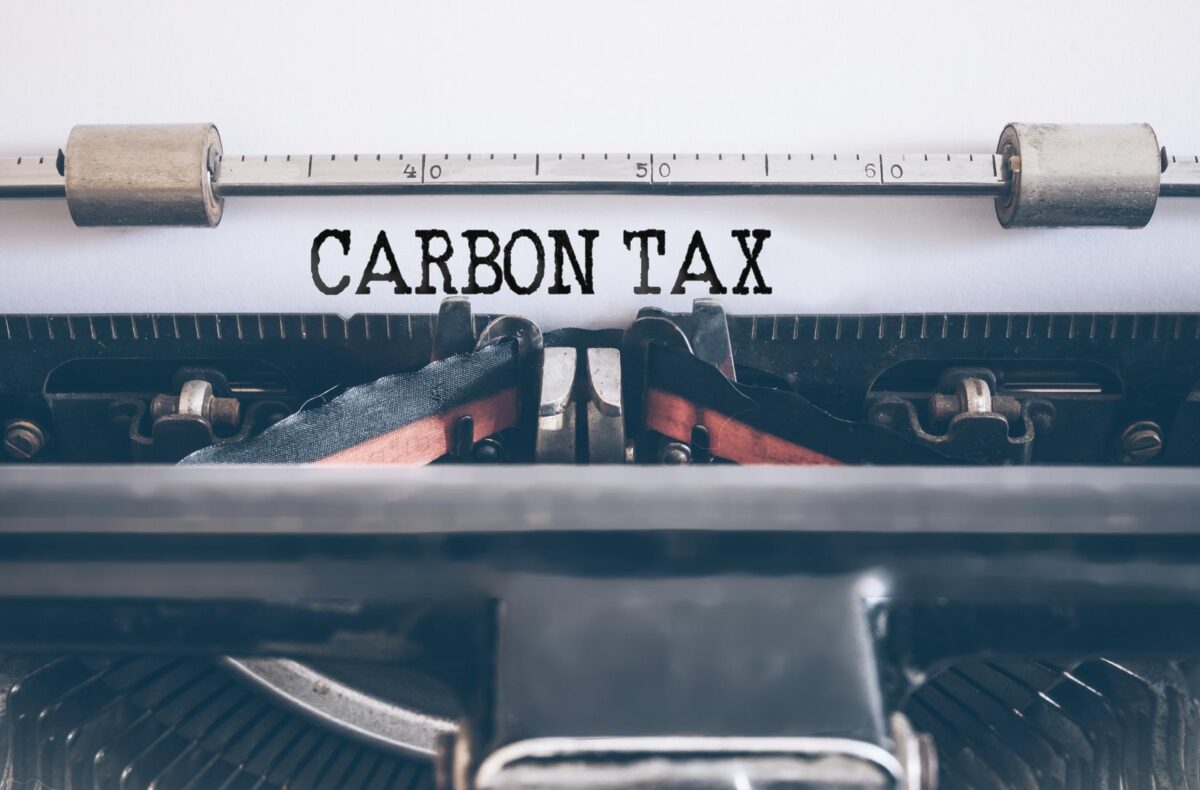
close-up of words CARBON TAX written on vintage typewriter

Virginians may be finally waking up to the consequences of the headlong rush to adopt utopian energy policies under our previous governor. The issues are getting more attention than ever before, and now people need to realize all the issues are really just one issue.

  • A California regulatory board’s decision to ban new gasoline vehicle sales by 2035 is finally being widely reported as binding on Virginia. This has angered many but was actually old news.  Under a 2021 Virginia law, our Air Pollution Control Board had already imposed the future sales restrictions, and it was some new amendments that sparked the news coverage.   Various political leaders have now promised to stop it but a bill to reverse it died in the 2022 General Assembly when Democrats rallied to save the mandate.
  • Our dominant electric utility has finally acknowledged that its planned $10 billion offshore wind facility is a gigantic financial risk and is now refusing to build it unless the State Corporation Commission (SCC) places 100 percent of the construction and performance risk on its customers.  Dominion Energy Virginia knows many things about this proposal it has not told us.
  • Governor Glenn Youngkin (R) is trying to remove Virginia from an interstate compact that mandates a carbon tax on electricity, imposed under former Governor Ralph Northam (D).  Advocates for the tax are pushing back and will fight, delay and likely sue to preserve the tax, which costs Virginians $300 million per year at current levels and will continue to rise.  Without explanation, the Governor did not keep his initial promise to promulgate an emergency regulation that could remove it quickly, so the tax lingers.
  • Governor Youngkin has opened the process for developing a revised statewide energy plan document, a political process to produce what in the past has been merely a political document.  The public comment portal has already become an ideological showcase. Northam’s 2018 plan had no engineering or economic detail.  It simply praised the legislative efforts to erase fossil fuels which had been adopted to that point and outlined the next steps his administration would take (couched as recommendations.)

Legislation also signed by Northam demands that the Youngkin plan now address far more issues in that plan than Virginia has addressed to date, issues not raised in the 2018 document.   He is required to produce a plan:

that identifies actions over a 10-year period…to achieve, no later than 2045, a net-zero carbon energy economy for all sectors, including the electricity, transportation, building, agricultural, and industrial sectors.

That instruction is not highlighted on the website about the new planning process, which merely mentions “environmental stewardship.”  Yet if the plan fails to chase net-zero to the satisfaction of those who claim carbon dioxide is an existential threat (rather than just plant food), expect additional litigation. 

That state law is the common thread running through all pending issues, and also wraps around the rising energy prices for your home and car and business. 

The Virginia General Assembly, during the short period of total Democratic control, voted narrowly to bind the state to California’s aggressive effort to remove gasoline and diesel vehicles.  It did so in line with that overarching policy imposed by the code, and that mandate is what needs to be examined, debated and considered for repeal along with the auto regulations. The Virginia General Assembly, during that same short period, voted to require Dominion to propose the offshore wind installation, a risky expense that would never be considered reasonable and prudent otherwise, as the SCC itself has implied.  Again, the justification is compliance with that net-zero policy demand, based on claims that failure to act is a path toward some onrushing climate catastrophe. 

The carbon tax under the Regional Greenhouse Gas Initiative is justified as a means of reducing carbon dioxide emissions but has the added attraction of raising dollars that politicians can then dole out with ribbon cuttings and press releases.  If Virginia were to reverse the underlying policy and decide a net zero economy is neither possible nor desirable, RGGI is clearly just another tax and spend regime. 

The debate as Virginia approaches its next round of legislative elections in November 2023, should be about that net zero statutory mandate and the evidentiary claims behind it.  The offshore wind boondoggle, the abdication of sovereignty to California, and the RGGI tax are all trunks growing off that one taproot.

If the root remains embedded, if that law remains on the books, then what has been going on in the electricity and transportation sectors will expand into mandatory building code restrictions and the elimination of natural gas, heating oil and propane as common fuels. The net-zero vision for agriculture includes the elimination of many fertilizers and limits on production of livestock.  If you doubt that, read about what is going on in Sri Lanka and The Netherlands

Posted in Energy, Environment, Taxes | Tagged , | Comments Off on Consequences of The Quest for Zero Carbon

Dominion Will Only Build Wind Farm If Risk is on its Consumers

Share this article on:


Now comes applicant Dominion Energy Virginia, petitioning the Virginia State Corporation Commission to reverse its recent decision to impose actual financial risk on the company and its stockholders. If a hurricane blows down its planned offshore wind farm in a few years, the related costs should be imposed 100% on its captive ratepayers, Dominion demands.

Imagine that, expecting a monopoly with a guaranteed right to earn in excess of 10% profit on a $10 billion project to face actual risk. What is the world coming to?

The claim this project was a safe and reliable investment was Dominion’s opening bet and smelled like a bluff to most of us.  The General Assembly bought it.  But the SCC called the bluff, and now Dominion is threatening to fold. What does that tell us about its hand?

The regular news media has covered this latest development in the Coastal Virginia Offshore Wind saga, so I’ll focus a bit deeper. When the SCC imposed a performance standard with some teeth, I wrote that a motion to reconsider that part of the approval was possible. Here is the petition. The motion has now been granted and parties to the case have until September 13 to dispute Dominion’s assertions, and the company gets a final reply on September 22.

If unhappy with the final SCC ruling, an appeal by the utility to the Virginia Supreme Court is likely.  In its petition Dominion helpfully reminded the Commission of other times the Supreme Court has overruled SCC efforts to protect consumers, one just a couple of weeks ago.

Here is the one thing all must remember, something stressed only in columns on this topic for Bacon’s Rebellion and the Thomas Jefferson Institute. Huge swaths of the case record are secret.  Sometimes it is a few redacted paragraphs, sometimes entire documents. Much of the information withheld from the public relates to the various risks that could increase the costs of the project or cause it to fail miserably.

The SCC judges and their staff have read all those secret documents. Attorney General Jason Miyares’ team in the Office of Consumer Counsel have read all those secret documents. The lawyers for the various environmental groups, otherwise highly supportive of offshore wind, have read all those secret documents.  There have also been secret interrogatories exchanged.

Having read them, they endorsed a significant performance standard with financial penalties. In its final order, the SCC noted the multiple risks, although it did not specifically cite any of the secret reports or testimony. What is in those secret documents? Can we see them now? Did they motivate the decision to adopt the performance standard?

Recent unrelated developments have many Americans on edge again over government secrecy. Secrecy is usually bad policy. In this case, it is Dominion itself which can open it all up. It requested the secrecy.

If the case moves up to the Supreme Court, the appeal will be based on the allegations in this petition, and the various hidden facts and expert opinions in those secret documents probably will not even be considered. The meanings of various statutes and the extent of the SCC’s authority will be the only debate, not the reasons for its decision to impose a performance standard.

One fact that is on the record is that no other utility on the East Coast is proposing to build and own such a project directly, imposing all the risk on its customers. The other projects in the pipeline are all being built by third parties who then sign a long-term contract to sell the power or the renewable energy credits. If the projects don’t produce power, the risk shifts at least in part to those developers. Dominion refused that option out of greed.

A quick refresher: No generator runs at 100% capacity 100% of the time. Projects dependent upon sun and wind have relatively low capacity factors, and in this case, Dominion bragged it would produce a 42% capacity factor with these 176 offshore turbines. That is substantially higher than has been achieved in Europe, with an average of just under 35% capacity output from offshore turbines.

The lower the energy output, the higher the cost to consumers per unit of energy. Zero output from a $10 billion project ($21 billion with profit and financing costs) would prove quite expensive.

In the discussion of the original opinion, I noted that some variation below the 42% figure probably would not have financial consequences for the company. And in this new brief, Dominion again argues the project is financially beneficial with as low as 38% capacity factor. (That would still, however, increase the cost per unit of energy.) That confirms my observation.

No, a steady output that simply fails to average out to 42% over each three-year period is not what scares the utility. The risk it refuses to take on, to impose on its shareholders, is the risk of major failure, including a catastrophic failure. That risk, which was evident before the first piece of legislation mandating this was ever introduced in Richmond, should have kept Virginia totally off this road in the first place.

Dominion admits the risk is huge.  That is how to interpret this appeal, an admission of risk and an effort to foist it on customers.  Ending this mistake now is a viable option.

A version of this commentary originally appeared August 24, 2022 in the online Bacon’s Rebellion, and has been updated with additional material. 

Posted in Energy | Tagged , , | Comments Off on Dominion Will Only Build Wind Farm If Risk is on its Consumers

Renewables Subsidy Chaos Coming

Share this article on:

A funny thing happened on the way to the Senate. It is all about the so-called Inflation Reduction Act (IRA), which really should be named the Inflation Act. Only Democrats can believe that raising taxes reduces inflation.

The Democrats writing the IRA decided that since tax credit subsidies do a good job of promoting renewables and electric vehicles, they should do more. They should promote things like union wages, mining and manufacturing, which have nothing to do with climate.

Think of it as social engineering squared. In the vernacular this is called “mission creep”. A program designed to do one thing tries to do something very different, often unsuccessfully.

In the process the tax credit rules have become very complex. The funny thing is that these complexities may actually stifle the growth of renewables and EVs.

Let’s just look at renewables and wages. The IRA takes a two step approach. First it cuts the tax credit subsidy by 80%, which is certainly not going to promote growth. In fact it could eliminate growth entirely since most developers of big wind and solar projects are only doing it because of the subsidies.

Step two then restores the tax credits under certain specific circumstances. Chief among these is that the construction of the project must be carried out entirely by contractors and subcontractors that pay all their laborers and mechanics what are called “prevailing wages”.

This sort of prevailing wage requirement is common for certain federal projects so the concept is well established. It typically means union wages, which can be significantly higher than non union contractors pay. Biden has repeatedly bragged about creating union jobs and this is what he is talking about, even though the word “union” is not used. The required amount of such wages is determined by the Secretary of Labor on a local basis.

Wages have nothing to do with climate and this is a wide ranging new requirement for the industry. Implementing it will be difficult and may create some serious problems. This is especially true because subcontractors are included, making the scope quite large.

To begin with the project owner will have to determine that every contractor pays the correct wages. In addition every contractor will have to make this determination for every one of its subcontractors, passing this assurance on to the owner.

An elaborate certification process will likely be necessary since large amounts of money are at stake. A single subcontractor not paying enough wages could get all the tax credits cancelled. In addition there are hefty financial penalties.

A bigger problem may be that some, or even many, potential contractors or subcontractors will not want to increase their wages just to work on a renewables project. Finding those that will could seriously delay a project, or even render it unworkable.

Here is a theoretical example. Wind tower foundations take a great deal of concrete. This might mean contracting with a firm to set up and operate what is called a batch plant, which makes concrete on site. Given that wind arrays are typically built in remote areas the number of available blanch plant contractors could be quite small. They might not want to up the wages they pay just for this project.

Then too, the subcontractors in this case include the cement maker, gravel vendor, and maybe a water seller that supply the batch plant, possibly also one or more trucking firms to deliver the stuff. Each of these firms would have to determine and pay the prevailing wages, which some might not care to do.

With solar there is a lot of site work, including timbering, earth moving, road building, assembly, erection, etc. and this could get truly hairy. With offshore wind there may well be foreign contractors or subcontractors, since that is where the technology comes from. How the wage rules apply to foreign companies could be a problem. If suppliers are considered contractors and subcontractors it gets really hairy. Stuff from China for example.

This is the problem with prescriptive social engineering that is essentially voluntary. People can decide not to do it.

On top of this there is another problem that is potentially much bigger. The law says that if there is a low wages noncompliance the cancellation of the credits and the penalties are both on the taxpayer. But many of these tax credits are sold to people with big incomes and firms with big profits.

In this case it is the buyers using the credits that get hammered, not the wind and solar companies that sold them the credits. Every buyer is at risk that it will later be found out that some subcontractor failed to pay the official prevailing wage. They could lose their entire investment plus be subject to serious penalties and interest. That is a lot of risk.

This new risk has got to have a seriously chilling effect on the market for renewables tax credits, which could greatly reduce the growth.

Moreover under the same IRA the IRS is being heavily funded to greatly increase its audits of big ticket taxpayers, which the renewables tax credit purchasers undoubtedly are. This makes the risk even greater. How this risk can be reduced remains to be seen.

In this case the audits should include the wages paid by the contractors and subcontractors, since the validity of the tax credits depends on these wages. This might be another reason why firms might not want to work on renewables construction projects, especially small businesses that cannot afford audits.

In short, turning the renewables tax credit program into an instrument to raise wages and support unions might wind up seriously hurting the industry. The new complexities and risks are daunting at best. Chaos is likely in the short run. Stay tuned.

A version of this commentary originally appeared on the Committee for a Constructive Tomorrow website. Dr. David Wojick is a civil engineer and cognitive scientist and a Visiting Fellow with the Thomas Jefferson Institute for Public Policy. He may be reached at info@thomasjeffersoninst.org.

Posted in Energy | Comments Off on Renewables Subsidy Chaos Coming