
Five Reasons For Supporting Youngkin Tax Plan

Share this article on:

Last week, the Republican majority in the Virginia House of Delegates passed a $1 billion package of tax cuts for individuals and businesses, the centerpiece of Governor Glenn Youngkin’s economic agenda. But Democrats, who have a two-seat majority in the state Senate, have a laundry list of policies and programs they would prefer to spend the surplus money on rather than return it to taxpayers.

Tax policy is a non-partisan issue that has real-world economic consequences, especially when it comes to taxes on business income. Here are five reasons why the state Senate should follow the House’s lead and pass the governor’s entire tax relief package, including reduction of the commonwealth’s corporate income tax rate:

  1. There’s a very large budget surplus

In fact, Virginia is sitting on a record budget surplus of $3.6 billion, which is revenue collected from businesses and individual taxpayers in excess of the needs and priorities state legislators have already identified and fully funded during the 2022-2024 biennial budget process. It’s disingenuous to suggest that Virginia “can’t afford” to return at least part of that surplus to taxpayers.

  1. Tax relief should be a priority

Senate Majority Leader Dick Saslaw, D-Fairfax, stated that “I don’t think cutting taxes … is the way to go because there’s a lot to be done.” But it was up to Saslaw and his colleagues in the General Assembly to make sure that any critical spending needs were included in the state budget. After all, setting spending priorities is a legislator’s most basic job, and taxpayers should not be penalized for their inaction.

Furthermore, a glance at the governor’s budget amendmentsshows that Youngkin is not proposing to spend the entire surplus (or even half of it) on tax relief. He’s asked for increased state spending in almost every department, including $500,000 to be used to lure the Washington Commanders to Virginia and $99 million for a one-time bonus for all state employees. If there’s enough surplus money for these and other nice-to-have wants, there’s enough for tax relief.

  1. Lower corporate income taxes spurs economic growth

The governor wants to reduce the corporate income tax rate for Virginia businesses from 6 percent to 5 percent, which Youngkin said was “the first step toward the ultimate goal of 4 percent at the end of our administration.” He also proposed a 10 percent Qualified Business Income Deduction for small businesses in the commonwealth, which aligns with a similar deduction in the federal tax code.

Virginia is one of 44 states that levy a corporate income tax, which ranges from 2.5 percent in neighboring North Carolina to 11.5 percent in New Jersey. Corporate income taxes are generally associated with lower economic performance because “they discourage the sort of activities which are most significant for growth, like investment in capital and productivity improvements,” according to the Tax Foundation. Such investments are key to creating jobs and making Virginia more competitive with its lower-tax neighbors.

Enhanced economic growth, in turn, increases future state revenue. So in a very real sense, corporate tax relief now will pay dividends for the state down the line.

  1. Corporations don’t pay taxes, people do

The late economist and Nobel laureate Milton Friedman soundly refuted claims that tax relief for corporations was just a government hand-out to the rich by pointing out that the elementary fact is that ‘business’ does not and cannot pay taxes. Only people can pay taxes. Corporate officials may sign the check, but the money that they forward to Internal Revenue comes from the corporation’s employees, customers or stockholders.”

Reducing corporate income taxes ultimately benefits individuals because it lowers the cost of doing business, which is always passed on to customers via higher prices.  Tax relief frees up money not only for capital investments and expansion, but also for employee salaries/benefits and stockholder dividends. Since the government cannot create new wealth, but can only redistribute it, a high tax burden makes Virginia less competitive when neighboring states like North Carolina and Kentucky are offering a much more business friendly environment.   

  1. It’s the right thing to do

The sheer size of the budget surplus is clear evidence that the commonwealth has been overcharging taxpayers far beyond what was necessary to keep the state government functioning. Any corporation doing business in Virginia that overcharged its customers would soon be under investigation by the Attorney General’s Office and the State Corporation Commission, both of which required Dominion Energy to refund millions of dollars it had overcharged Virginians. It would be hypocritical for the state not to follow the same rules it imposes on everybody else.

For these reasons, tax relief has been a longstanding policy goal of the Thomas Jefferson Institute for Public Policy.  Now that Virginia is finally in a fiscally sound position to ease the tax burden on businesses, the state Senate should not stand in the way.

Barbara Hollingsworth is Visiting Fellow with the Thomas Jefferson Institute for Public Policy.  She may be reached at Barbholl3@gmail.com.
Posted in State Government, Taxes | Tagged , | Comments Off on Five Reasons For Supporting Youngkin Tax Plan

Let Them Eat Cake

Share this article on:

On being told that peasants were starving for lack of bread, Marie Antionette is reputed to have said “Let them eat cake.”

Marie Antionette had nothing on Delegate Suhas Subramanyam.

At a House subcommittee meeting on Wednesday, Delegate Subramanyam was confronted with more than a dozen low-income families and black community leaders demanding educational choices and opportunities for their children.

His response? “Kids do have a choice right now.  Their parents can pay for a private school if they wanted to.”

Easy for Delegate Subramanyam to say.  He represents a district with a median household income of $125,000.

But these parents and leaders weren’t from his district.  They live in and represent communities facing imploding school systems where black students – already behind — lost more than two years’ worth of math instruction and more than 1.5 years in reading instruction as a result of the pandemic.

Covid underscored the poor performance of low-income students of color and the inadequate instruction given in a one-size fits all environment.

The parents of those students aren’t taking it anymore.

As Shequanna Becot pointed out, it is not just about academics.  With two children in Richmond Public Schools, she finally obtained a scholarship for her severely bullied son to attend Anna Julia Cooper School.  Her reason for supporting Education Success Accounts?  “The bullying in public schools … is the reason why as a parent I should have the choice to send my child anywhere.  I want my child to be in a safe environment.”

Another mother tearfully testified that the bullying had driven her son to suicide, saying “Maybe if I’d had another option, he could have gone elsewhere and things could be better.”  Yet another community leader noted that students attending a summer camp she runs feared going back to the community and the school he is designated to attend because of the zip code he lives in.

What made the subcommittee hearing extraordinary is the rarity of black and brown witnesses lining up to support a bill sponsored by a Republican.  Delegate Glenn Davis’ bill would create Education Success Accounts – accounts giving parents who move their children from public school a portion of the funding the state would have spent on their public school, but allowing the parent to spend it on private school tuition, tutoring, fees, books, therapies, and the like.  Federal and local funding stays with the local school system.

Lining up with the parents are the community leaders they rely on.  Former Richmond School Board member Tichi Pinkney Eppes noted “I support this bill because it provides an option.  We all know the condition of our public schools.  Some are thriving, some are not.  In Richmond, unfortunately, not enough of them are.  And parents need options.”

Michael Bailey stepped up, as well.  After 35 years of experience in public education and with the NCAA, Bailey now works as a Life Skills Coach, working with at-risk children teaching them the skills they will need not only to survive but to thrive.

“I represent a different culture of people who don’t have opportunity and choice today,” Bailey noted.  “And they want to be able to choose a school in which their student may attend.  The voters are here.  We are represented.  And we want to be able to choose which schools our students attend, whether they are in a zip code or out of the zip code.  Education is education, it doesn’t have a color.   Either you’re for it or against it.”

Different culture indeed.  According to Delegate Schuyler Van Valkenburg, “That’s just not the reality of what we have.”  He claims, “Every school system has different courseloads, different programs, different methods and models within the schools, have different choices, you have magnet schools, governors schools, CTE programs you can go to.”

Yes … if one lives in Delegate VanValkenburg’s district, where nearly 60 percent of the residents have a post-secondary degree and can agitate for a multitude of programs to serve their children, that no doubt is the case.

But the parents he dismissed were standing before him simply seeking a school where their child would learn skills for life and be safe in the process of doing so. It is a concept alien to those like Mr. VanValkenburg.  He turned them down and turned them away.

Repeated studies demonstrate the attributes of choice programs:  That they serve less advantaged students, increase educational attainment, reduce the likelihood of incarceration, and increase academic achievement for students in both private and public schools.  All of that makes for better students, better adults, and a better society.

The bill is expected to head to the full Education Committee next week, and both Republicans and Democrats need a call or email of support.

No one understands what is at stake for those parents better than Lt. Governor Winsome Earle-Sears, who initiated the bill and is fighting to see it passed.

That more Republican legislators don’t understand the opening before them to make common cause with these parents, on principles of opportunity they have long advocated, is astounding.

But Dr. Mark James, a former reading teacher and public high school administrator, does understand … and he fired a shot across the bow of those hellbent on blocking the bill:  “If you came with a No in your pocket today you’re saying No to the people who campaign and walk for you.  No to the students that are going across town to schools where they don’t fit in.  No to the opportunity for a student to be able to have a choice. When you have a choice, you have opportunity.  What are you trying to gain by stopping something that will give opportunity to people that don’t have it?”

Delegate Subramanyam and his colleagues may well feel equally comfortable offering the 21st century equivalent of “Let them eat cake.”

But they should remember the consequences that came with it for Marie Antionette.

Posted in Economy, Education | Comments Off on Let Them Eat Cake

Small Customers In Danger When Energy Elephants Dance

Share this article on:

The Virginia House of Delegates is expected to vote this week to exempt certain Virginia manufacturers, which ones to be determined later, from the coming wave of energy costs created by Virginia’s rapid transition to unreliable forms of power generation.

House Bill 1430, sponsored by Delegate Lee Ware, R-Powhatan, mirrors a similar failed effort from the 2022 General Assembly.  It was approved in the House Commerce and Energy Committee Thursday on a party line 12-10 vote, with only Republicans in favor.   The likelihood of a similar partisan divide is the bill’s biggest challenge in the Virginia Senate, because Democrats hold a majority there.

Supporters are correct in noting that the higher energy costs on the way will stress the manufacturing sector and create a strong incentive for some of these companies to either leave Virginia or spend any expansion dollars in states – or foreign countries — with lower energy costs.

Opponents are equally correct in noting that if that many large energy users no longer have to help pay for projects such as Dominion Energy Virginia’s coming offshore wind project, with $10 billion now the low-end cost projection, it will substantially raise the costs of those who cannot evade the bill.  It simply shifts the costs.

And this is something Democrats apparently understand because they have already done exactly the same for a group they want to protect, low-income households.  That group won’t pay for the wind project either.  When Democrats passed the 2020 bill mandating the massive wind project, they included a provision to exempt those residential households which will be part of the Percentage of Income Payment Plan (PIPP).  How many that will be is yet to be determined.

The PIPP energy subsidy for low income customers is also funded by a separate charge on electric bills.  Ware’s new legislation will save the manufacturers from having to pay for that, as well, providing a second boost in shifted costs upon homeowners and businesses who get no exemption.

This is the dominant theme of energy policy in Virginia today – everybody must look out for themselves.  Another example:  customers of Virginia’s many regional electric cooperatives were also exempted from paying for the wind project.  They won’t have to pay for the additional cost of the wind project when they buy power wholesale from Dominion.

In its promotional material, the Virginia Manufacturers Association points to cost projections from both the State Corporation Commission and the utility itself:

According to an SCC order last year, Dominion Energy’s residential customers may pay 46% more for electricity by 2035. Dominion Resources own 2020 Integrated Resource Plan projects that between 2022-2036 their compounded retail rate will increase anywhere from 21.21% – 46.61%5. This does not include the Grid Transformation & Security Act, Coal Ash, Undergrounding, RGGI, PIPP or other riders/costs the legislature has passed in the last few years that will compound cost increases.

The SCC has also stated in a recent order that the Coastal Virginia Offshore Wind project alone would cost 78 cents (per) kWh or 26 times the cost of purchasing energy from the market. In a recent SCC settlement, this project was approved to substantially exceed its original cost estimate.

It addressed the issue of cost shifting by arguing that will still happen if the factories in question close or leave, causing far more economic hardship than just higher home electric bills.  Again, that is perfectly true.

Should the bill pass as written, it would not cover all companies that can make the argument they are especially vulnerable to higher energy costs.  The exemptions are limited to 200 megawatts in aggregated demand for Dominion’s territory, and 40 megawatts of aggregated demand among industrial customers of the Appalachian Power Company in Western Virginia.  Which companies make the cut will be fought out in front of the SCC.  It could end up being a short list of very big companies.

A story on the bill in the Richmond Times-Dispatch translated Dominion’s 200 megawatt ceiling as equivalent to 180,000 residential accounts.  Think of every home in the City of Richmond, for example.  The PIPP customers exempted from paying for the turbines might equate to another major city.  Perhaps before the session ends somebody will get the SCC staff to produce some real numbers on the impact on the rest of us.

In testimony on Ware’s bill, a Dominion vice president said the company endorsed it, and a lobbyist for Appalachian said that firm had no position, but with a couple more tweaks might add its support.  While APCO does have some major green energy project costs coming, which its big customers might want to avoid, it has nothing comparable to Dominion’s wind and solar ambitions.

In the giant political trading marketplace that Virginia energy policy has become, both Dominion and Appalachian have goals they want to accomplish this session.  Dominion’s new rewrite of its regulatory process, discussed here last week, is now formally introduced as House Bill 1770.  Appalachian has filed an even more dramatic revision to the rules, a breathtaking escape from SCC oversight.  See House Bill 1777 and Senate Bill 1075.

Even Governor Glenn Youngkin (R), reported as taking no position on the Dominion regulatory scramble, has something he badly wants that may need utility support to pass.  His ambitions with regard to small modular nuclear reactors are fleshed out in House Bill 2333.  The bill is clearly drafted to favor Dominion as the entity that would develop such a multi-billion dollar project over the coming decade.

So we have something brewing that’s good for manufacturers, other bills likely to enrich Dominion and Appalachian stockholders, and a high profile project that a governor clearly desires.  The absence from this game of average ratepayers or someone fighting for them, be they homeowners or small businesses, is obvious.  The inviolable rule of legislative politics is, if you are not at the table, you are on the menu.

Posted in Energy | Comments Off on Small Customers In Danger When Energy Elephants Dance

Complex Energy Bill Will Raise Costs to Customers

Share this article on:

The headlines in the coming General Assembly may be captured by fights over abortion and taxes, but the deepest reach into your pockets will involve your energy bills. The state’s dominant electric utility appears to once again be seeking to amend Virginia’s regulatory and ratemaking process to its benefit.

draft bill circulating among energy issue observers, not officially identified yet as Dominion Energy Virginia’s handiwork, would drastically change the rules on consumer choice, the process for determining utility profit margins, and the treatment of any excess profits beyond those allowed returns on equity. The changes are likely to increase the monopoly’s hold on the market and its profits.

A provision would also reverse a major element of the 2020 Virginia Clean Economy Act by eliminating the mandate to close all remaining fossil fuel plants by the 2040s.  Instead, the State Corporation Commission would have to approve proposed closures after reviewing their impact on system reliability. Much will probably be made of nearby Duke Energy’s unprecedented brownouts last month as its solar assets proved worthless during bitter winter nights.

Rumors have circulated for weeks that Dominion has a major bill in the works, with two people who met with them to discuss the effort confirming that to me. One tied the effort to the company’s recently announced top-to-bottom review of its operations to improve “shareholder value.”

There will be many other bills, but two deserve mention in this analysis.

The draft presumed to be Dominion’s effort makes no mention of the small modular nuclear reactor technology which Governor Glenn Youngkin (R) wants the state to pursue.  A separate bill on that topic is expected, one that so far has not leaked out. The Governor’s nuclear aspirations may be compatible with the utility’s plans to rewire the regulatory process and could be incorporated into one bill.

Also, a news conference has been called for Tuesday by four legislators, three Democrats and a Republican, to announce their so-called Affordable Energy Act. “This bipartisan bill seeks to address rising energy bills in Virginia and customer overcharges from electric utilities by restoring regulatory authority to the State Corporation Commission,” an advisory states.

Their bill reasserting traditional SCC autonomy over rates and profit margins is totally incompatible with the utility’s approach. That bill is simple, short and clear. The utility draft is long, complex and obscure. If a real debate is allowed to materialize the contrast could be useful, and legislators will face a real choice if both bills advance.

In his 2021 campaign and in his 2022 energy plan document, Youngkin has made controlling consumer cost, increasing choice and competition, and returning SCC authority his stated goals. Much of this Dominion draft moves in the other direction.

It does return both Dominion and Appalachian Power Company, serving Western Virginia, to two-year rate review schedules, something in the Governor’s energy plan. Dominion would have to file its next case later this year, reviewing the expenses and profits from 2021 and 2022.

It also calls for some of the rate adjustment clauses, now separate bill elements tied to specific purposes or power plants, to be rolled into the base rates. Youngkin also called for that.  But the SCC is still directed to consider each activity independently, without regard to costs and profits elsewhere in its operation, so it is a meaningless change.  The SCC’s hands remain tied in a way they are not under true “cost of service” regulation.

The bill maintains what is called the return on equity (ROE) collar. Dominion’s current authorized ROE is 9.35%, but it really is allowed another 50 basis points and can earn 9.85% before being deemed to have earned excess profits. Excess profits are then divided 70% to customers and 30% to the company.

This bill going forward raises that collar to 70 basis points and the authorized ROE would really be 10.05%, probably an important milestone for Wall Street analysts.  And, as noted, that is 10.05% plus 30% of any excess.

But the change that may provide the greatest benefit to the company, and cost to consumers, involves the language guaranteeing that the profit margin will be set equal to or higher than the authorized profit margins at “peer” utilities.  Unique in the industry when created in 2007, at least the peer comparison standard gave the SCC some leeway in choosing the members of the peer group. That discretion is taken away in this draft.

This is the most obscure element in the draft, but it is likely to produce a higher ROE over time. Dominion, worried as it is about its reputation with investors, isn’t going to propose a method that would produce a lower ROE ceiling. Which is also why it will reject the proposal from the four legislators which gives the decision back to the SCC.

Should the new peer comparison process produce an ROE floor above 10%, remember there is still that 70 basis point collar allowing the utility to make and keep even more, plus its claim on 30% of every dollar earned above that.

The return on equity is a percentage of the company’s capital invested in its assets, and they get it every year. The more stockholder funds it uses to build things, the more profit it can keep.  An additional 1% annual ROE on the $10-$14 billion Coastal Virginia Offshore Wind project, for example, will add up to more cost to consumers for that energy.  In its recent approval of the project the SCC stressed that it doubles the company’s rate base subject to ROE.

It will be interesting to see how all this is pitched as good for consumers, and who helps with the messaging.

Posted in Economy, Energy | Comments Off on Complex Energy Bill Will Raise Costs to Customers

Here’s the Tax Cuts Youngkin Proposes: Will the General Assembly Say Yes?

Share this article on:

The set of Virginia tax changes Governor Glenn Youngkin (R) has baked into his proposed 2023 budget amendments is far more extensive and involves substantially more tax relief than the descriptions he offered in his December 15 presentation.

“Baked into” is the correct phrase because his actual proposals can only be found in the budget document itself. None of them are introduced as bills yet, but the text can be found in a series of Code of Virginia amendments starting on page 713 of the printed budget bill under “Additional Enactments.” You will not find them in the on-line version most people see, or even the heading Additional Enactments. You have to call up the full PDF document.

The 50 pages of dense text also include apparent changes to Virginia’s marijuana laws and the rules dealing with skill games. It is 50 pages of “legislating in the budget” on steroids, continuing and building on a trend many legislative process purists decry. In fairness, Youngkin didn’t start this. Nor is he fixing it.

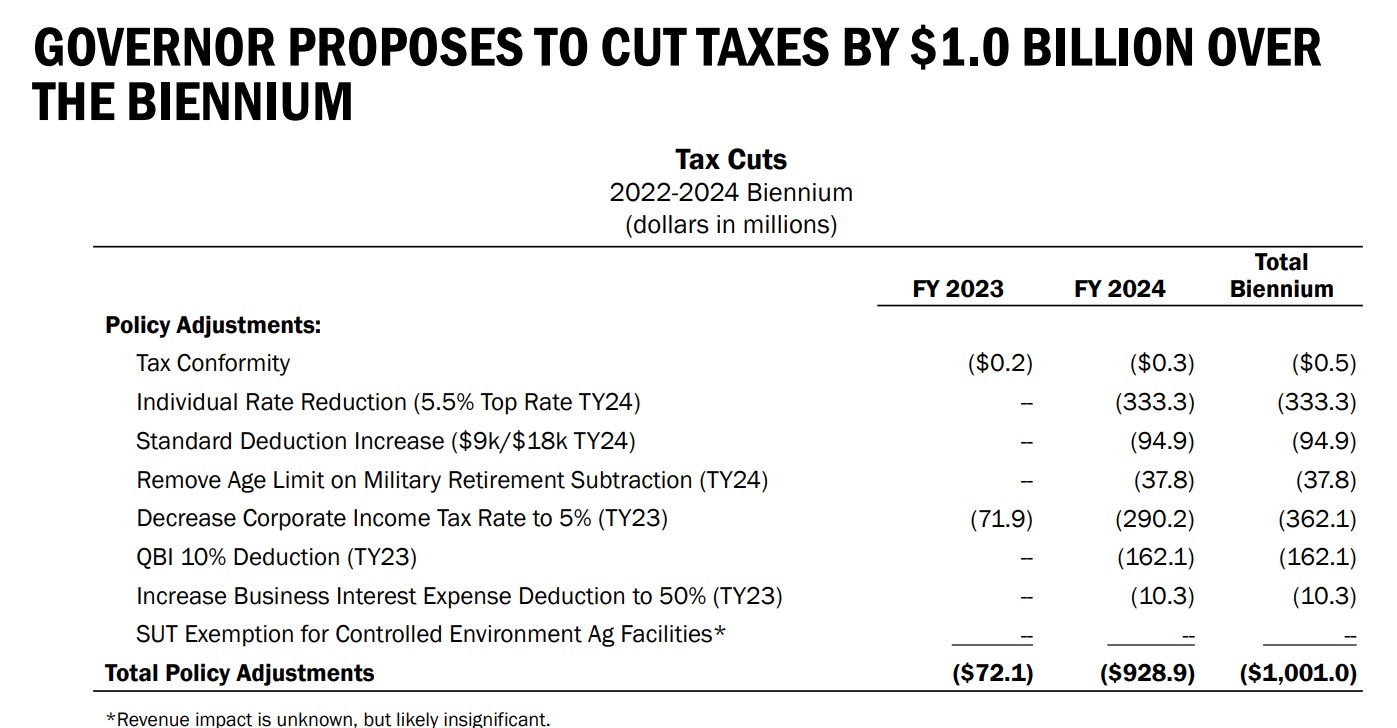
In his presentation, Youngkin focused on two major tax proposals. He wants to cut the corporation income tax by 16%, from a headline tax rate of 6% to 5%. He wants to cut the top income tax rate for individuals from 5.75% to 5.5%. Since that top rate kicks in at $17,000 of taxable income, quite a few middle income households will benefit from that. How much they benefit I discuss below. (Hint, not much.)

Youngkin pegged it at $1 billion in tax relief, but that is just for the remainder of this two year budget cycle, ending July of 2024. The foregone revenue rises to $2.9 billion in the next biennium cycle, and $3.1 billion in the following, Fiscal Year 2027 and 2028 cycle. Those numbers were included in Secretary of Finance Stephen Cummings presentation from the same day. It totals $7 billion over six years, back loaded. If combined with last year’s changes, Virginia businesses and individuals will enjoy significant tax cuts.

What is included in the new batch other than the two income tax rate changes?

For individuals, Youngkin wants to increase the standard deduction another $1,000 per individual or $2,000 on a joint return. That achieves the 2021 campaign promise of doubling the standard deduction Virginia has offered for the past several years, only partially met last year. For a married couple that saves another $115 in tax (but only $110 if the top rate drops).

For individuals collecting military retirement pay, the administration wants to expand the subtraction to cover all retirees of any age, not just those 55 and older, effective with tax year 2023. The subtraction amount is $20,000 next year, $30,000 in 2024 and $40,000 starting in 2025. This, of course, would be in addition to the $9,000 (or $18,000 for a couple) standard deduction.

Cummings’s proffered explanatory table “scores” this at $37 million of revenue lost (or taxes reduced). That is ignoring the out years when the full $40,000 subtraction kicks in immediately upon retirement from the military at any age. The foregone state revenue on $40,000 at the top tax rate is $2,300 ($2,200 at 5.5%). A full fiscal impact analysis should be produced at some point in the coming session.

Measured by revenue impact on the state treasury, reducing the top individual tax rate to 5.5% is the largest proposal, putting about a third of a billion dollars back in individual pockets each year. But that is divided among millions of taxpayers. For someone with $50,000 of taxable income, it saves $125. On income of $1 million it saves $2,500. That will be a hard sell.

And while comments were made last week about tax relief being tied to future revenue growth targets, which if missed leave the tax rules unchanged, it appears that only applies to the individual tax rate cut. Most of the other proposals have no contingencies attached in the budget language. Another Cummings slide confirms that.

On business taxes, Youngkin’s two major proposals balance nicely. There is his cut in the corporate tax rate to 5% for businesses organized as C corporations. But for sole proprietors and partnerships, business income ultimately taxed under individual tax rules and rates, he proposes to piggyback on a popular federal small business tax provision allowing them to subtract 20% of their business net income.

That qualified business income or QBI deduction was created in the 2017 Tax Cuts and Jobs Act. On federal returns it is applied after the calculation of adjusted gross income (AGI). Since federal AGI is the starting point for state taxes, there is no similar QBI deduction recognized in Virginia.

Youngkin proposes to allow it in Virginia, but at 10% rather than 20%. According to a legislator who has looked, no other state with an income tax has conformed with the federal QBI. Virginia could be the first and it could be very attractive for small businesses and attract start-ups. And remember, if the top rate is cut to 5.5% for individuals, that also lowers taxes on Schedule C and other forms of business income reported on personal returns.

Attracting more business investment is also the justification for reducing the corporate income tax to 5%, which Youngkin ultimately wants to make 4%. North Carolina has slashed its rates and shows stronger economic growth than Virginia.

In the wake of passage of the 2017 federal tax bill, some legislators proposed similar corporate tax rate cuts. That is what the feds had done, cut the corporate tax rate. The state bills hit a wall in 2019, however, with the senior legislators reporting that the business community itself was apathetic. Nobody was saluting that flag but the patrons and us at the Thomas Jefferson Institute for Public Policy. Our proposals on the standard deduction got more traction (and still do).

The bills also got no support from then-Governor Ralph Northam (D). Youngkin presumably will push the idea and line up major business endorsements and some economic analysis to bolster his argument. He also built his budget on the assumption this and all his other ideas pass, removing the usual whining about having to “cut” the budget to “pay” for lower taxes.

Virginia is enjoying a bonanza of revenue growth. The $3.6 billion in unallocated revenue legislators have to work with is based on very conservative estimates that assume a period of recession, which might not materialize. Even with the tax cuts Virginia will be sitting on huge and growing cash reserves.

Yet the battle on all these proposals (except maybe on the third rail of military retirement pay) will be fierce. Government always wants more.

Posted in Government Reform, Taxes | Comments Off on Here’s the Tax Cuts Youngkin Proposes: Will the General Assembly Say Yes?