
Youngkin delivers early Christmas gift

Share this article on:

Virginians received an early Christmas present this year. For four years, the Thomas Jefferson Institute for Public Policy has been strongly urging state officials in Virginia to lighten what has become a steadily increasing tax burden on residents and businesses in the commonwealth by enacting tax cuts and tax reform.

On December 15, during his appearance before the joint Senate and House of Delegates’ Finance and Appropriations Committees, Governor Glenn Youngkin took bold steps to do just that. The governor announced his plan to “accelerate” the state government’s transformation based on what he said was “driving better outcomes for less money.”

In his budget amendments to the 2022-2024 biennial state budget delivered to the General Assembly’s “money committees,” Youngkin proposed cutting taxes on Virginians by a billion dollars – in addition to the $4 billion tax relief bill he signed earlier this year.

Youngkin told legislators that the state, which is running a large surplus, can afford the tax cuts despite his acknowledgement that a national recession is looming. “Our carefully planned budget balances spending priorities and tax cuts, with roughly $1 billion … conditioned on meeting our 2023 revenue forecast,” Youngkin told state lawmakers.

The governor wants to “finish the job of doubling the standard deduction” for state income tax filers, a long-time policy objective of the TJIPP. He also wants to reduce the individual income tax rate for the highest income bracket to 5.5 percent and eliminate state income taxes on military retirement pay. Youngkin said that these individual income tax reductions will save Virginians $700 million per year.

Under the governor’s plan, the corporate income tax rate for businesses would also be reduced from 6 percent to 5 percent, “the first step toward the ultimate goal of 4 percent at the end of our administration.” For small businesses, Youngkin is proposing a 10 percent Qualified Business Income Deduction. These measures, if approved by the General Assembly, would total $450 million in business tax relief annually.

The Jefferson Institute argued back in 2018 that doubling the standard deduction for individuals “is the best of the various choices for individual taxpayers with the current projected revenue. It is the step taken by the Congress, which was seeking to move people away from itemized deductions. It also aligns Virginia with most surrounding states that use the income tax but do so with higher standard deductions for individuals and couples.”

We also argued that “reducing the corporate tax rate is the best step for business taxpayers and will help make Virginia more competitive.” Youngkin told legislators the same thing, pointing out that neighboring states such as Tennessee and North Carolina are more tax-friendly to business than the commonwealth.

And, while not part of the Youngkin package, we’ve firmly argued that Virginia tax brackets, standard deductions, and exemptions should be indexed for inflation, so taxpayers are no longer punished for rising consumer costs – and government coffers no longer profit from it.

But with the state government running a record budget surplus of $3.6 billion, the state can afford to return some of that excess to taxpayers. Especially since the governor noted that his proposed budget amendments include contingencies that halt any tax cuts and $2.5 billion in new spending initiatives if revenue targets are not met. “In the event of a recession, Virginia will be able to avoid raising taxes or cutting needed public programs by maintaining revenue reserves greater than 15 percent of expected revenues,” the governor’s office explained in a briefing document.

Besides the clear benefits of tax cuts to the Virginia economy, tax relief is needed now more than ever as the worst inflation in 40 years continues to erode state residents’ standard of living. Tax cuts will at least help mitigate some of the brutal effects of inflation.

“For the first time in about a decade, you’ve got a budget that is on the side of working people,” said state Sen. Steve Newman, R- 23rd District, a member of the Senate Finance and Appropriations Committee, after hearing Youngkin’s presentation.

Of course, tax relief won’t become a reality unless the General Assembly actually approves the governor’s budget amendments. But legislators will have a hard time explaining to their constituents that they refused to lighten their tax burden while sitting on a record budget surplus.
Posted in Government Reform, Taxes | Comments Off on Youngkin delivers early Christmas gift

On Slow Path to Repeal, RGGI Tax Passes $500 Million

Share this article on:

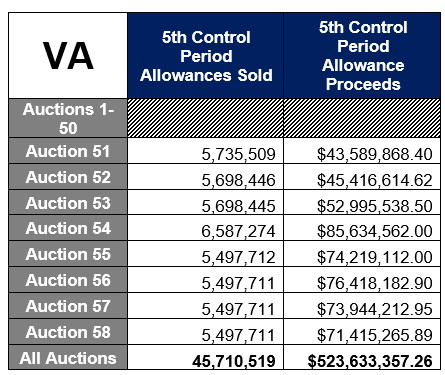
The tax on each ton of carbon dioxide emitted by Virginia electricity plants dropped to below $13 a ton in the most recent sale of CO2 allowances conducted by the Regional Greenhouse Gas Initiative (RGGI). That meant Virginia collected only $71 million in tax revenue for the fourth quarter, the lowest amount of the four auctions in 2022.

The auction was held December 7, the same day Virginia’s Air Pollution Control Board voted to take the next step in the slow process to withdraw Virginia from the interstate compact to cap, tax and shrink CO2 emissions from large power plants.  It is a state regulation that forces large electricity producers to buy emissions allowances in the quarterly auctions.

Soon after his election 13 months ago, Governor Glenn Youngkin (R) announced his intention to withdraw from RGGI.  By mid-2022 he had appointed four of the seven members to the regulatory board and started the process for repeal.  His appointees voted for repeal, and one holdover Governor Ralph Northam appointee voted against , with two Northam appointees abstaining, according to the Virginia Mercury.

The process is really moving toward an expected legal challenge.  Democrats began the process for Virginia to join RGGI as a purely regulatory effort but completed it after it was blessed in 2020 legislation signed by Northam.  Eventually one or more judges will probably be asked to decide if that bill simply allowed (the word in the law is “authorized”) or indeed required participation in RGGI.

There apparently are even conflicting signals about the statute from the two attorneys general for the period, and perhaps even conflicting opinions from the current one, as detailed in the report from Virginia Mercury.  An assistant to current Attorney General Jason Miyares (R) advised the board last week it could move forward with repeal.

Until the regulatory repeal process is complete next year, or until some court acts to interpret the statute, Virginia electricity producers will still have to buy and cash in emissions allowances (think of them as a tax stamp) and Virginia will continue to reap tax revenue.  The total over two years is up to almost $525 million, despite the downtick in allowance prices.  This will ultimately be paid by Virginia electric ratepayers or customers of Virginia businesses.

Another aspect of the 2022 legislation which is crystal clear is how that tax revenue is spent by the state. About half is supposed to be used for capital projects intended to mitigate flooding or stormwater problems or protect coastal regions from ocean storms.  The other half is dedicated to making energy efficiency improvements or repairs to housing used by low-income Virginians.

Both dedicated revenue streams of more than $100 million a year have created networks of beneficiaries motivated to maintain the tax.  Read the claims of environmental advocates uncritically, and you might conclude the RGGI tax by itself will lower average global temperatures, stop hurricanes, restore the polar ice caps and reduce everybody’s electric bills.  Several local governments weighed in seeking continuation of the grants (which could certainly be funded another way.)

The first step in the regulatory process was a notice of intended regulatory action (NOIRA) and after the Air Board issued that an initial 30 day comment period occurred, now closed.  Supporters of RGGI who oppose repeal dominated that, filing about 730 comments opposed to the 50 or comments in support of repeal.

The “comments” continued during the Air Board meeting.  Last week the opponents stood up and turned their backs (in uniform black shirts) on Acting Secretary of Natural Resources Travis Voyles as he made a presentation on the issue.  The board still did what it said it intended to do and approved the actual repeal language. The document is to be circulated for internal agency review, published, and then will face another public comment period, this one lasting 60 days.

One detailed comment in support of repeal came from Dominion Energy Virginia, which has long opposed participation in RGGI.  Its main argument is that with so many other states not part of the compact, RGGI’s main result is to just shift fossil fuel generation to other states, with Virginia power companies buying off the interstate grid.

Dominion can do that internally, because its largest coal fired plant is in West Virginia and needs no RGGI allowances at all.  So can the state’s second largest utility, Appalachian Power, serving about 500,000 Virginia customer accounts. It has only one small power plant needing allowance in Virginia.  Most of its generation is already in non-RGGI states.

The stated goal of RGGI is to slowly reduce reliance on fossil fuels, but the Virginia General Assembly has also imposed renewable generation mandates on Dominion and Appalachian.  Those cannot be evaded by simply buying off the grid, and those targets are more stringent than RGGI.  Dominion wrote:

Compliance with the (Renewable Portfolio Standard) entails costs from REC (renewable energy credit) purchases and development of eligible energy resources. And to reiterate, RGGI compliance entails costs from CO2 allowance purchases. Both the RPS program and RGGI participation thus result in costs borne by Virginia electric customers to achieve what is fundamentally the same objective – ongoing reductions in power sector CO2 emissions.

Dominion was also clear in its comments that state law allows it to recover the cost of RGGI allowances from ratepayers, and it will do so. Even if repeal goes smoothly and on schedule it may need to continue to collect from customers into future years to cover the full expense.

With the RPS mandates in place, the only function served by RGGI is financial.  It taxes electricity to fund programs popular with a portion of the populace, and to drive up the price of using fossil fuels in order to discourage their use.  The power to tax has long been the power to destroy.

Posted in Government Reform | Comments Off on On Slow Path to Repeal, RGGI Tax Passes $500 Million

Feds Admit: Ocean Wind Projects Threaten Whales

Share this article on:

Soon after a group of opponents to proposed East Coast offshore wind projects hired a law firm with environmental regulation expertise, the federal Bureau of Ocean Energy Management (BOEM) announced a new plan to protect North Atlantic Right Whales and put it out for public comment.

The opponents, with Thomas Jefferson Institute for Public Policy as part of the coalition, had been pointing to the impact of the project on the whales for months and this protection and mitigation plan admits the problem is significant.

One apparent result of that will be a major delay in publication of the draft environmental impact statement (EIS) on Dominion Energy Virginia’s Coastal Virginia Offshore Wind (CVOW) project off Virginia Beach. It was supposed to be available this past August, and once published is expected to be the focus of extended comments and perhaps litigation from opponents.

The ongoing debate at the Virginia State Corporation Commission over consumer price protections (a decision should come soon) is not the last hurdle to construction of the $10 billion project, with a much higher cost now under discussion. That EIS clock is not even running yet.

Other projects along the East Coast are a bit further along in that EIS process, but their location in the known migration corridor for the endangered right whales is a complication for all of them. The BOEM document includes a series of maps showing the density of the whale populations mapped against the proposed project areas.

BOEM is quite clear its primary goal is not protecting sea life but complying with President Joe Biden’s Executive Order 14008, which calls for the development of 30 gigawatts of offshore wind turbines by 2030. Dominion’s 176 turbine, 2.6 gigawatt project is less than 10 percent of that total. By one count the planned projects include 3,400 turbines, other transmission structures and almost 10,000 miles of submarine cable.

BOEM asserts in the document that the steps it proposes solve the problems those create for the whales, while at the same time calling for more observation and continuous improvement to the protection plan. The thousands of comments for or against that assertion received so far have not been released.

The right whale population (about 340 individuals) is so reduced and stressed that the federal standard is not one can be accidentally killed. The loss of even one will accelerate the path to extinction. That has already been established by the National Marine Fisheries Service in a 2021 Potential Biological Removal (PBR) ruling. That “zero take” PBR is also behind an ongoing regulatory effort to reduce the speed of commercial shipping in the corridor, also being resisted by that industry.

Protecting the whales is now becoming a problem for New England’s lobster fishermen, fighting federal regulations against certain fishing methods that risk entangling the giant mammals. A federal court recently ruled against the fishermen, and retailers are under pressure to eliminate the product. Whole Foods did.

Writes Virginia attorney Collister Johnson for the Committee for a Constructive Tomorrow, in a comment filed with BOEM:

When the PBR (which prohibits the human killing of a single whale) is combined with the fact that BOEM has no knowledge of the number, location, or travel path of any individual whale, the entire Strategy is doomed to failure.

No amount of “mitigation,” “minimization,” “reduction,” or “observation” can succeed in complying with a PBR where zero tolerance is the standard. Indeed, this issue has been adjudicated recently by the U.S. District Court for the District of Columbia. In Maine Lobstermen’s Assoc. v. NMFS, Judge Boasberg ruled that where the PBR is effectively zero, any ocean activity authorized by BOEM which includes the continuation of human caused (whale) mortality is ipso facto arbitrary and capricious….

In summary, BOEM cannot research, collaborate, minimize, mitigate, monitor, avoid, evaluate, or otherwise strategize its way out of a zero take marine environment for the (right whale). Therefore, the Strategy is a huge waste of time and resources and doomed to failure.

Under these circumstances, litigation appears to be inevitable.

For the Dominion project, litigation produces delay and delay will increase the ultimate cost to Dominion’s customers, already beginning to pay for the project on monthly bills.

A separate but similar federal review is underway because a company is seeking a permit for extensive underwater surveys off New York State, potentially useful for future wind plans, which could also result in the “incidental taking” of marine life. More public comments are being sought. The assumption is that some loss of wildlife is likely, so the permit is needed. This survey activity is far less invasive than building and maintaining thousands of structures which remain in place for decades.

Industrial development of the oceans on this scale is going to harm wildlife, with right whales most vulnerable species. Period. The response from the climate alarmists? Attack the messengers, of course, as in this Huffington Post article that dismisses Johnson and others as “climate deniers” and claims they are just tools of the fossil fuel industry. In fact, the money flow is stronger between the wind industry and the environmentalists willing to kill off the whales.

As a mental exercise, imagine the debate if 3,400 turbine structures, 500 to 800 feet tall, and ten thousand miles of crisscrossing high voltage cables were proposed for the length of the Appalachian Mountains from New York to North Carolina. Nobody could dispute those would be bird and bat blenders. Surrounding landowners by the tens of thousands would decry the changes to the view. Which is why the push is to put them offshore, instead.

Propose instead a series of ocean oil or gas drilling rigs and every concern raised about the offshore wind turbines would suddenly dominate the environmentalist websites. Their silence on the threat to whales and other environmental impacts on coastal waters is deafening.

Posted in Energy, Environment | Comments Off on Feds Admit: Ocean Wind Projects Threaten Whales

Time to index Virginia income taxes to inflation

Share this article on:

Inflation is eroding the value of each dollar earned by Virginians, making it harder for them to afford decent housing, put food on the table and educate their children. But what many Virginians don’t know is that they have also been paying more in state income taxes while their real income has declined because the commonwealth’s tax code is not indexed to inflation.

A new report by Virginia’s Joint Legislative Audit and Review Commission (JLARC) points out that state income taxes in the commonwealth “have far outpaced median income,  because income brackets have not been changed since 1990.”

Thanks to inflation, state income taxes owed by a median filer have increased 173 percent since 1990, while that same taxpayer’s actual income increased only 108 percent.

The result of 32 years of “bracket creep” is a 65 percent income tax hike automatically imposed on Virginia taxpayers without a single vote in the General Assembly. Over the years, bracket creep has made the state income tax much less progressive because, as the JLARC report explains, “a much higher percentage of each filer’s income [is] being taxed at Virginia’s highest rate of 5.75% on income of more than $17,000.”

That’s right. People earning just $17,000 per year are taxed at the highest rate, the same rate as those making a million dollars a year. That’s the opposite of a progressive system in which taxpayers making the most money are taxed at a higher level.

To make Virginia’s income tax more progressive, JLARC recommends “reducing taxes on lower-middle and middle-income filers,” including those earning between $36,000 and $68,000 per year, “by indexing the tax brackets to account for inflation.”

Indexing has been a longstanding policy objective of the Thomas Jefferson Institute for Public Policy. Back in 2018, TJIPP proposed indexing Virginia’s individual tax brackets, personal exemptions and standard deductions to inflation. But inflation was just 1.76 percent in 2019, compared to 8.20 percent in 2022.  The case for protecting Virginia’s taxpayers from the ravages of inflation is much stronger now.

General fund revenues have increased nearly 30 percent over the past four years. So it should come as no surprise that JLARC acknowledges that “revenue from the individual income tax is by far the largest source of state general fund revenue,” thanks to inflation-created bracket creep. This 30 percent revenue windfall was in addition to other taxes imposed on businesses and individuals in the commonwealth that led to a $2 billion state surplus.

The unfair effect of bracket creep is to force taxpayers to pay higher taxes on income that has lost some of its buying power due to inflation, and this unlegislated tax hike falls most heavily on lower- and middle-income Virginians.

The JLARC report notes that indexing alone, without any other needed tax reform, would increase the  progressivity of Virginia’s state income tax by 23 percent. Because indexing would have to address 32 years of bracket creep in the state tax code, it would result in a one-time revenue reduction of 6 percent.

Another option is to create more tax brackets than the current four, which would increase progressivity even more and result in a 4 percent decrease in state revenue. Or JLARC suggests that the General Assembly could index tax brackets for inflation and add progressive new rates at the same time, benefiting mostly lower- and middle-income tax filers and resulting in just a 2 percent revenue shortfall.

Whatever form indexing takes, it is imperative that the General Assembly make sure that inflation does not harm taxpayers more than it already has. Since Virginia is just one of 13 states that do not currently index their income tax brackets for inflation, lack of action on the part of the state legislature will continue to further erode the system’s progressivity over time. Virginians will watch helplessly as their income taxes continue to rise, while the buying power of that same income declines.

And this annual unlegislated tax hike will continue until and unless state legislators finally decide to do something about it.


Posted in Economy, Taxes | Comments Off on Time to index Virginia income taxes to inflation

Wind Projects Faltering

Share this article on:

In recent days several proposed offshore wind projects, which unlike Virginia’s are not guaranteed by captive ratepayers, are showing cracks in their pylons.

Multinational developer Avangrid recently told Massachusetts regulators that its proposed 1.2 gigawatt Commonwealth Wind project is no longer economically viable.  It seems to be seeking to renegotiate the power purchase agreement for more money because the electricity price it promised in the contract is being eroded by rising costs and interest rates.

Then the developer of a smaller Massachusetts project, 400 megawatt Mayflower Wind, made a similar announcement.  An EE News Energy Wire story on both can be found here and included this:

Avangrid’s warning — echoed in part days later by Mayflower Wind, the developer of the state’s other upcoming offshore wind project — is the strongest signal yet that a chilling trend on renewable energy projects may migrate into the offshore wind sector.

That was before Monday brought another signal.  New Jersey’s Public Service Enterprise Group (PSEG) announced it is considering pulling out its stake in the 1.1 gigawatt Ocean Wind 1 project.  In that case, the utility does have a 25% equity stake in the project.  Bloomberg reports on that here, stating:

Higher prices and ongoing supply chain constraints are straining the project’s finances, the project’s lawyers said in an Oct. 20 filing.

The Biden Administration’s so-called Inflation Reduction Act shored up already fat subsidies for the industry, but with several conditions.  There is a clear preference for domestic-manufactured content, for example, which might be of no value to these overseas-based contractors.  Labor costs will now be dictated by unions.  The full impact of all that is still unclear.

Here in Virginia, of course, Dominion Energy Virginia’s ratepayers can simply expect to pay more for its planned Coastal Virginia Offshore Wind project.  That one project (2.6 gigawatt) is about the size of the three mentioned above combined, and of course the utility plans a second wave just as large.

This is why the discussion of risk is central to this debate.  In private projects financed with power purchase agreements, the developer’s investors carry most of the risk.  In Dominion’s projects, ratepayers do.

proposed agreement pending in front of the State Corporation Commission seems to be premised on an expectation that the construction cost will rise to at least $11.3 billion from the previous $9.8 billion, with $1 billion of that to be repaid to the utility by its customers over time (and with annual profit.)  The agreement mentions the possibility of a price tag up to $13.7 billion.  Those numbers were not chosen at random.

An additional $1 billion from ratepayers amortized over decades will substantially increase the projected bill impact of the project, which began to show up on Dominion’s monthly bills in September. (Look on the bill for Rider OSW).  The cost numbers reported earlier will be scrambled, and a new analysis may not appear before the SCC decides.

Avangrid, which has the Spanish firm Iberdrola as its majority owner, is also developer of the proposed Kitty Hawk project.  It will be built off North Carolina’s Outer Banks, but the power cables are going to come ashore in Virginia Beach to connect with the transmission grid.

Defenders of the proposed settlement have claimed privately that it is a consumer victory to put Dominion on the hook for some (one-third) of the cost overruns up to $11.3 billion, and all of the cost overruns beyond that point.  Again, the unspoken premise is the cost overruns are coming.  They also claim the SCC will have full power to stop the project if the costs explode.

Yes, but how likely is that?  Once ten or eleven billion has been spent, will the SCC impose that sunk and stranded cost on ratepayers with the prospect of no electricity production or renewable energy credit sales?  In another realm, does the Navy cancel ships when they are 80% built and costs rise?  Not often.

The original condition imposed by the SCC, holding Dominion responsible for any marginal energy costs if the project fails to produce power at 42% capacity, did more for consumers.  It also apparently imposed so much risk on the company that it was threatening to drop out, just like those other developers in other states.

Those other companies are taking steps to protect their shareholders.  Under the original SCC condition, Dominion might have done the same.  Absent that, it doesn’t have to.

A version of this commentary originally appeared on November 4, 2022 in the online Bacon’s Rebellion.  Steve Haner is Senior Fellow with the Thomas Jefferson Institute for Public Policy.  He may be reached at steve@thomasjeffersoninst.org.

Posted in Energy | Tagged | Comments Off on Wind Projects Faltering