VIDEO: Watch “Confessions of a Union Negotiator”

Share this article on:


Watch a replay of “Confessions of a Union Negotiator…What to expect if public sector bargaining passes in your county.” Frank Ricci, a former firefighter union negotiator details the tactics and strategies used by government unions during collective bargaining.
Counties, cities towns, and school boards in Virginia now have the ability to allow government unions to collectively bargain on behalf of all public employees. While there is no obligation to allow such monopoly union contracts, local governments and School Boards who wish to consider public sector bargaining should go into it clear-eyed about what it entails.
Mr. Ricci talked about how the process works in the real world of collective bargaining. He shared the pitfalls of public sector bargaining he learned while being on the union side of the bargaining table in Connecticut.
Mr. Ricci was joined by Thomas Jefferson Institute Visiting Fellow F. Vincent Vernuccio, detailed specifics on the law passed last year in Richmond allowing government union to bargain and what localities are doing now.

Posted in Government Reform, Labor, Workplace Freedom | Comments Off on VIDEO: Watch “Confessions of a Union Negotiator”

Richmond City May Cancel Gas Service For Its Citizens, Henrico and Chesterfield

Share this article on:

BE IT FURTHER RESOLVED: That the (Richmond) Council hereby commits to working with the City’s Administration on an equitable plan to phase out reliance on gas and shift to accelerated investment in City-owned renewable energy and hereby recognizes that the continued operation of the City’s gas utility is an obstacle to the City’s goal of Net-Zero emissions in accordance Resolution No. 2020-R024, adopted June 8, 2020.

Translation:  The Richmond Gas Works, a municipal owned public service utility, is targeted for closure.   Council sees its continued operation as “an obstacle.”  The 117,600 customers (as of 2018) may soon need to run their lives and businesses without natural gas.  Those customers are not confined to the city itself but are also located in Henrico and Chesterfield counties. (Disclosure:  I am one of their Henrico customers.)

The city probably has a legal (and enforceable) obligation to continue service under current law. Every candidate for the legislature in Richmond, Henrico and Chesterfield needs to tell the voters whether they will let this stand or oppose this effort to kill natural gas options.  It will end up before the General Assembly or the State Corporation Commission or the courts or all three.  The resolution itself contemplates needing legislation to accomplish its goals.

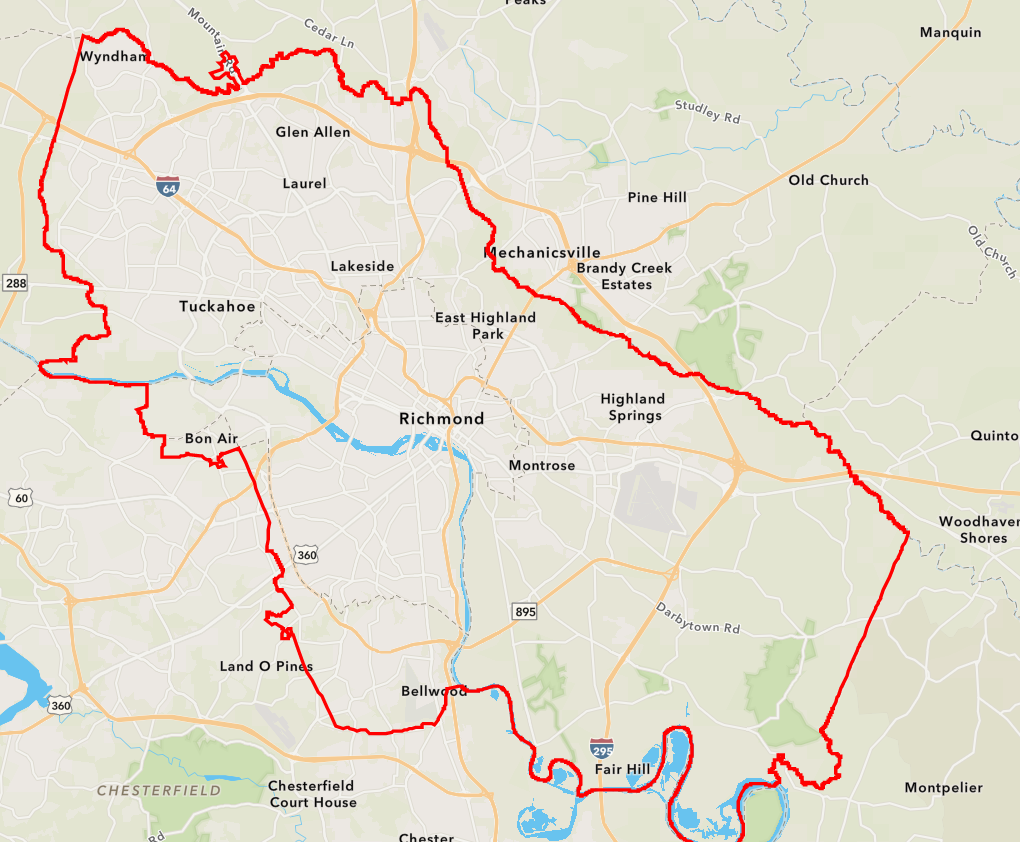
Here is a map of the current service territory. The city is probably less than half the full area.  Think of all the industries around the Richmond airport and south of town along Interstate 95.  Be prepared to say goodbye to some of them.

Incumbent candidates who voted for the Virginia Clean Economy Act and the similar bills in 2020 and 2021 should further explain if they understood this to be the ultimate goal.  When you talk about an economy that is 100 percent carbon free, in all aspects, that basically means no natural gas.  Period.

The council resolution (full text here) was adopted unanimously during the September 15 council meeting, having been introduced by Second District Councilwoman Katherine Jordan back in July.  The only place I saw the action reported was on Twitter, with green activists all excited.  They are dead serious about this happening.

The city gas company serves homes, small businesses, churches, and huge industrial operations.  Those big firms with an industrial process tied to natural gas will simply consider relocating.  Restaurants will need to dump gas ovens.  Residential customers, of course, will need to convert to electric heat pumps and stoves at a substantial cost already outlined in a previous Jefferson Policy Journal post.

That earlier post and the report it was based on were dismissed by some as not credible.  Richmond City Council just moved it from hard to believe into the “consider this fair warning” category.

According to a 2018 city annual report on its utility operations, the gas operation had gross revenue of about $155 million in 2018 and gross operating profits of $20 million.  After debt payments and other adjustments, the net profit was $10 million.  On top of that, of course, the city also collects consumer use taxes directly from the consumers of the gas. It makes money both ways.

The financial benefits to the city would largely continue, of course, if the intent is to simply let a private entity buy the assets (actual capital value unknown) and operate as public service companies do elsewhere in Virginia.  But that is not the intent.  That does not advance the city and the state (and national) goal of net zero or zero emissions.

I have no idea what bonds or other debts support that gas system, but that is a further complication that could affect the city’s bond rating.  Another provision of the resolution calls for the city to stop dealing with any banks that invest in fossil fuels in any way.  In other words, to stop working with banks investing in the City of Richmond itself, since it owns and profits off a gas company.  Which get dumped first, banks or the gas company?

As to the idea of city-owned renewable energy assets to instead serve those customers, again, that is not possible under current law.  The existing electricity monopoly belongs to Dominion Energy Virginia, and it is already planning more wind and solar than we will ever use.

There is a check box on the resolution form noting whether or not a fiscal impact statement was prepared.  You get one guess which of the two boxes was checked, yes or no.

These are not serious people.  They should not be allowed to handle money or manage large complex operations.  Even if this particular effort fails, the gas operation now needs to move to safer private hands.  But this outcome was predictable and predicted, and other progressive-dominated local governments share exactly the same goals.  This is your seven a.m. wake-up call (most having ignored the wake ups at six and six thirty.)

Posted in Energy | 6 Comments

VIDEO STREAM: Virginia Energy Consumer Conference

Share this article on:

THURSDAY, SEP. 16,  9:30 AM – 11:30 AM EDT.

*If you don’t see the video stream yet, refresh this page after 9:30 am on Thurs, Sept. 16.

*If you don’t see the video stream yet, refresh this page after 9:30 am on Thurs, Sept. 16.

Posted in Energy, Government Reform | Comments Off on VIDEO STREAM: Virginia Energy Consumer Conference

A Promise to Reverse Northam’s Tax Hikes

Share this article on:

Republican nominee for governor Glenn Youngkin is proposing to reduce Virginia taxes in much the same way Governor Ralph Northam has raised them:  Several individual proposals, some not all that large, which accumulate into a significant change.

As Northam ends his term, his attitude seems to be, what tax increases?  He claims the current $2.6 billion general fund revenue surplus and the almost $400 million transportation fund revenue surplus are due to economic growth.

No. Tax increases greatly contributed to that surplus and will keep the Commonwealth’s coffers overflowing. Youngkin’s proposal tracks those tax hikes and softens their individual blows.

A change in sales tax collections, imposing the tax on more out-of-state shippers just as online retail exploded, contributed to both surpluses.  Youngkin proposes to counter that by removing the sales tax on groceries. Exempting them from tax has been a long-time goal of some in both parties, especially former Democratic Governor Douglas Wilder.  Northam had promised it.

After the 2017 federal Tax Cuts and Jobs Act pushed the federal standard deduction to $25,000, millions of Virginians gave up taking state itemized deductions in order to enjoy that higher federal deduction. That one change produced the largest piece of the bonanza of additional state revenue that politicians are now plotting to spend in January.

So Youngkin proposes to increase the state standard deduction to $9,000 for an individual and $18,000 for a married couple.  That will take hundreds of thousands of taxpayers entirely off the income tax rolls and provide a significant reduction for the millions who use the standard deduction — $518 per year for married filers.

It is something the Thomas Jefferson Institute recommended three years ago, and legislators in both parties have previously proposed higher standard deductions. Over the long term, this is by far the largest of the tax cuts proposed by Youngkin and best for the economy.

The surplus in transportation accounts was created by 2020 legislation which raised the gasoline tax by 17.6 cents per gallon in some parts of Virginia, 10 cents per gallon in others, and then created a new highway user fee imposed on vehicle registrations.

Youngkin’s proposal for a one-year suspension of the most recent 5 cent gas tax increase won’t save taxpayers much, but it does remind Virginians about the major 2020 tax increase under Northam, little noticed as gasoline prices fluctuate.

More surplus revenue came from the unfortunate decision this year to impose income tax on the federal Paycheck Protection Program and state Rebuild Virginia Grants.  Under pressure from the Thomas Jefferson Institute and others, the Assembly exempted the first $100,000 in grants from tax.  Youngkin proposes to exempt it all.

His list of proposals includes a $40,000 exclusion for military retiree pay.  Also one-time individual rebates of $300 per person or $600 per couple, larger than the 2019 rebates of $110 each that Northam and the legislature agreed to in pretending to return that year’s surplus.

The other truly major tax idea is related to the wave of inflation which is following the massive federal COVID relief spending.  Real estate values are already exploding all across Virginia.

Higher house values produce higher real estate taxes unless local governments lower tax rates.  To capture the inflation-driven tax increase now, it takes a simple vote by the governing body.  Youngkin would add the requirement for a voter referendum in those instances.

The complaints about that from local officials in both parties will be quick and loud, and this idea might produce the largest legislative battle.  Former Republican Governor Jim Gilmore also sought to rein in a local tax, the car tax, and had only mixed success.  People still pay a portion of that tax.

Most voters who remember that battle 20 years ago blame the Assembly for the tax surviving, not the former governor.  They may appreciate the next governor making a similar push on another out-of-control local tax.

A version of this commentary originally appeared in the September 2, 2021 edition of The Fredericksburg Free Lance-Star.  Stephen D. Haner is Senior Fellow with the Thomas Jefferson Institute for Public Policy.

Posted in Government Reform, State Government, Taxes | Tagged , , , | Comments Off on A Promise to Reverse Northam’s Tax Hikes

Could Vineyard Wind Challenge Impact Dominion’s Virginia Project?

Share this article on:

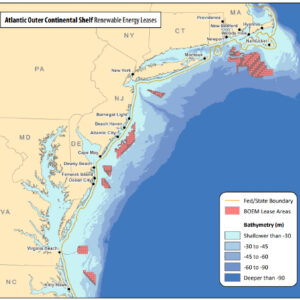
A group of Nantucket Island, Massachusetts residents have filed suit challenging the pre-construction environmental review on a massive offshore wind complex planned off its shores. The issues raised may have a direct impact on the similar wind energy project planned off Virginia Beach, which is only now beginning its environmental impact process.

A loose coalition of offshore wind opponents is forming from North Carolina to New England to the Great Lakes to question or challenge the expanding list of proposed projects. The Thomas Jefferson Institute for Public Policy has affiliated with the coalition, with our concerns over Dominion Energy Virginia’s proposed 5,280 megawatt project basically economic.

One of the key organizers of the broad coalition and this Nantucket lawsuit, David Stevenson of the Caesar Rodney Institute in Delaware, will be speaking at the Virginia Energy Consumer Conference on September 16 outside Richmond. Thomas Jefferson Institute is one of the three sponsors. The full conference will be available through streaming (details to follow.)

The umbrella group is using the name “Coalition for Ocean Protection and Safety.” The Nantucket group, playing off the code designation for its local airport, call themselves ACK RATS, with the RATS standing for Residents Against Turbines. The wind developments there are not 27 miles offshore the way it is planned in Virginia.

“Some people oppose the industrial offshore development because it will harm their ocean view. Some people oppose it because it will result in higher electricity rates. Some will oppose it because it will hurt commercial fishing,” stated Val Oliver, co-founder of ACK Rats, in a prepared media statement.

“While those are all valid and true concerns, what motivates us in our opposition to the industrial offshore development is the fact that it will result in the destruction of our ocean floor, its ecosystem, and have a deadly impact to countless bugs, birds, bats, fish, and the critically endangered North Atlantic Right Whale. Saving those species, and especially the critically endangered Right Whale is why we are here today,” Oliver continued.

“The whales belong to all of us and with fewer than 400, of which there are fewer than 100 breeding females left, each one is worth protecting. The people of Nantucket have a long history with these whales, and we have done so much recently to protect this species. It would be a tragedy to see all of them lost in order to build an industrial offshore development,” stated Mary Chalke, co-founder of ACK Rats.

With its Environmental Impact Statement (EIS) still in the early stage, the Dominion project already has the enthusiastic endorsement of the Biden Administration, Virginia Governor Ralph Northam and the Democrats in control of the General Assembly. Threats to any whales probably won’t shake that. But if the Vineyard Wind EIS fails a federal court review because it was rushed and flawed, that likely will add roadblocks to the Virginia project.

The suit challenges the Bureau of Ocean Energy Management (BOEM) as having failed to comply with the National Environmental Policy Act and the Endangered Species Act.

“Despite preparing an Environmental Impact Statement (EIS) and a Supplement to the EIS (SEIS), BOEM failed to take the requisite “hard look” at the Vineyard Wind project’s adverse impacts on whales and other marine mammals, fish, sea turtles, birds, air quality, greenhouse gas emissions, cultural resources, aesthetics, and other resource categories. BOEM’s two NEPA documents also failed to examine a legally adequate range of alternatives; failed to mitigate the project’s impacts; and grossly underreported the project’s cumulative effects,” the opening summary states.

The suit reads like and cites complaints similar to those in legal challenges to natural gas pipeline projects in Virginia, some of the projects now abandoned. Any successful federal court precedents established in those cases on reversing permit approvals may apply here.

Vineyard Wind LLC submitted a construction and operation plan to BOEM in 2017, seeking to erect 100 turbines about fourteen miles offshore from Nantucket and neighboring Martha’s Vineyard. Plans are in place to expand to other adjoining lease areas and build a total of 600 650-foot-tall turbines in that region.

The Dominion project, which Wednesday announced its formal lease of Port of Virginia space to use as a staging area, plans to produce 2,600 megawatts of energy from its first phase. Massive world-wide economic forces are behind this push, most of them positioned to earn substantial profits from energy ratepayers.

The Virginia State Corporation Commission, basically under orders from the General Assembly to approve the offshore wind proposed by Dominion, has estimated the all-in consumer cost of the Dominion project at more than $37 billion. It accounts for about a third of the $807 annual increase in residential electric bills the SCC has projected by 2030, with the power provided dependent on unreliable wind.

The five-turbine, 30 megawatt Block Island wind project off Rhode Island currently has four of its five turbines off-line as the manufacturer inspects for the kind of stress fractures which are appearing in similar units in Europe. Block Island has been operational on windy days since 2016, but recently the turbines were remaining still on those windy days and some newspaper finally asked why.


 

Posted in Economy, Energy | Comments Off on Could Vineyard Wind Challenge Impact Dominion’s Virginia Project?