
Welcome, Dr. Coons! Let’s Talk Math

Share this article on:

In K-12 education, can Virginia lead the nation?  If that’s the goal, in my view as a career educator, Dr. Lisa Coons is the best possible choice as our new state Superintendent. As Chief Academic Officer in Tennessee, the programs she guided to help teachers improve reading instruction are among the best in the nation.

But in Virginia, challenge #1 is mathematics. The department Dr. Coons now leads is tentatively scheduled in June to submit to the state Board of Education a proposed revision of our K-12 math Standards of Learning (SOLs).  Workforce math skills are vital for our nation’s prosperity and defense, but current standards, in both our state and nation, are failing to teach mathematics effectively.

The evidence?   On national standards, much of it can be found in the International Journal of Mathematics Education, among other places.

  • Since 2012?  In national NAEP LTT testing in January 2020, before the U.S. arrival of Covid-19, math scores were lower than in 2012 for nearly every student group.
  • As noted by columnist George Will, “About 76,000 students each year receive from U.S. universities advanced degrees in engineering disciplines …. Of those graduates, about 43 percent are U.S. citizens….”
  • Electrical engineering (EE) is an especially important field in the competitive world economy.  Of EE doctorates awarded by U.S. universities, the proportion going to non-U.S. citizens rose from 62% in 2010 to 70% in 2019.  Almost as many U.S. EE Ph.D.’s went to citizens of China as to U.S. citizens.

Many of these “best and brightest” from around the globe stay in the U.S. and contribute disproportionately to our economy.  But one wonders:  How long will U.S. taxpayers support higher education their children are not being prepared to enter?
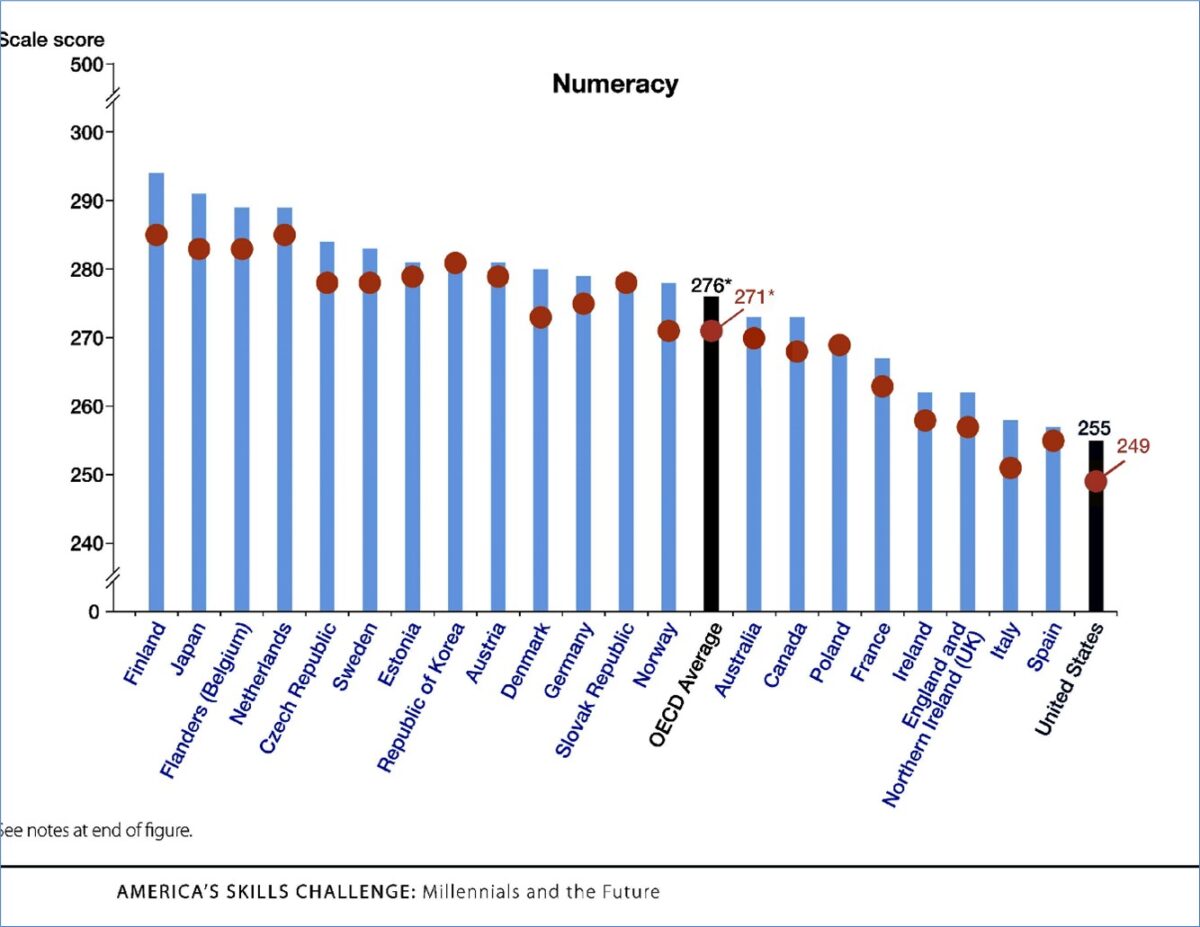
gure 1. Average scores in numeracy for age 16-34 (bars) and age 16-24 (red dots): OECD PIAAC 2012. (From Goodman et al. 2015, Data © OECD 2012. Used with permission.)

What Went Wrong

As a major factor explaining these results, scientists who study learning have found that in teaching mathematics, the methods required by U.S. K-12 standards have proven to be inefficient and/or ineffective.

Historically to learn math, students had no choice but to memorize fundamental facts and procedures.  Change arrived in the 1980’s as low-cost calculators to solve arithmetic became available.

Another change was a 1989 agreement by state governors to adopt “standards” to direct K-12 instruction.  By 2003, all states had adopted standards.  As Tom Loveless points out in Stability and Change in American Education, for guidance in math, most relied on standards proposed by the National Council of Teachers of Mathematics (NCTM), an organization heavily influenced by professors in schools of education.

The NCTM standards called for “calculator use at all grade levels” and for students to “create” procedures to solve arithmetic rather than be taught a standard procedure. “Decreased attention” was recommended for “memorizing” and “rote practice.”

The NCTM had impact. By 2003, most states required teachers to prepare students to use calculators to solve arithmetic on 3rd grade state testing.  As textbooks changed, parents complained their children’s ‘create math’ homework did not work. And it turned out parents were right.

What Science Says

Starting in the 1990’s, with help from new technologies, scientists were investigating how the brain learns mathematics.  By 2008, cognitive scientists had discovered that because of its structure, the human brain is very good at solving problems when needed information can be quickly retrieved from memory — but is very limited when needed information cannot be quickly recalled.

As one example, scientists found as a foundation for learning mathematics, students need to thoroughly memorize all of the “basic facts of arithmetic, such as 9+6=15 and 56/8=7, as had been required pre-calculator.  In 2009, University of Virginia cognitive scientist Daniel Willingham advised educators, “Automatic retrieval of basic math facts is critical to solving complex problems.”

Science also documented that in the limited instructional time available, achieving quick recall of the over 250 basic math facts requires ‘drill and practice’ such as flashcard use.

But the NCTM has continued its opposition to science. In a March 2023 “position paper,” the NCTM reiterated its claim students can avoid memorizing basic facts by applying complex and time-consuming “calculation strategies.”  At no point in the past 15 years has the NCTM addressed why their leaders believe verified findings of science should be denied.

Concerns about falling test scores led to drafting “Common Core Math Standards” (CCMS) in 2010. Unfortunately, among those asked to draft or vote to approve the new standards, none were cognitive scientists. At most points, the CCMS aligned with positions of the NCTM, and the CCMS were adopted by 45 states.

Virginia SOLs

For many years, Virginia’s students were fortunate.  As math supervisor and then Superintendent of the Virginia Department of Education, Dr. Patricia Wright listened to science. Between 1995 and 2015, our math SOLs called for helping students commit to memory all the basic math facts, and by the last year those standards were in place in Virginia classrooms, our scores on the National Assessment of Educational Progress (“main NAEP”) had risen to be in the top five states in the nation.

But after Dr. Wright’s retirement, new math SOLs were adopted in 2016 and implemented in 2019. At key points, the memorization of basics required by prior SOLs was replaced.  Substituted were the NCTM/Common Core “calculation strategies.”  The current SOLs do not ask that students know from memory any basic arithmetic facts.

The impact?  While much of it can be attributed to the effects of school shutdowns during Covid, Virginia’s 4th grade math scores on the 2022 NAEP showed the largest decline in the nation, dropping 11 points (vs. a national drop of five points), and eight points in 8th grade math.

All of us would hope memorization could be avoided, but science says in learning math, thorough memorization of basics is essential.  When state standards require instruction based on magical-thinking that denies science, what achievement should we expect?  What will be the consequences for our state and nation?

Going Forward

Superintendent Coons will submit revised SOLs to the state Board in June or thereafter, followed by public hearings, opportunity for public comment, and a final Board vote.

In December of 2022, I joined about 20 “stakeholders” invited to review a draft of the revised SOLs prepared by math staff of the Department of Education.  At many key points, the December draft called for the opposite of what science recommends.

Several of us wrote to staff and leaders detailing our concerns. Appointed leaders replied and stated their strong support for standards that were science-based. But at this point, the draft to be submitted for Board consideration has not been released.

From my personal readings in the science of learning, I can attest: How the brain learns is complex — and often counter-intuitive.  In June, our new Superintendent will have been on the job for only two months.  Department leaders have immense responsibilities for managing state education at all levels.

Governor Youngkin recently proposed a Numeracy Act similar to the 2022 Virginia Literacy Act (VLA) that passed the General Assembly unanimously.  The VLA emphasized: Instruction must be science-based.  The Numeracy Act will need a foundation of science-based SOLs.

In this SOL revision, I hope Department leaders will set as a goal writing math standards that can serve as a model for the nation. As one step in the process, a team of cognitive scientists should be asked to review the current draft and recommend changes if needed. The team might also include faculty from math “special education” who have experience applying the science of learning to improve instruction in real K-12 classrooms.  Virginia’s universities are home to many nationally recognized experts in both areas.

Our nation desperately needs math standards that work. Virginia can lead the way. Let’s base instruction for our children not on wishful thinking that has failed, but on tested strategies science says have proven to be effective.

Eric (Rick) Nelson is a Visiting Fellow with the Thomas Jefferson Institute for Public Policy.  He served 28 years with the Fairfax County Public Schools teaching math-intensive chemistry and physics.  For more than 10 years, he was an elected president of the Fairfax County Federation of Teachers/AFT/AFL-CIO.  Currently, Rick works with college educators to publicize cognitive research on how students learn in math, sciences, and engineering.  He may be reached at EANelson@chemreview.net
Posted in Education | Comments Off on Welcome, Dr. Coons! Let’s Talk Math

How Broken is Virginia’s Energy Regulatory System?

Share this article on:

Let Us Count the Ways

How badly broken is Virginia’s energy regulatory system? One recent State Corporation Commission decision on Dominion Energy Virginia’s proposed next wave of solar projects illustrates several of the problems. The projects are unimportant, routine. What matters are the policy failures revealed.

Only the rich can look at the future and yawn.

Virtually all of the participants in the case other than the utility itself, including consumer advocates and customers themselves, complained that the projects the utility wanted to build on its own were too costly, especially compared to alternative choices offered to Dominion by independent developers. The Attorney General’s Consumer Counsel was particularly aggressive. Even the Commission’s own hearing examiner agreed that two of the projects should be rejected over cost.

The Commission approved them all. So there is problem one: the Commission no longer has any real authority to decide what is reasonable and prudent and to deny projects on the basis of cost.

Virtually all of the participants in the case argued that Dominion is misreading the 2020 Virginia Clean Economy Act (VCEA), which set the share of wind and solar energy to be provided by outside sources under power purchase agreements at 35%. They argued that 35% is a floor but a higher percentage of energy could come from outside providers, especially if the costs were significantly lower that way.

The Commission, which had punted on the same question in earlier cases, came down firmly in favor of Dominion’s interpretation that the 65-35% split written into the law is not a floor but a mandate. Dominion is just getting started on building all the generation needed to satisfy the massive goals of VCEA, so the cost impact of this decision will grow. There is problem two: the General Assembly put a fixed limit into law on how much generation the utility must offload to less expensive providers.

The third glaring problem highlighted by this case, not a new issue but a basic one, is the level of secrecy surrounding the data.  Just how much cheaper electricity from the independent solar providers would have been has not been made public, and in arguing their points the advocates for competition couldn’t cite the hard numbers. They could only hint at the disparity, which will really add up over decades.

The SCC staff analysis once again is honeycombed with omissions and redactions, and entire testimony files are marked as too sensitive for the public to read.  The staff concluded many of the projects were not economical and would not normally make sense if not required by the VCEA. Their cost-benefit analysis is also highly dependent on future estimated costs for renewable energy credits, with those projections also marked secret and not disclosed.

The SCC staff analysis also illustrated problem number four. In drafting the VCEA, Dominion invented a cash penalty ($45 per megawatt hour) it would face for failing to meet VCEA targets. Having invented the fine out of thin air, it then uses avoiding the fine as a “benefit” to consumers in running the cost-benefit analysis on these projects. It also inserts into the calculation a social cost of carbon, an equally arbitrary number with no basis in real world costs.

So problem four is how the economic decisions on energy choices are now based on imaginary numbers, what others might deem to be fudge factors.  They make more expensive alternatives to reliable fossil fuel or nuclear generation seem to be of similar or lower cost, when in reality they are not.

Problem five is the remaining and seemingly persistent vacancies on the Commission itself, and the political stalemate that represents. The regulatory body is unable to perform its constitutional duty. This leaves the General Assembly in an even more dominant position.

This decision was signed by the panel’s only sitting member, Commissioner Jehmal Hudson. He was joined by former Commissioner Patricia West, sitting in as a substitute judge despite being intentionally removed by Democrats in the General Assembly a few years ago. The 2023 General Assembly has come and gone without filling two vacant seats, and any temporary appointment made by Governor Glenn Youngkin might last only until the General Assembly returns next January.

To recap:

1) The regulatory body lacks the authority to say no to a monopoly utility on the basis of excess cost, not if the projects are needed to comply with VCEA.

2) The General Assembly has locked in a guarantee that the utility will own 65% of the solar, battery and onshore wind projects and reap profits on billions extracted from ratepayers over decades. Dominion is developing 100% of the offshore wind, the main cost driver. Governor Glenn Youngkin’s recent effort to create competitive bidding for offshore wind was summarily executed by legislators.

3) The key financial analyses and comparisons are secret for no valid reason.

4) The key financial analyses are heavily tilted in favor of utility-owned wind, solar and battery and against fossil fuel or nuclear power by the invention of an arbitrary cash penalty for failing to meet the VCEA’s renewable energy goals and imposition of an arbitrary social cost of carbon. The majority Democrats in the Virginia Senate have killed efforts to include nuclear power as renewable.

5) The Commission itself is hamstrung by having two of its three seats vacant, leaving the legislature dominant. The blunt message of who is charge has been reinforced by the partisan removal of two duly elected SCC members, one rejected by Democrats and one by Republicans.

There are other problems, but those five are major.  Barring a course change, Virginia’s next decade will be dominated by an expensive, forced transition from reliable and diverse energy sources to almost totally electrified transportation, home and office heating and cooking, with more electricity drawn from unreliable, intermittent generation.

Working folks and the poor will feel real pain. Only the rich can look at the future and yawn.

Posted in Energy, Government Reform | Comments Off on How Broken is Virginia’s Energy Regulatory System?

Youngkin Energy Reforms Killed Without Votes

Share this article on:

Governor Glenn Youngkin’s proposal to ensure that any future wave of wind turbines built off Virginia must follow a real competitive bid process ended up dead as a beached whale. The General Assembly didn’t just kill his proposed amendment during its reconvened session April 12, it refused to even take up the matter.

Both the Republican-controlled House of Delegates and Democrat-controlled Senate voted to “pass by” the substitutes. They then died when the motion to adjourn was approved at the end of the day. Such a motion is often used to avoid a recorded vote loaded with political risk.

Rejection of the amendments, first discussed here, leaves Youngkin (R) free to veto the underlying bill (actually two identical bills, one in each chamber), but his argument was not with the underlying bills themselves. He was just trying to weaken Dominion Energy Virginia’s control over the wind development process, which has led to Virginia building the first and only $10 billion project with all the cost and risk on its ratepayers. At this point, any second phase will likely be the same.

The gubernatorial amendment on competitive bidding for offshore wind was injecting a new issue in the last stage of the 2023 session. Youngkin offered other amendments which constituted repeat efforts to pass things rejected during the regular part of the session. They met the same fate, some also by motions to pass by supported by his own party.

Again using identical House and Senate bills, Youngkin sought to revive a requirement that a more careful review of system reliability precede any decision to close a fossil fuel generation plant, meaning perhaps the plants would survive. (See amendments 2 and 3 here.) This would be a serious change in the 2020 Virginia Clean Economy Act, which sets a deadline for those retirements. Concerns over future reliability are growing as the U.S. power grid becomes more dependent upon intermittent solar and wind generation.

A partisan divide on that issue was expected, with Senate Democrats having the votes to kill the idea, but the hope was that one or more of them might break with the pack since the issue never actually was voted on in the full Senate. A straight yea or nay vote on that issue would at least provide a roll call for use in the coming election campaigns.

The Senate cooperated to that extent, and a roll call vote was held on those amendments, made in the Senate to Senate Bill 1231. The vote to reject the extra reviews on reliability was indeed totally partisan, with the 22 Democrats voting against and 18 Republicans voting for. The same vote also killed an amendment to recognize nuclear and hydrogen generated power as qualifying as renewable under that same Virginia Clean Economy Act.

But on the House side, the same set of amendments offered to House Bill 2026 never faced a vote. It died on the same motion to “pass by” that killed the offshore wind amendment, a motion made by Republican Majority Leader Terry Kilgore (R-Scott County). No clean roll call on the reliability issue was produced for later use.

There was a bill dealing with plans to place a major transmission line underground, an expensive approach that always ends up padding all consumer bills through higher transmission charges. House Bill 1637, sponsored by Delegate Michael Webert (R-Fauquier County), also had a matching Senate version. The Governor’s substitute suffered the same fate, passed by on the same joint motion from Kilgore and a similar motion in the Senate.

Northern Virginia loves to protect its viewsheds with underground 230 volt lines by sending the bill to the rest of Virginia’s Dominion Energy ratepayers. This deserves a deeper dive at another time. Such lines are going to multiply incredibly in the all-electric future envisioned for Virginia.

Youngkin was successful with a series of amendments to the proposal to re-energize a legislative Commission on Electric Utility Regulation. His amendments added the Attorney General or a member of his Consumer Counsel staff as ex-officio members, required that citizen members have a history of sticking up for ratepayers, and authorized the commission to start issuing estimates of how legislative proposals would affect electric rates.

Given the harsh treatment afforded the Governor’s other amendments, and the total lack of any debate or even explanation before the votes went down, handing more information and authority to legislators in this realm may not prove of benefit to consumers.

Posted in Environment, Government Reform | Comments Off on Youngkin Energy Reforms Killed Without Votes

Youngkin Seeks Competitive Bid on Future Ocean Wind

Share this article on:

Governor Glenn Youngkin (R) has proposed a stronger requirement in state law that any second wave of offshore wind serving Virginia be subjected to a competitive procurement process, rather than simply allowing Dominion Energy Virginia to build it with all the costs and risks imposed on its customers.

The planned 176-turbine Coastal Virginia Offshore Wind (CVOW) project now under federal environmental review remains the only such project in the United States which is being developed directly by a monopoly utility.  Other projects involve third party developers raising the capital and taking on much of the financial risk for the multi-billion dollar investments, then selling the power to utilities.

This is just one of several consumer-oriented amendments Youngkin proposed on a series of energy bills, to be voted on at the General Assembly’s reconvened session April 12.  Should the Assembly reject his amendments, his option then is to either sign or veto the bill as it passed in February.

The financial and operational risk imposed on ratepayers by direct utility ownership of the wind farm was the focus of debate before the State Corporation Commission (SCC) finally authorized the project, now estimated to cost $10 billion.  A method to shift some of the risk to the company’s shareholders if power output fell below projections was initially accepted but then abandoned by the regulators.

Youngkin has now proposed a major rewrite of what was a fairly innocuous bill dealing with Dominion’s planned, but not yet applied for, second wave of turbines off Virginia Beach.  As introduced, House Bill 2444 encouraged the State Corporation Commission to look favorably on a project using Virginia-manufactured parts, in part because a major turbine manufacturer is considering setting up such a factory in Hampton Roads.

The Governor’s proposed substitute preserves that language but sets up an advisory body led by a state agency head to compare the cost and benefits of utility ownership versus third party ownership, deciding the matter “on a cost per megawatt hour basis” including any needed transmission expenses.

State law is also amended by the substitute to make it clear a power purchase agreement for wind generation satisfies the Virginia Clean Economy Act, which Dominion argues requires that it own 65% of all the wind and solar developed to satisfy its mandates.

This approach on reviewing a second wind tranche offered by Youngkin was not something discussed during the session, or at any point during the debate over the first major wind project.   In other amendments he has now proposed, the Governor is trying to revive proposals which were attempted but not adopted just weeks ago.

When Dominion first offered its major regulatory legislation for 2023, one provision supported by Republicans but rejected by Democrats involved another aspect of the 2020 Virginia Clean Economy Act.  It proposed to give the SCC authority over the planned retirements of existing fossil fuel generation plants, allowing the SCC to keep them operational on its own motion to protect system reliability.

That provision disappeared from the final conference report on the bill dealing with the utility’s rates and profit margins.  Youngkin has now brought it back as a proposed amendment to House Bill 2026, which as passed dealt with Virginia’s biomass generation facilities.  In this case the Governor has proposed amendments to the bill, not a substitute, and those amendments can be voted on individually.

The language he proposes to add requires a utility that wants to retire a fossil fuel plant to first get a ruling from the SCC on whether doing so would impair system safety or reliability.  And closing a loophole the SCC itself pointed out last year, the amendment would allow the SCC to act on its own to extend the closure deadlines in the VCEA to protect system reliability.

Yet another amendment to the bill would allow zero-emission hydrogen projects or any new nuclear energy developed after January 1 of this year to be considered renewable energy and to count toward the renewable energy percentage mandates in the VCEA. This, too, was proposed in the regular session but failed to pass.  Lots of reasons were given, but as written VCEA is focused on wind, solar and battery projects and fewer of those may be built if nuclear and hydrogen can compete with them.

Legislation to strengthen an existing legislative study panel on energy issues also got Youngkin’s attention and he has offered a major substitute.  The Commission on Electric Utility Regulation (formerly Restructuring) has long existed but has largely been moribund, meeting almost never, dominated by the utilities and legislators favorable to their whims.  The acronym CEUR is pronounced by critics as “sewer”.

House Bill 2275 and a Senate companion were intended to breathe life into it, adding citizen membership and series of required activities and reports.  The Governor’s substitute requires that those citizen members have expertise in ratepayer advocacy, and also adds to the membership the Attorney General of an assistant attorney general who works on utility regulation matters.

Youngkin has also proposed that the panel take on a major task, the preparation of ratepayer impact statements on proposed utility legislation.  The lack of such information from a disinterested source has been a weakness as the Assembly has wrestled with bill in recent years.  The SCC has long resisted being required to prepare such impact statements (and legislators often don’t ask anyway), but in recent years has taken to providing hard data on specific questions from legislators.

Virginia’s problem in recent years has been the legislature’s eagerness to take over the role of energy regulator, to substitute its judgement for that of the SCC, to substitute a secretive political process for open debate in a court of record.  The legislators’ general lack of knowledge is one reason that was a problem, and adding to knowledge may be preferable to remaining in ignorance.

But if this strengthened and empowered panel adds to the legislative appetite for control, it may not represent progress.

Posted in Energy | Tagged | Comments Off on Youngkin Seeks Competitive Bid on Future Ocean Wind

Consumer Cost Estimates Rise Higher for Green Economy

Share this article on:

Customer cost projections for compliance with the Virginia Clean Economy Act have increased again from the first such estimates made in 2020. The bill for 1,000 kilowatt hours of electricity from Dominion Energy Virginia to power a home for a month may rise almost $100, or 83%, by 2035.

Dominion residential customers were already paying $288 (21%) more per year for 1,000 kilowatt hours per month by December 2022, compared to May 2020, just before VCEA became law. That will cost another $547 annually by 2030 and $878 more by 2035. Cost projections are even higher for commercial and industrial customers.

After all the hyped discussion coming out of the 2023 General Assembly that regulatory changes it made will “lower electricity bills,” it is important to face reality. Ignore claims from any incumbents who say they voted to “lower bills.”  VCEA compliance is still going to be very expensive, and nothing just passed changes any of that.

The most recent figures are very similar and slightly higher than those reported in 2020.  They were filed last year by the utility as part of the annual VCEA compliance plan, outlining its planned conversion from fossil fuel generation to massive amounts of wind and solar power over the next two decades.

The baseline comparison is $116.18 per 1,000 kwh for May 2020.  The predictions above use a calculation method preferred by the State Corporation Commission staff, which projected that bill would be $185.81monthly at the end of 2030 and $213.36 by the end of 2035. Not all of that is directly tied to VCEA compliance, but most of it is.

Dominion prefers another calculation method with some more favorable assumptions, but even the company sees those bills rising to $165.64 by 2030 and $177.48 by 2035. That is still $61 a month ($736 per year, 53%) more than the pre-VCEA electricity cost.

The figures were included in the filing Dominion made for additional solar and storage facilities needed to comply with VCEA. That case is about to wrap up. They are also contained in the integrated resource plan it filed with the SCC in 2022, which is summarized on the company’s webpage.

Dominion Remains Worried About Reliability

This is also all based on the future development plan preferred by the company, designated Plan B in both documents, which complies with the VCEA but does not retire the company’s natural gas generation as rapidly as many environmental advocates are demanding. Other alternatives mapped out retire them more rapidly. In the application the company repeats a warning mantra that one day will turn into an “I told you so”:

… if other states pursue the same clean energy future as the Company resulting in significant volumes of intermittent resources with the same operational profiles as the Company’s, the Company may not be able to fill any deficits in specific hours with market purchases.

In other words, soon it won’t be possible to import power from other states which have coal and natural gas power to share when our solar or wind are offline:  They will have closed theirs too. Such imports have soared in Virginia since passage of the VCEA and since Virginia began imposing a carbon tax on its own native fossil fuel generators.

One additional caveat is that the financial impact of the recent federal changes in renewable energy incentives is still unclear.  Federal subsidies or tax preferences could lower the future bills, but it is important to remember that those costs are ultimately paid instead by taxpayers rather than ratepayers (and Virginians are both). Quite a bit of key guidance on the new legislation is still pending at the U.S. Department of the Treasury.  Things should be clearer for the next update.

The various cost projections are found in Attachment11, starting on page 51 of this document. This report focuses on Dominion’s Plan B, with its residentialcosts compiled on page 67.  That is the VCEA compliant plan that keeps natural gas in play as long as possible.

That page is where you see, for example, that the total bill for that 1,000 kwh residential user had already climbed to $140.21 by December of 2022, a 21% increase since May 2020.

Another Offshore Wind Farm is Included

The new generation assets in that Plan B include the second phase of offshore wind, with the utility expecting the additional turbines off Virginia Beach to be operational by about 2033 (six years after the firstproject.) The net cost of offshore wind to that consumer is projected to rise from $3.42 per month this coming December to $22.87 by December 2035.

Since all this was published in late 2022, other proposed wind projects off the east coast of the United States have complained of major price pressures on their construction plans, with similar projects in Europe also claiming they need more money to operate. Whether Dominion has adjusted its estimate for the cost of Phase 2 is not discussed.

Rider CE, the rate adjustment clause covering the solar farms at the heart of the current application for additional solar resources, is projected to rise from $2.97 per month this coming December to $20.65 by December 2035. A new rate adjustment clause is expected to be created to cover the various power purchase agreements, again mainly for solar, needed to meet VCEA.

A key thing to remember is both the wind and solar cost projections are “net” and include assumed values of “benefits” to customers for avoided fuel costs and the avoided need to purchase renewable energy certificates or to make capacity payments. You can see them on the spreadsheet as negative numbers, reducing the bottom line cost.  If those assumptions do not pan out, the monthly cost to consumers will rise.

Dominion’s Plan B adds a cost projection line for small modular nuclear reactors but enters zeros across the board indicating there is no real plan to go that route soon, not in Plan B.

Projections like these not only can change but willchange. This is a planning tool at best.  Costs could be lower, but that is not what you should plan for.

Posted in Energy | Comments Off on Consumer Cost Estimates Rise Higher for Green Economy