Under RGGI, Virginia Releases More CO2, Not Less

Share this article on:

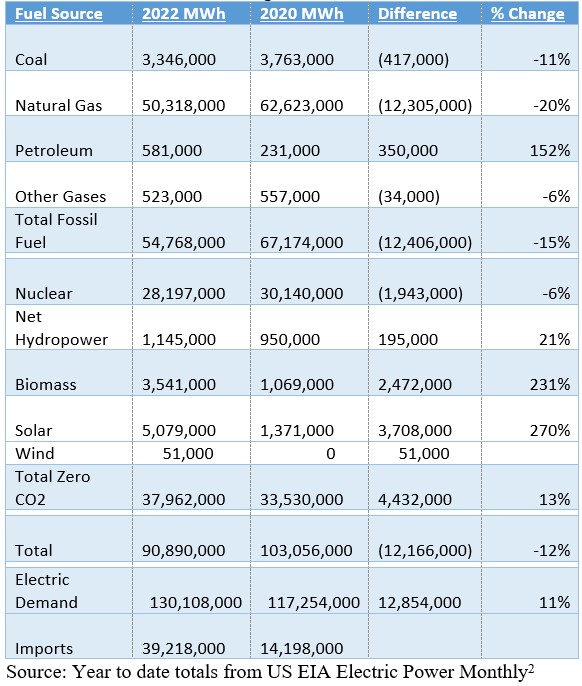
Since Virginia joined the Regional Greenhouse Gas Initiative (RGGI) compact at the start of 2021, according to data reported by the U.S. Energy Information Agency, the amount of carbon dioxide emitted to provide electricity to customers in the state has grown. Despite two years of RGGI caps and taxes, total CO2 emissions did not shrink, but grew by 3.7 million tons.

That is because the emissions total includes tracking all power producers providing electrons to the state, which is not the same as emissions from power producers located within the state. Virginia’s membership in RGGI is having the exact opposite effect from what its adherents claim it does because, as many predicted, it has forced Virginia to import far more electricity than it used to.

During the two-year period, electricity consumption within the state grew to 130 million megawatt hours, up 11%. Electricity imports grew from 14 million megawatt hours in 2020 to more than 39 million MWH in 2022, up 280%. RGGI has simply driven power production from fossil fuels used by Virginia to other states. As it has for the other RGGI member states.

These conclusions come from EIA data compiled by David Stevenson, director of the Caesar Rodney Institute in Delaware, and long a skeptic on the benefits of RGGI in this region. He added them to the growing list of public comments on the Virginia Air Pollution Control Board’s pending proposal to take Virginia out of RGGI at the end of 2023. More details and citations from Stevenson are contained in a longer discussion which you can read here; and in a table he created, which is reproduced below.
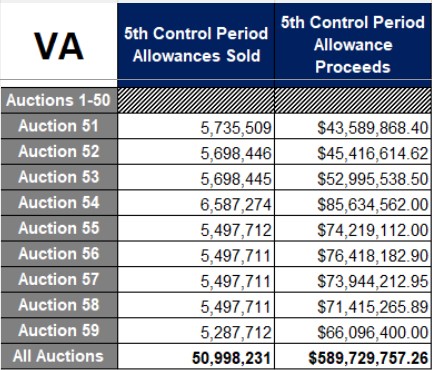
Virginia collected another $66 million last week from electric power producers paying the necessary carbon taxes to use coal and natural gas, bringing the tax total the state has reaped over nine auctions to just under $590 million. The cost of Regional Greenhouse Gas Initiative (RGGI) allowances is usually passed on to electricity purchasers.  Dominion Energy Virginia wants to do so directly on your bill.

Stevenson points out that the direct cost of allowances, the carbon tax, is just one of the economic impacts on Virginia’s economy from membership and adherence to RGGI.  Within the state’s borders, it is providing a strong disincentive for the production of power.  Virginia’s native production of power from fossil fuels dropped 15% over those two years. He applies an average monetary value of the power not produced and estimates generators lost $840 million in revenue.

There is a third economic impact. There are higher transmission costs to cover the process of importing power from the states not covered by RGGI.  All these dollars are coming from consumers, one way or another. If and when utility-owned fossil fuel plants are closed ahead of schedule, consumers will also be on the hook for the stranded capital costs.

Solar production inside the state is increasing, and some of the imports are from solar or even wind in other states. But Stevenson’s compilation of the EIA data also shows that burning biomass accounts for much of the growth of supposed “non-CO2” generation during the two years. Many doubt it qualifies for a “green” classification, and in one plant in Virginia it is mixed with coal to get an efficient output.

With power demand on the rise, RGGI will force Virginia to become even more dependent on imports, especially during those periods of low or no production from solar or wind. The whole justification for the new regulatory scheme Dominion Energy Virginia demanded and got in 2007 was to finance a massive program of building in-state generation to reduce dependence on imported power.

That is entirely out the window thanks to RGGI and the even more stringent Virginia Clean Economy Act. The plants built under the buildup are underutilized and in danger of becoming stranded assets and all the while CO2 concentrations in the atmosphere here and around the world are growing, not shrinking.

The economic impact of RGGI on Virginia is just getting started.  Should Virginia remain under its edicts, CO2 emissions from the electric power sector within the state will need to shrink another 13 million tons by 2030. To get there, all the remaining coal plants will have to close and electricity production from natural gas would have to reduce by 35 percent, as well.   Those would represent a loss of about $1.6 billion in revenue.

The same outcome is dictated by the Virginia Clean Economy Act, meaning RGGI is also redundant. One difference is RGGI includes the tax. VCEA picks consumer pockets by ordering utilities to buy renewable energy certificates when they miss renewable energy goal.

There is another reason to think about 2030, just seven years away. That is the year that another multi-state organization, the PJM regional transmission organization (RTO) predicts serious problems caused by the early retirement of reliable, mostly fossil fueled generators and their (slow) replacement with intermittent wind and solar. A previous article on Bacon’s Rebellion addressed that.

Another interesting footnote goes back to that 2007 legislation. At the time, environmentalists considered it a major victory that the final bill included a legal mandate for Virginia to reduce its electric power consumption by 10% by 2022. We’ve now passed that landmark and the consumption of 130 million MWH instead represents growth of more than 20%. Again, this is the opposite of what advocates intended and promised, the opposite of the General Assembly’s solemn command.

It is like the law of unintended consequences was created to explain the failures and follies of the climate catastrophe movement.  Ignore what its adherents say and focus on what they really do. A version of this commentary originally appeared March 13, 2023 in the online Bacon’s Rebellion. 
Posted in Government Reform | Comments Off on Under RGGI, Virginia Releases More CO2, Not Less

Energy Wars Stalemate Hinders Reforms

Share this article on:

What the 2023 General Assembly didn’t pass is also an important Virginia energy policy story, starting with failure on its part to fill the two open seats on the crucial State Corporation Commission. This follows its failure last year to fill one open seat on the three-judge panel.

As reported previously, advocates for restored SCC authority over utility rates had more success this year than in a long time, largely because Governor Glenn Youngkin (R) was among them. The bills awaiting his signature may not mean much if the Commission itself is barely functioning. A string of major cases for 2023 was created by these new bills, with just one commissioner and perhaps some interim substitute judges to hear them.

The failure to agree on two names was accompanied by a refusal to pass the proposed legislation that would have given both new judges a full six-year term. Otherwise, one of them would be filling out the short remaining tenure of retired Commissioner Judith Jadgmann. She left her seat early in part to create the opportunity for Republicans and Democrats in the divided Assembly to each name one commissioner. Compromise eluded them.

There is one difference this time. This year, unlike last year, the Assembly is fully adjourned. Unless names appear at the reconvened session April 12, it may be possible for Youngkin to name interim commissioners, but anyone so named would have to be confirmed by the next (post-election) General Assembly.

The battle over SCC seats is really another battle over energy policy. How its members will rule on banking, insurance or railroad safety controversies cannot matter to legislators, but how they rule on offshore wind and solar developments are of great concern to many. The idea that commissioners might just follow the law, evidence and precedents seems like wishful thinking.

The deadlock over the SCC is just another result of the overall energy deadlock between the Republicans who control the House of Delegates and Democrats who control the Virginia Senate. Along with other liberal priorities, Democrats defended all the elements of the Green New Deal energy vision they adopted under Governor Ralph Northam. Nothing was rolled back this year, just as nothing was last year.

Once again, the House voted to pass but the Senate killed a bill to decouple Virginia from California’s air pollution regulations which will soon begin to mandate certain levels of electric vehicle sales. The House voted to pass but the Senate killed legislation to prevent Virginia’s local governments from restricting or banning the use of natural gas in homes and businesses.

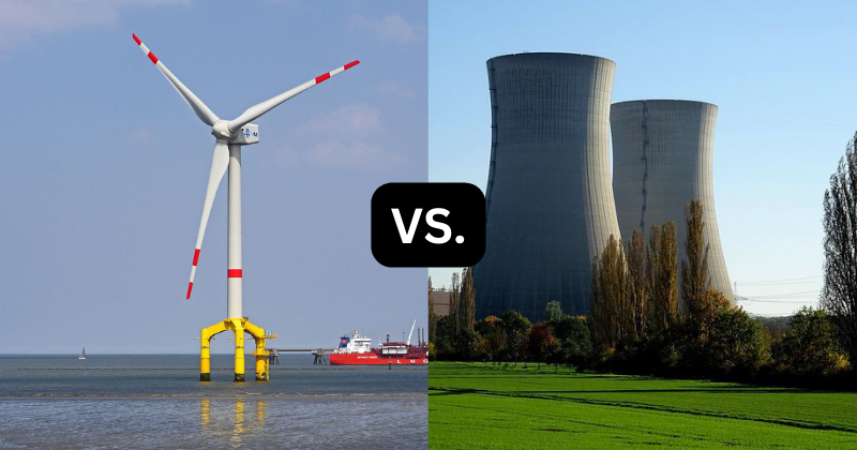
This year did bring a new issue on that front, however, harder for the Democrats to just reject. Governor Youngkin has revived interest in nuclear power, clearly a no-carbon alternative and one that provides the kind of reliable baseload that can support the intermittent power generation of solar and wind facilities.

No law needs to pass or change for any Virginia utility to propose such a facility, or for the SCC to approve such a facility. It is just another power plant covered by the usual process for building new generation. But two major bills were introduced to give the technology a boost, in particular the small modular reactors (SMRs) likely to replace the standard nuclear designs of earlier decades.

Perceived as threats to the advantages and incentives in place for wind and solar and battery, both bills ultimately failed.

House Bill 2333 seemed to be drafted to ease the path to such a facility for Dominion Energy Virginia, since it required the developer of an SMR facility to have a prior history with nuclear plants. Legislators who elsewhere were voting to restore SCC autonomy seemed quite comfortable with this language that attempted to dictate terms to the regulators, although there was no effort to assert that SMR technology was “in the public interest” or to be “deemed reasonable and prudent.”

But it did include language that such applications would be “liberally granted to facilitate” such a plant. That is where the Senate Democrats had other plans, and they sent the bill back approved, but with the following revision:

The costs of a small modular nuclear reactor approved under this section, other than return on projected construction work in progress and allowance for funds used during construction, shall not be recovered prior to the date such facility constructed by the utility begins commercial operation. In the event a utility abandons a small modular nuclear reactor approved under this section prior to commercial operation, the utility shall not recover any capital costs regardless of whether such costs were reasonably and prudently incurred. The Commission may impose additional conditions it believes necessary to protect customers against unreasonable construction, development, or operational risk.

The first thought one might have on reading that: that would have been a great addition to the bill mandating construction of the offshore wind boondoggle. Of course, Democrats had no interest in imposing such consumer protections in that case. The House Republicans wouldn’t accept it on behalf of the SMR idea either, so the bill died in a conference committee.

House Bill 2197 was a more direct threat to the wind-solar-battery hegemony, and the gigantic global industries getting rich off that near monopoly. It would have allowed nuclear power onto the renewable energy credit gravy train, allowing it and hydrogen-fueled projects to count toward utilities meeting their renewable portfolio standards mandates. More gigawatts from nuclear might mean fewer from wind or solar (and batteries become totally unnecessary.)

When killing the bill in a Senate committee, which Democrats promptly did, the discussion mainly focused on the hydrogen proposal. Even with the use of hydrogen, only a subset of possible sources is favored by environmental purists, because it takes energy to split off and capture the volatile hydrogen atoms. The committee discussion devolved into a debate over blue hydrogen, green hydrogen, or brown hydrogen.

That was a distraction. It is nuclear power that is a real threat to the wind and solar industrial complexes. The bill went away because it wanted to treat nuclear energy as morally and legally equal to those, which under Virginia Democrats’ vision for Virginia’s energy future cannot be allowed.

To top it off, Democrats in the Senate killed a simple House bill to allow a few Southwest Virginia localities to form a local revenue sharing agreement in the event a nuclear plant got built out there. The only reason to kill that was to reinforce that no such plant is coming, not while they rule the Senate.

Posted in Energy | Comments Off on Energy Wars Stalemate Hinders Reforms

SCC Oversight Returned, But Lower Electric Bills Unlikely

Share this article on:

The final version of a regulatory revision for Dominion Energy Virginia restores State Corporation Commission authority over the utility’s profit margin and rates, a major goal for Governor Glenn Youngkin (R). It was also the highest priority in a detailed energy policy put forward by the Thomas Jefferson Institute for Public Policy.

Of the aggressive goals set out in Dominion’s initial legislation, few were accomplished in the end. The General Assembly did agree to directly legislate a profit margin for the utility for two years, and it is an increase. Come 2025 the SCC will be free to set the next profit rate without any reference to the peer group of other utilities now required by law.

Setting a directly stated return on equity of 9.7 percent, right in the text of Virginia law, has never been done. The promise is the General Assembly and utility won’t ever do it again. Past promises in prior utility legislation have not always held for long.  In this case, Governor Youngkin should still be around to prevent any backsliding, but precedents are precedents.

The bill as passed also mirrors separate legislation restoring the SCC’s full authority to raise or lower rates, an accounting process that is interrelated with determining the allowed profit margin.  It will depend on economic conditions in 2025, but the profit margin set by the SCC may or may not be lower than 9.7%.  Having the SCC decide that, however, is a return to proper regulatory policy.

Also gone for the future is the unique-to-Virginia return on equity “collar” which added another 70 basis points (0.7%) to the allowed profit margin.  With the increase in the official return on equity from 9.35 to 9.7%, Dominion is getting half of it back, at least.  The collar didn’t apply to all of its operations, but this higher base profit margin will, so it is largely a wash.

The profit margin on the massive Coastal Virginia Offshore Wind project, for example, is now 9.35% with no collar.  This legislation increases that to 9.7%, an extra $3.5 million in annual profit on every $1 billion of equity capital.

The peer group for return on equity decisions, and the rate collar allowing utilities to keep excess profits, also go away in approved legislation changing the rules for the state’s second largest electric provider, Appalachian Power Company.  The two companies will be operating under different regulatory regimes if both become law, a step backward to counteract some of these steps forward.

The one area where the General Assembly, or least the Democrats who control the Virginia Senate, refused to return power to the SCC was over the generation mix for Virginia utilities. There, a future SCC is still bound by numerous dictates imposed by past Assemblies to rapidly retire fossil fuel generators and replace them with a massive investment in wind, solar and batteries.

The best element of Dominion’s initial bill was it gave the SCC a stronger hand in controlling the pace and nature of that conversion, directing it to make system reliability the key to its decisions. That was a complete reversal of the approach laid out in Governor Ralph Northam’s (D) Virginia Clean Economy Act. The idea survived in House versions of the Dominion bill but disappeared immediately in Senate versions. It didn’t make the cut in the conference report.

Democrats claim that the Virginia Clean Economy Act will allow the SCC to keep a fossil fuel plant open, or reject a renewable investment, on the basis of reliability.  The SCC itself, in a report late last year, warned that it lacked the power to keep Virginia’s reliability high. Concerns are going to grow, not fade.

The legislation as it heads to the Governor still includes Dominion’s proposal to take several of its stand-alone rate adjustment clauses (RACs), now billed individually, and merge them into the lump base rates.  The claim is that will “save” consumers $350 million, which it will not, but the disappearance of those monthly charges could create an appearance of lower bills.

Using base rate dollars to replace the dollars collected by those RACs means any excess profit that otherwise might occur will disappear, preventing any refunds to customers.  They could save $350 million on the bills but lose $350 million in refunds.

That’s why claims that this legislation will reduce electric bills are slippery.  The Richmond Times-Dispatch, in its report February 26, mirrored Dominion’s advertising claims and stated it will produce an “immediate” reduction of $6-7 for many residential customers, based on the RAC conversion.  In his victory press release, Governor Youngkin was more careful, stating the legislation will “save customers money on their monthly bills.”

Comparing this bill to what Dominion introduced weeks ago, the Governor’s statement is correct.  Dominion was seeking a much higher legislated profit margin with no sunset on the peer group.  But there are so many moving pieces in the electric bill, so many expensive projects like the offshore wind complex and nuclear reactor upgrades are soon to be added, it is impossible to predict where a family’s cost will be in one year or two.

Another major cost element that remains impossible to predict is the price of fuel.  This conference report includes Dominion’s proposal to allow the SCC to spread that cost over multiple years, with interest.  Basically it would create a bond to cover part or all of the $1.6 billion in fuel costs it ran up when prices spiked after Russia attacked Ukraine.

Those fuel costs, mainly natural gas, have since dropped substantially.  If the unpaid backlog is amortized over a long period, in the short run the customer bill will be lower but in the long run the total cost is far higher.  As the time period lengthens, the total interest paid starts to pile up, just like with a credit card when you make only the minimum payment.

Dominion in written arguments for the bill provided some examples from other states.  In one, a big fuel bill would have added $39 to monthly bills if paid off over a year ($468), but only $5.64 per month if paid out over ten years ($676.80 in total).  That extra $209 (45% more) will be collected by some lender.  Is that saving customers money?  No, but it will sure look like it has between now and the next election.

The final Dominion and Appalachian bills both include provisions where the state’s largest users can just pay off the fuel arrearage in twelve months, avoiding those years of interest costs.  The option is only granted to the largest customers, those with lobbyists watching out for them.  When they opt out of something, the smaller customers should beware.

Posted in Energy | Comments Off on SCC Oversight Returned, But Lower Electric Bills Unlikely

In Final Week, Uncertainty Clouds Energy Bills

Share this article on:
With adjournment less than a week away, the 2023 General Assembly is a mixed bag for electricity consumers, with the Assembly seeming to release control to regulators in some areas but continuing to assert its tight control in others. Dominion Energy Virginia’s legislation to sweeten its authorized profit margin, which will not lower customer bills despite claims in its advertising blitz, passed the Senate but remains in trouble in the Virginia House of Delegates.  A key House committee voted late last week to stick with a version of the bill that leaves the return on equity formula unchanged. Dominion had lowered its ambitions in the version that passed the Senate, now seeking to enhance its rate of return on equity only through December of 2027.  Even five years of a higher profit margin, however, likely more than wipes out any financial benefit from the company’s proposal to move $350 million dollars of rate adjustment changes (RACs) into its base rates. A recent SCC staff estimate was that five years of enhanced profit would cost ratepayers an additional $1.2 billion.  It also confirmed that the accounting change with the RACs, simply moving the charges from one part of the monthly bill to another, may not save the ratepayers anything.  Its real effect could be to prevent $350 million in customer refunds. The House version removes all the provisions dealing with the return on equity and eliminates language allowing a long, drawn out repayment for past fuel cost increases, also potentially expensive to consumers.  Democrats continue to oppose that version because it contains language giving the SCC more power to keep fossil fuel plants operating. Their commitment to SCC independence has its limits. The General Assembly is set to adjourn Saturday.  The conflicting versions may not be resolved in time.  No bill passing would not be a bad outcome for consumers. Other legislation that is favorable to consumers is poised for passage, although not all the final votes are taken.  The most important are matching House and Senate bills that restore State Corporation Commission authority to set rates in future cases without some the handcuffs imposed by previous General Assembly actions. House Bill 1604 might have passed the Senate last week, having cleared a Senate Committee with bipartisan support.   But it was delayed for consideration until this week, perhaps because the Senate version of the same bill is not quite as far along.  Senate Bill 1321 has seen similar bipartisan support in committee and will be on the House floor this week, as well. In previous years, the SCC was prohibited from lowering the utility’s base rates unless it could prove the company had earned excess profits for at least two consecutive cycles.  The SCC was also told it could not lower rates more than $50 million per year, far less than was justified by the company’s excess profits.  Those restrictions are gone for the future if these bills pass. Another effort to strengthen the SCC’s independence was offered only on the House side. House Bill 2267 remains pending for the final meeting of Senate Commerce and Labor Committee Monday afternoon.  It passed the House 99-0, but that may not be enough to carry it past that Senate committee, friendlier to Dominion.  The change it proposes involves those stand-alone rate adjustment clauses (RACs) and lets the SCC decide when to use them for new projects rather than base rates. Dominion has proposed two bills dealing with its offshore wind project which are advancing without any headwinds.  Senate Bill 1477 is now pending on the House floor after a unanimous endorsement by the House Commerce and Energy Committee.  It lays the groundwork for Dominion to recruit a capital partner on the $10 billion (or more) project or perhaps on a second wave of turbines in the same place. The second, Senate Bill 1441, is another strong indication that the second wave is still under consideration.  Returning to the old ways of the Assembly dictating outcomes to the SCC, it seeks to direct commission acceptance of an offshore wind project if it is tied to development of a wind turbine manufacturing facility in Virginia.   Representatives of Siemens Gamesa have testified to their interest in such a plant in Portsmouth, which would create far more jobs than the facility it already plans to assemble turbines built overseas. Also advancing without significant opposition is a change in the ratemaking rules for the state’s second largest utility, Appalachian Power Company, serving Western Virginia.  Should it pass, there will be major differences in how its rates are reviewed and its customers are charged, with the vast majority of the existing, stand-alone rate adjustment charges folded into base rates.  It passes, and Dominion and Appalachian will be operating under very different regulatory structures. The companion versions of the Appalachian bill, Senate Bill 1075 and House Bill 1777, have been amended over the weeks but have remained identical or nearly so.  There is no House versus Senate conflict, perhaps because Appalachian quickly distanced itself from Dominion’s push to change the return on equity formula.  Appalachian will remain under the peer group calculation of its allowed profit margin as it has been in place for 15 years. The big difference for Appalachian is the SCC is now directed to set rates that give the utility that profit and adjust its forward rates to compensate if the utility fails to make that profit.  Under traditional ratemaking the rates are set to create the opportunity to earn a profit, but nothing is promised. This remains another example of the Assembly making the rules rather than trusting Virginia’s independent regulators.  So far it has been a session of steps forward and steps backward on the issue of SCC independence.  The final tally probably can’t be known until Governor Youngkin (R) gets his opportunity to veto or amend whatever bills reach his desk.
Posted in Energy | Comments Off on In Final Week, Uncertainty Clouds Energy Bills

Virginia’s Math SOLs: Science-Based — or Common Core?

Share this article on:

Parents depend on schools to prepare their children with the skills needed in the global economy. In Virginia public schools, K-12 instruction is governed the Standards of Learning (SOLs). Between 1995 and 2015, our math SOLs were based on “best practices” identified by scientists who study how the brain learns mathematics.  Listening to cognitive experts worked.  In national testing, Virginia’s math test scores rose to rank in the top 10% of the nation.

But in 2016, at key points, Virginia’s science-based SOLs were replaced with Common Core math standards.  According to cognitive scientists, the Common Core asks students to learn math in ways that have proven to be ineffective.

During 2023, math SOLs will again be revised by the Virginia Board of Education. Citizens will be invited to submit public comments.  Should we once again align our SOLs with the Common Core?

Facts On K-12 Standards

Virginia adopts standards for subjects including English, Mathematics, Science, and History.  By law, SOLs in each subject are reviewed and re-adopted every seven years.  Since 2002 in all states. K-12 reading and math instruction in states has been governed by state-approved standards, and students are tested on those standards.

I was a Virginia K-12 educator both before and after the adoption of the SOLs.  Standards are only one part of instruction, but I found they played an important role.  Virginia’s SOLs and their accompanying “Curriculum Frameworks” specify what to teach, and often how to teach, each subject.  Local school divisions may use a state-supplied framework or their own but the result is the same: Good standards provide guidance helpful for beginning teachers.  Poorly written standards require teachers to use ineffective strategies in classrooms.

For 20 years prior to 2016, Virginia was one of the few states with math standards that followed recommendations of cognitive science.  By the end of those two decades, on the National Assessment of Educational Progress (NAEP), Virginia’s 8th graders ranked 5th in math among the 50 states. Most states had adopted “Common Core” or similar standards that were not science-based, and nearly all that did scored lower on the NAEP than Virginia.

Yet in 2016, Virginia changed its math SOLs to be nearly identical at key points to the Common Core standards.  How did this happen?  

A History of Standards

To learn mathematics, historically students had no choice but to memorize facts and procedures.  But in the 1980’s, as calculators became inexpensive, theorists in math education proposed that memorizing facts (such as times tables) was no longer necessary.

The National Council of Teachers of Mathematics (NCTM), an organization including education professors, in 1989 proposed “standards” calling for “decreased attention” to “memorizing rules and algorithms” and “rote practice.”  By 2003, over 40 states adopted standards modeled on the NCTM’s.

Virginia chose a different direction.  In the early 1990’s, cognitive scientists made an unexpected discovery: that the human brain is very good at reasoning with information that is quickly recallable from memory, but the brain is exceptionally limited when applying knowledge that has not been well-memorized. 1

University of Virginia cognitive scientist Daniel Willingham explains that math is about more than fact memorization. but as a foundation, because of the brain’s structure, for all the basic arithmetic facts (such as 8 + 7 and 42/6), answers must be “not calculated but simply retrieved from memory.”

Another scientific finding was:  To achieve quick recall in the limited time available for math in classrooms, flashcards and similar “retrieval practice” are essential.

And for 20 years, Virginia officials listened to science — until the SOL revision of 2016.

The 2016 Changes

From 1995 to 2015, the Virginia SOLs called for students to “recall” from memory all the basic math facts.  But in 2010, the new Common Core standards set the goal as “demonstrating fluency with addition and subtraction.”

In 2016, Virginia’s SOLs were changed to say students should “demonstrate fluency for addition and subtraction.”

Similar to the Common Core?

Both 2016 Virginia and 2010 Common Core defined “demonstrating fluency” as calculating math facts. Science finds basic facts should be “not calculated but simply retrieved.” 1  The 2016 changes made our SOLs the opposite of what science recommends.

The 1995 to 2009 SOLs called for using “flashcards” to learn facts.  The 2016 SOL revision dropped flashcards, calling instead for complex calculations science says the developing brain of children in Grades 1-4 simply cannot manage.

In line with the Common Core, instead of teaching students the “standard algorithms” of arithmetic, the 2016 SOL Framework requires 2nd graders to “invent” their multi-digit addition and subtraction procedures.

Guess how well that works.

In the 2023 SOL revisions, the 2016 changes can be revisited, and it comes at a good time.  In 2022, the General Assembly unanimously passed the Virginia Literacy Act calling for reading instruction to be science-based.

Jillian Balow, Virginia’s Superintendent for Public Instruction, has taken steps to open the standards-setting process to more citizen input. In March of 2023, a draft of the 2023 math revisions is scheduled to be released for public comment.

My hope would be that citizens evaluate those standards by asking these questions.  Will the 2023 SOLs call for:

  1. Quick recall, not calculation, of all basic math facts?
  2. Using flashcards and practice to help in learning?
  3. Teaching students all the standard algorithms?
  4. Teacher explanation, rather than student “invention,” of math?
  5. Help for teachers in implementing the science of learning?

If each answer is YES, a foundation will be in place for SOLs that work.

As parents, when we take our children to doctors, we don’t ask:  Are they Baptist or Buddhist? Red or blue?  We seek treatment based on science.

From officials who decide education standards, children also deserve science-based best practices.  Shall we ask state leaders to restore Virginia’s science-based SOLs?

Both the Board of Education (BOE@doe.virginia.gov) and the State Superintendent (superintendent@doe.virginiagov) are anxious to hear your views.  If we are to ensure Virginia’s students learn using the best science-based practices, the time to contact them is now.

Eric (Rick) Nelson served 28 years with the Fairfax County Public Schools teaching math-intensive chemistry and physics. For over 10 years, he was an elected President of the Fairfax Co. Federation of Teachers/AFT/AFL-CIO.  Currently Rick works with college educators to publicize cognitive research on how students learn in math, sciences, and engineering.  He may be reached at EANelson@chemreview.net.  For references on the science of learning cited in this commentary, visit https://bit.ly/3V7xCMc .

Posted in Education | Comments Off on Virginia’s Math SOLs: Science-Based — or Common Core?