Right To Work Repeal Would Cost “Thousands” of Jobs, Say VEDP

Share this article on:

Editor’s Note:  A bill to repeal Virginia’s right-to-work law is currently working its way through the Virginia House of Delegates.  More dangerously, a bill to require “Agency Shop Fees” will be considered Sunday in the Senate Commerce and Labor Committee, and would require non-union employees where there is a union contract to pay up to 60 percent of union dues to the union – an average of $450 each year from more than 19,000 workers.  Business leaders have made clear that this will have the same effect as full right-to-work repeal.  And here is the effect of that repeal …

The repeal of Virginia’s Right-to-Work law would result in the loss of dozens of economic development projects, “thousands” of manufacturing and supply-chain jobs, and $9 million to $25 million per year in annual General Fund revenue just from the state’s current project prospect pipeline, reports the Virginia Economic Development Partnership (VEDP) in a fiscal impact statement for HB 153.

The bill, introduced by Del. Lee Carter, D-Manassas, with six co-patrons, would repeal the Right-to-Work law, which prohibits making union membership a prerequisite for employment. Virginia is the northernmost Right-to-Work state on the East Coast, and the law has been a pillar of the state’s economic competitiveness. Scrapping the law would have a particularly devastating impact on rural areas and small metros where manufacturing and supply-chain operations comprise a large part of the economic base.

As the fiscal impact statement explains, a state’s Right-to-Work status is a primary factor considered by company executives and site-selection consultants scoping out sites for corporate expansions. A 2019 survey by Area Development found that more than 70% of corporate executives and 38% of site-selection consultants indicated that it is “important” or “very important” for a state to have a Right-to-Work law. Site selection consultants have told VEDP that a change in the policy would impact Virginia’s competitiveness for economic-development projects, especially in the manufacturing and supply-chain sectors.

Over the previous 18 months, Virginia announced nearly 60 projects in the manufacturing and supply chain sectors that represented 8,500 jobs and $6 billion in capital investment. VEDP believes many of these announcements would not have occurred if Virginia were not a “right to work” state at the time the companies made their location decisions.

VEDP is currently working on 349 potential projects in the manufacturing and supply chain sectors with more than 37,000 total jobs and more than $11 billion in capital investment. … VEDP’s position is that Virginia’s competitiveness for these potential projects will be materially compromised if an outright repeal of “right to work” were to advance. …

VEDP conservatively estimates that repeal of Virginia’s “right to work” status would result in the loss of new project announcements representing thousands of manufacturing and supply chain jobs, particularly in rural and small metro areas, and that the Commonwealth would lose approximately $9-$25 million in general fund revenue per year from our current prospect pipeline, a loss of revenue that would grow over time as Virginia is not considered for future projects or is not selected due to changes in its “right to work” status.

Here are some of Virginia’s recent economic development successes in the past two weeks that might have been put at risk had the Right-to-Work law been repealed:

Custom Truck One Source
Manufacturer and distributor of specialized trucks and heavy equipment
$2.6 million investment, 61 new jobs
Bedford County
Feb. 4, 2020

ePac Flexible Packaging
Digitally printed flexible packaging
$6.5 million investment, 35 new jobs
Henrico County
Feb.3, 2020

Acesur
Olive oil manufacturing
$11 million investment, 29 new jobs
City of Suffolk
Jan. 32, 2020

Mack Trucks
Manufacturing of medium-duty trucks
$13 million investment, 250 new jobs
Salem
Jan. 30, 2020

Blue Ridge Designs 
Manufacturer of screen-printed apparel
$2.28 million investment, 118 new jobs
Carroll County
Jan. 29, 2020

GMAX Industries
Manufacturing and sourcing of medical disposable products
$10.5 million investment, 40 new jobs
City of Franklin
Jan. 27, 2020

Traditional Medicinals
Herbal tea manufacturing and processing
$29.7 million, 56 new jobs
Franklin County
Jan. 21, 2020

Patton Logistics Group
Logistics and warehousing operation
$12 million, 33 new jobs
Pulaski County
Jan. 21, 2020

A version of this commentary originally appeared in the February 5, 2020 online Bacon’s Rebellion.

bacon-90Email this author

Posted in Economy | 1 Comment

“Attorneys’ Full Employment Act” Moves Through General Assembly

Share this article on:

The progressive Left calls it the “Virginia Values Act.” But it would more appropriately be called the “Attorneys’ Full Employment Act.”

SB868 has been approved by key committees of the Virginia legislature, aided by blatantly inaccurate claims. It will revolutionize Virginia discrimination law, turning what once was a pro-business state into an anti-business state, in key areas of employment, housing, and public accommodations law. The media is not reporting this, and  reported only on the fact that the SB868 will add “sexual orientation” and “gender identity” to state discrimination laws.

But the legislation changes Virginia’s discrimination law as a whole, for discrimination cases of all kinds — not just discrimination against gay and transgender people. For example, it provides for unlimited punitive and compensatory damage awards against companies that lose any type of discrimination lawsuit. It also expands state employees’ ability to sue the state of Virginia for money, which will come at a cost to taxpayers.

Yet, the Senate bill containing the Virginia Values Act, SB 868, claimed it has no cost. That’s blatantly false. The bill’s Impact statement describes its “Fiscal Impact” as “None” and says the the bill “presents no fiscal impact to Executive branch agencies.”

That is nonsense. The lawsuits authorized by it are very costly. SB 868 and its counterpart, HB 1663, require the state to pay more damages for discrimination, and makes it liable for more types of discrimination. That obviously costs money. A discrimination lawsuit by a single employee can easily cost a government employer hundreds of thousands of dollars, simply for emotional distress, even when punitive damages are not available. Class action discrimination lawsuits cost the government many millions.

The bill also directly imposes costs on the state of Virginia by greatly expanding the administrative grievance process for discrimination claims. So it clearly does have a cost.

SB868 passed the Virginia Senate Committee on General Laws by a 12-to-0 vote, with two Republicans abstaining, on January 29. And the House version of the bill, HB 1663, passed the House Committee on General Laws by a 15-to-6 vote on January 28, with all Democrats voting in favor of it. These lopsided votes suggest it will likely pass the legislature as a whole.

If passed, the legislation creates a disturbing conflict of interest. It empowers the state attorney general to sue not just private employers, but also public employers — including the state itself — for discrimination. But it is the attorney general’s job to represent state agencies, not to sue them.

The lopsided votes in favor are surprising given that it contains provisions that have been rejected in other states not just by conservatives, but even by liberals. For example, Washington State is a liberal bastion where Democrats control all three branches of the government. Yet Washington law, unlike the proposal for Virginia, does not impose punitive damages in discrimination cases, only compensatory damages. (Punitive damages can be 70 times the size of a compensatory damage award).

Amazon chose to locate new facilities in Virginia rather than Washington State in 2018, apparently based on the assumption that Virginia had a better business climate than Washington. Maybe it did back then. But if either SB868 or HB1663 is enacted, that will no longer be the case.

Indeed, the proposal is at least as anti-business as the discrimination statutes of anti-business states that other companies in Virginia fled from, such as California. Like California law, it awards  unlimited punitive and compensatory damages against employers. But it is more hostile to employers than California law, because it subjects employers to civil penalties as well, in lawsuits brought by the state attorney general.

The legislation is also more anti-business than California law in the way it awards attorney fees.  Under it, the court can only “award a prevailing plaintiff reasonable attorney fees and costs.” Not a prevailing defendant — like a business that was found not guilty by a jury. So if the plaintiff brings a totally groundless lawsuit, and forces an innocent business to spend $250,000 defending itself, the business is not reimbursed a penny for its legal expenses under the bill.

By contrast, in California, the employer can be awarded its legal expenses if it shows the lawsuit was groundless. That’s because California’s Fair Employment and Housing Act provides that an employer is entitled to be compensated for its legal bills if “the court finds the action was frivolous, unreasonable, or groundless when brought, or the plaintiff continued to litigate after it clearly became so.” (That is the same standard used by the U.S. Supreme Court in federal civil-rights cases).

These bills lack even these minimal protections against groundless lawsuits brought to extort money from employers, and will open a floodgate of lawsuits … guaranteeing the only new businesses moving into Virginia will be law practices envisioning a generation of guaranteed income for themselves.

A version of this commentary was originally published in the February 1 edition of the online Bacon’s Rebellion.

Email this Author

Posted in Law and Justice, State Government | Comments Off on “Attorneys’ Full Employment Act” Moves Through General Assembly

Lawmakers Coddling Hospital Monopolies

Share this article on:

My last essay, “Runaway Costs and Hospital Monopolies,” discussed the fact that Virginians who get their health insurance at work and through the Affordable Care Act website pay the highest premiums in the country. We traced those costs to a number of sources, including the Certificate of Public Need (COPN), Virginia Department of Health (VDH) protection of regional monopolies through its administration of COPN, hospitals acting like monopolies without oversight, and the increasing integration of health insurers and monopoly providers in Virginia’s largest markets. 
COPN is the most spectacular example of rent seeking in Virginia history. By the early 1970’s, African-American hospitals had closed because Federal equal-access laws desegregated white hospitals. Black surgeons were looking to open viable practices. The General Assembly enacted COPN in 1973 as a parallel effort by a segregationist Democratic leadership to exclude black doctors and by white hospitals to exclude new competitors of any color. It worked. 
The biggest trend in surgery continues to be the migration of surgery from inpatient to outpatient settings. So, if hospitals can’t buy physician practices, they neuter them with a combination of COPN and hyper-aggressive leverage of their regional monopolies and integrated networks, including the ownership of health plans.
Now hospitals want more. Bills introduced in the General Assembly this session would toughen COPN restrictions on competition, drive up costs, reduce access, and negatively impact career opportunities for physicians.
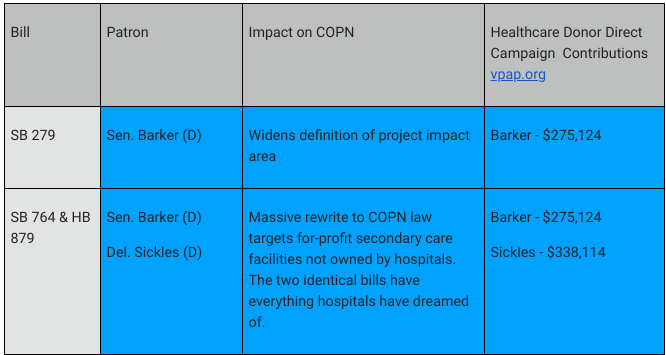
The spreadsheet below shows the worst bills, their sponsors and donations by healthcare interests to their campaigns.

Not shown in the donation numbers are the massive contributions by the same interests to Democratic PACs that passed it on to these campaigns. Hospitals give similar amounts to Republicans, but Republicans in general do not return the favor with such legislation.
Sen. George Barker, D-Alexandria, is on the Senate Commerce (Health Insurance) and Labor Committee, the Education and Health Committee, the Finance and Appropriations Committee and the Joint Commission on Healthcare – a clean sweep for shepherding his legislation. For 30 years he worked for and ran the Health Systems Agency of Northern Virginia, the gatekeeper for COPN applications that makes recommendations to VDH on the disposition of those applications. He is currently a consultant. 
Del. Mark Sickles, D-Alexandria, is the new chairman of the House Health, Welfare and Institutions Committee and Vice Chair of the House Appropriations Committee. Sickles’ Senior Advisor for Policy is Donald Harris. Mr. Harris retired from Inova as its chief lobbyist.
The bills are couched in language that will allow the patrons to claim that they are designed to increase access to intermediate care to poor people by requiring such facilities to care for indigent and Medicaid patients. In truth, they will result in the closing of many of the few existing intermediate care facilities not owned by hospitals and ensure that few independent physicians ever again apply for a certificate. Virginia nation-leading hospital operating margins will expand again as will the costs of government, commercial and workmens’ compensation, health insurance and co-pays. 
Hospital-owned ambulatory surgery centers (ASCs) and imagery centers get paid far more than independent ones by both government and private insurers. Additional facts:
▪       These bills make the charity care requirement apply to ambulatory care facilities, including existing ones. That provision will have no practical effect on hospital-owned facilities.
▪       Most of Virginias intermediate-care facilities are structured as taxable partnerships or LLCs. Neither of those corporate structures is able to deduct from its taxes charitable services provided to indigent patients or losses incurred in treating Medicaid patients.
▪       Many hospital-owned surgery and imagery centers, including Northern Virginia stalwarts Inova Ambulatory Surgery Center at Lorton, Inova Surgery Center at Franconia-Springfield and others, provided no charity care in 2018. They are taxable partnerships owned by a tax exempt health system.
▪       Patients cant report to a secondary care facility without a referral. Many of the doctors in the employ of integrated health systems are expected to refer within those systems and to refer for indigent and government insured patients for ambulatory services and procedures to their hospitals, not their outpatient centers.
▪       Barker and Sickles’ bills also
1.     define a new state board to write a multi-year plan for health services facilities dominated by incumbents and
2.     Extend to ASCs a tax that hospitals volunteered to pay to secure the massive additional profits hospitals will get Medicaid expansion. 
The outcome: no change for hospital systems and huge new burdens on their secondary-care competitors.
The General Assembly, if it cares about either the appearance of internal corruption or the budgets of their constituents, will legislate that no members serving on any committee including appropriations can accept donations either directly or through party PACs from interests benefiting financially from bills brought before those committees.  Those who have accepted more than $100,000 in their careers could serve on the committees but could not vote on any legislation that would benefit their donors.
Seems simple enough. Dont hold your breath.
This annotated version of the Sickles/Barker bill will offer readers a glimpse into how complex, restrictive and utterly subjective COPN law is. I hope my footnote commentary proves a useful guide.
A version of this commentary originally appeared in the online Bacons Rebellion on January 24, 2020.
E-Mail this Author

Posted in Health Care | 1 Comment

Accountability Without Testing = Trouble

Share this article on:

Editor’s Note:  Several bills have been introduced by both Democrats and Republicans in the Virginia General Assembly to eliminate a wide swath of state tests – from high school end-of-course  tests in the sciences and history to all writing exams testing whether a generation that has learned to type with their thumbs can communicate effectively.  While the concept of replacing these tests with “authentic assessments” has a certain attractiveness, there are clear pitfalls – particularly if the state does not take the money it will save by eliminating these tests (why can we not help but wonder if this is the real reason for their elimination?) and reinvest it in ensuring such assessments are of equal rigor and evaluation from Petersburg to Fairfax. 

In this column, Chester E. Finn, Jr. provides a cautionary tale for legislators, educators, and students alike.  Mr. Finn’s experience includes chair of the National Assessment Governing Board, vice chair of the Maryland State Board of Education, assistant secretary of the US Department of Education, and Professor of Education at Vanderbilt University.  Before plunging into a dramatic and drastic elimination of examinations, Virginia legislators might do well to heed the tale.

An unhappy episode in Montgomery County, Maryland, (where I live) reminds us that the quest for accountability options other than standardized assessments can open the door to new forms of chicanery.

First, a bit of background. Maryland’s high school graduation requirements include statewide end-of-course exams in science, algebra, English, and government. Students may substitute passing scores on AP or IB exams in several of those subjects, but it’s accurate to say that the Old Line State has stuck with mandatory EOCs even as a number of jurisdictions have backed away from them. Still, there are kids who have trouble passing those exams, and Maryland has long offered a work-around known as the Bridge Plan. Students who twice fail the EOC in a subject can undertake an individual project in that subject, and if they successfully complete it, their exam failure won’t preclude them from graduating. Ten or 11 percent of Maryland diplomas are typically achieved with the help of the Bridge Plan, and in some parts of the state it has become a major highway to the graduation stage: Almost a quarter of the diplomas in Prince George’s County and close to two-fifths of those in the city of Baltimore are Bridge-dependent. Which is to say, sizable fractions of the girls and boys in those jurisdictions would not be graduating from high school if they were actually required to pass the state EOCs.

The Bridge Plan has been controversial for years now and was much debated—and deplored—during my time on the State Board of Education and the Kirwan Commission, the obvious issue being whether kids who graduate with its help are, in effect, getting diplomas they don’t truly deserve because they haven’t actually met the state’s none-too-demanding academic standards in core subjects. Legislators are currently weighing the Kirwan recommendations, and if those get adopted in full, the Bridge Plan will eventually be history, though much finetuning will need to be done by state education officials before new standards and metrics for “college and career readiness” are set for the long haul, and there is certain be continued pressure to allow some sort of workaround.

Meanwhile, however, myriad incentives are at work to ensure that as many kids as possible get their diplomas, and Maryland’s twenty-four local jurisdictions currently have the Bridge Plan available to assist with that quest.

The state has taken steps to try to build rigor and reliability into the ways that localities deploy the Bridge Plan, but at day’s end it’s the educators in one’s school district—and usually in one’s own school—that evaluate a student’s project to determine whether he or she deserves credit. (The state is unable or unwilling to disclose data on how many of those who actually complete their project “fail” it.) Because of pressure to get kids across the graduation stage—and to see that the high school’s graduation rate looks good for ESSA purposes—there is ample reason to suspect that the criteria and rubrics by which Bridge projects get evaluated are rather elastic.

The recent episode in Montgomery County, however, points to something worse than elasticity. There, a feisty, veteran whistle-blowing high school social studies teacher named Brian Donlon reported that he saw students planning their Bridge projects in government with the help of a worksheet that someone had filled out for them in advance. He viewed it as cheating. “If a student was taking an actual test and gave the student some guidance toward the answer, I think this is exactly the same thing,” he told a Washington Post reporter. “It’s a highly improper level of assistance.” He reported his concern to district officials, but in the absence of any evidence that they were doing anything about it, he contacted the state. State officials looked into the matter in what may have been a cursory way and reported back to Donlon that the district had adequately handled the matter. The district insists that only one pupil—an ELL student—was helped, and that the help given was within bounds. Donlon disagreed and wrote back to the state, saying this wasn’t an isolated instance but something more like a pattern. He also testified before the State Board, noting that the state’s own guidelines say that Bridge monitors “should not complete any portion of a student’s project” and yet declaring that he had seen this done in his school.

How the particular episode gets resolved remains to be seen, but the issue it poses is self-evident, worrying, and I think unavoidable: Educators under pressure to get diplomas to kids and to boost their schools’ and districts’ graduation rates are obviously tempted to help in every way they can. But at some point “helping” crosses a blurry line and becomes “cheating.”

The temptation is obvious in exam-based accountability systems where we can point to documented instances of school officials leaking test questions, changing test responses, and in other ways falsifying information. But exam-based systems have well-established protocols and security provisions that are nearly always implemented. Test booklets are kept under lock and key (or online test questions appear on the screen only when the correct test taker is sitting there). Student identifications are validated. Cellphones and cheat sheets are barred from the testing room. Proctors hover. The completed test books are gathered up and locked away or sealed and shipped for scoring—or the online equivalent is similarly secured.

None of those measures is foolproof, and clever adults with powerful incentives to manipulate the results will continue to seek ways by which to do so. Yet the security protocols are well known and widely adhered to. (Moreover, those doing the scoring have ways of detecting cheating, and periodically one reads of scores being invalidated and exams retaken because something was fishy the first time around.)

When we seek alternatives to the proctored and monitored exam form of high-stakes accountability, however, the challenges multiply. Nearly always, those alternatives—whether classroom work, teacher-administered exams, student projects, performances, portfolios, you name it—are judged subjectively, almost always by adults who know the kids’ identities and academic track records, and most of the time by adults who also have reasons to seek student success, whether it’s because they care about a kid passing and graduating or they’re being hassled by parents or principal or they know that the school’s passing or graduation rate is on the line. And how on earth can anyone actually monitor the criteria by which that alternative work gets judged or what kinds of assistance are given to students while they do it? (Parents and paid outside tutors and counselors may also get involved in “helping,” not just educators. Remember “Varsity Blues”?) Few intentionally cheat—but there’s no foolproof way effectively to monitor where the lines get drawn by whom.

Sure, there are ways to ameliorate the risk. Teachers from other schools can evaluate kids’ projects or portfolios. Student names can be “blinded” from evaluators. External reviewers can double-check the work or at least audit a sample of it. At day’s end, however, we’re still wrestling with the same challenges of incentives, familiarity, and “wanting to help.” Nobody likes to see kids struggle, flounder, or fail.

I, too, worry about over-testing and placing excessive pressure on test scores. I understand that, even under the best of circumstances, tests—including the very best kinds, such as AP and IB have developed—can only yield limited information about what students have learned and what they know and can do. I understand that there’s much more we want to know about kids and schools than test scores can tell us. But I also understand this: Accountability systems are meaningless (or worse) if they lack integrity, and when we rest them on subjective judgments by adults who face many pressures and incentives, we heighten the risk of mischief. A secure, well-proctored assessment may not yield an optimal accountability system, but at least the data will have integrity. Project-based alternatives such as Maryland’s Bridge plan contain far greater risks of finagling.

A version of this commentary was originally published in The Flypaper, a weekly publication of the Thomas B. Fordham Institute.

E-Mail this Author

Posted in Education | Comments Off on Accountability Without Testing = Trouble

Never Too Late for Serious Tax Reform

Share this article on:

The new chair of the House Finance Committee has introduced a major long-term tax reform proposal that will help most Virginia families, and the former chair of the same committee has offered a significant improvement to it. Both are good bills that should be embraced by the Virginia General Assembly.
Delegate Vivian Watts, D-Fairfax, has proposed House Bill 735 to apply an annual inflation adjustment to Virginia’s income tax brackets, credits and the standard deduction. The federal tax code does that, recognizing that without that simple adjustment a progressive tax system becomes more and more regressive over time. Without indexing inflation provides the government with an annual unearned raise and families with a sneaky annual tax hike.
Delegate Lee Ware, R-Powhatan, dropped in House Bill 1717 right on the deadline Friday, to increase the standard deduction used by most Virginia taxpayers from the current $9,000 per married couple to $12,000. That was the standard deduction level recommended in several bills during 2019, and the Assembly did raise the amount – just not that high. It remains a goal of the Thomas Jefferson Institute for Public Policy.
Neither bill has been “scored” by the Department of Taxation, and once their fiscal impact is estimated the outcries from the spending crowd will begin. Were they to pass, there would be a large tax cut in the early years, followed by a general downward bend in Virginia’s future revenue growth. Tax policy should be considered without respect to the appetite for spending, if only because it will never keep up.
These ideas would be far more viable if Governor Ralph Northam had not plundered and spent the Taxpayer Relief Fund that the 2019 General Assembly created, knowing full well that conformity with new federal tax rules created an ongoing windfall. Now advocates will be cynically challenged to identify exactly what in the massive state budget they would cut to give taxpayers a break.
Watts is joined on her bill by Republican Joseph McNamara of Salem, a CPA who serves on the committee with her and Ware. Their idea is to apply the federal inflation measure known as Chained CPI-U (for urban consumers) to:

  • The four tax brackets of 0-$3,000, $3,000-$5,000, $5,000 to $17,000 and above $17,000.
  • The standard deduction of $4,500 per person or $9,000 per couple
  • The personal exemption of $930
  • The $800 exemption for aged or blind taxpayers.

All would rise, slowly and steadily, keeping tax increases more moderate. Virginia has applied its maximum rate of 5.75% to incomes above $17,000 for decades. When it started that was a middle-class income, but that is long gone. Indexing Virginia’s tax code for inflation is long overdue.
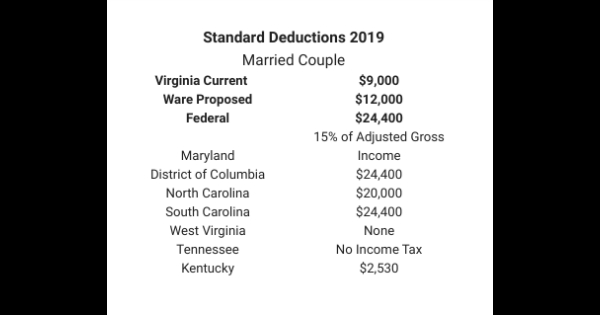
Also overdue are additional amounts fully exempt from tax under the standard deduction. Most surrounding states are far more generous with their standard deductions, some matching the federal amount, which will be $24,400 for a married couple for 2019. But the states are, pardon the pun, all over the map on this as you can see in this useful table. For the most part, the states Virginia competes with for jobs and population have high standard deductions (North and South Carolina) or no personal income tax at all (Texas, Tennessee and Florida).
So, a Virginia family pays no federal income tax on their first $24,400 but starts paying Virginia tax at $9,000. If Virginia matched the federal standard deduction the savings would be a noticeable $800, give or take. Taking it to $12,000, as Ware proposes, is a first good step saving up to $173.
Ware’s bill takes Virginia at least to about one half the standard deduction at the federal level, and in North and South Carolina and the District of Columbia. Maryland allows a variable deduction of 15% of adjusted gross income, surprisingly harsh on working class incomes for that supposedly progressive state.
The Watts bill to add annual indexing was also recognized as a great move for families by the liberal Commonwealth Institute for Fiscal Analysis, although that may be the only common ground between it and the Jefferson Institute. As before, CIFA is pushing the idea of taking the existing Earned Income Tax Credit for low-income workers and making it “refundable,” meaning that if the credit amount exceeds the tax bill, the taxpayer would get the difference as a check.
Del. Jay Jones, D-Norfolk, has that bill. Last year Governor Northam was all over that idea, but now the path to “justice” is spend, spend, spend. He has proposed higher taxes on fuel, tobacco, gaming devices, new carbon taxes, and is introducing rules changes to make it easier to enforce tax collections from low-wage gig economy workers. Those are all regressive steps that the rich will hardly notice. Soak the poor.
Government spending never creates prosperity. If Virginia is going to have an income tax, it should certainly not apply it to dollars even the rapacious federal government will not tax. Step one is to do what the feds do and index the key provisions for inflation. Step two is to move closer – if not all the way – toward exempting the same basic amount of income from tax through a higher standard deduction. The Watts and Ware bills should pass.

E-Mail this author

Posted in Taxes | Comments Off on Never Too Late for Serious Tax Reform