Economic Impact: President-elect Trump’s plans should support economic growth

Share this article on:

Based on the increase in stock prices since the election, investors believe the Trump administration is going to usher in faster economic growth.
Are they being too optimistic?

Tax cuts for individuals and corporations, which is a key component of President-elect Donald Trump’s campaign promises, should support economic growth.
Since consumer spending makes up about 70 percent of U.S. gross domestic product, reductions in individual income taxes will support growth.
Not all of the tax cut will translate into spending, however, because some households likely will use the tax savings to pay down debt or increase savings.
Even so, the proposed Trump policies call for tax cuts in various degrees for all income groups.
Based on an estimate by the Urban Institute and the Brookings Institution, the plan would cut taxes by an average $2,940 in 2017 for households. The plan also calls for the elimination of the alternative minimum tax, the estate tax, and the gift tax.
Increasing productivity growth is critical to boosting the potential growth rate of the U.S. economy and improving living standards. This is where Trump’s promises of lower corporate tax rates and reduced regulation can make a big difference in GDP growth.
Cutting the corporate tax rate from the existing 35-percent rate to a 15-percent rate and repatriating overseas profits should boost profits to domestic firms.
These changes, combined with other policies allowing businesses to expense investments rather than depreciate them over a long period, should increase business investment in plant and equipment that will lead to productivity gains.
Promised reductions in business regulations, including key environmental and financial ones, also can increase productivity growth as increased regulations are generally associated with lower productivity growth. Many analysts expect changes to the Dodd-Frank law regulating financial institutions and the Clean Power Plan that affects energy companies.
Relaxing environmental regulations also will allow for more domestic energy exploration and production. This will increase the domestic energy supply and keep oil prices down. Lower oil prices can dampen future inflation, while increasing business investment and personal consumption at the same time.
On government spending, the new administration has promised to increase spending on military and infrastructure, which should stimulate economic growth.
On the other hand, Trump also vows to decrease the size of government agencies, which tends to reduce overall government spending.
The net effect of these policies will depend on whether some or all the plans are implemented.
Incorporating these policy changes into Chmura Economics & Analytics’ macroeconomic model indicates the proposed economic policies of the new administration can boost 2017 GDP growth by 0.6 percentage points, from 2.4 percent under the pre-election forecast to 3.0 percent.
For 2018, the new policies can increase GDP growth to 3.9 percent, up from 2.7 percent under the pre-election forecast.
In the new forecast, we assume that Trump’s trade policies impact both exports and imports, with a larger reduction in the growth rate of imports that reduces the U.S. trade deficit thereby increasing GDP growth.
With the presidency and both chambers of Congress under the control of the Republican Party, big shifts are likely regarding future economic policy. The longer-term effects of a Trump administration depend on whether economic activity increases enough to offset tax cuts and new spending as well as how other countries react to Trump’s trade policies.
And, of course, the midterm election in two years may impact the Trump administration’s ability to put in place new policies in the second-half of his term.
(This Column first appeared in the Richmond Times Dispatch on Jan. 2, 2017)

chmura-100Email this author

Posted in Economy | Comments Off on Economic Impact: President-elect Trump’s plans should support economic growth

Environmentalist Insurance Policies

Share this article on:

Many liberals went into denial, outrage and riot mode after November 8. Now they’re having meltdown over President-Elect Donald Trump’s cabinet nominees with climate and environmental responsibilities:

Former Texas Governor Rick Perry at Energy, Oklahoma AG Scott Pruitt for EPA, Alabama Senator Jeff Sessions for Attorney General, ExxonMobil CEO Rex Tillerson at State, Montana Congressman Ryan Zinke at Interior. As Department of Agriculture secretary and multiple assistant, deputy assistant and other senior level positions are filled, the meltdown will likely raise sea levels by several feet.
It’s even worse than “white supremacists” and “Russian hackers” rigging and stealing the election. Having these people at the helm will be an “existential threat to the planet,” say meltdowners.
A typical over-the-top reaction came from an aptly named spokesperson for radical pressure groups and five-alarm climate scientists that feed at the trough of taxpayer and tax-exempt foundation funding “This is the wealthiest, most corporate, most climate-denying cabinet in history,” snorted Kiernan Suckling, director of the anti-development Center for Biological Diversity.
After eight years of anti-fossil-fuel, anti-growth, anti-job, anti-blue-collar policies – and the Left’s fervent wish for eight more years under Hillary Clinton – any Trumpian shift is bound to look that way to them.
So we’re likely to get a bellyful of bombast from like-minded (or ill-informed) office and neighborhood partygoers, especially if they’re too much imbued with holiday spirits. At the risk of offending those who do not share an NRA perspective on gun control (stance, grip, sight alignment, trigger control), here’s a little intellectual ammunition that conservatives may find helpful during those “spirited” discussions.
The United States needs to reduce taxes and regulations that have hobbled energy development and job creation – threatening to put federal bureaucrats firmly in control of our states, communities, livelihoods and living standards. However, as I noted recently, these essential, long overdue changes will come with no reduction in air, water or overall environmental quality standards that ensure our health and welfare. They will address rogue agency actions that actually impair our living standards, health and wellbeing.
Indeed, nearly all these autocratic government actions are based on some variation of the infamous “precautionary principle.” This infinitely malleable pseudo-guideline says chemicals and other technologies should be restricted or banned if there is any possibility (or accusation by radical activists) that they could be harmful, even if no cause-effect link can be proven.
Even worse, the bogus principle looks only at often-inflated risks from using chemicals, energy systems or other technologies that activists or regulators dislike – never at the risks of not using them; never at risks that could be reduced or eliminated by using them. Sustainability “guidelines” are very similar.
Just as perversely, if the Powers that Wannabe like a technology, they ignore or actively suppress any harmful impacts. For instance, since wind turbines can supposedly replace fossil fuels, they ignore bird and bat deaths, human health damage from infrasound, and the fact that essential metals are mined and processed under horrendous conditions by men, women and children in African and Asian countries.
Those environmental, health, human rights, and child labor violations are far away (literally not in their backyards), and thus can be conveniently ignored.
So can the poverty, disease, malnutrition and early death perpetrated and perpetuated by extremist groups that campaign tirelessly to shut down industries in developed nation communities – and prevent the poorest nations on Earth from gaining access to modern technologies that improve and save lives.
Eco-extremists claim they can save lives by preventing higher temperatures, rising seas, and more storms, droughts and crop failures due to “dangerous manmade climate change” decades from now. So they block fossil fuel power plants that provide reliable, affordable energy for modern homes, hospitals, schools and factories that improve health and living standards – and end up killing millions right now, year after year.
Climate change has been real throughout history. Sometimes beneficial (moderately warm, with ample rainfall), sometimes destructive (decades-long droughts or cold spells, glacial epochs with mile-thick ice sheets crushing entire continents), it is driven by solar, cosmic ray, oceanic and other powerful natural forces that humans cannot control. Carbon dioxide may play a role, but only a minor one, and rising atmospheric CO2 levels make crops, grasslands and forests grow faster and better.
The “unprecedented” manmade climate cataclysms that Al Gore and Barack Obama promised are not happening. For example, we were supposed to get more frequent, powerful and destructive storms; instead, a record 11 years have passed without one category 3-5 hurricane making landfall in the USA. 
To attack fracking and natural gas use, bureaucrats claim methane is 86 times more potent than CO2 as a greenhouse gas – but won’t admit that it is 1/235th as prevalent in Earth’s atmosphere (0.00017%), and at least 1/600,000th as prevalent as water vapor (1-4%), the most important GHG.
Their “social cost of carbon” schemes assign ever-higher monetary impacts to every climate and weather problem they can possibly attribute to using carbon-based fuels – but totally ignore the enormous and undeniable benefits of utilizing oil, natural gas and coal that still provide 82% of US and global energy.
They’re convinced their anti-energy diktats will “save the planet,” by shutting down US power plants and factories, despite vastly greater emissions from China, India and a hundred other nations that are rapidly expanding their fossil fuel use, to lift billions more people out of abject poverty, disease and malnutrition.
The same anti-technology activists and bureaucrats also detest biotechnology and genetically modified crops that require less water and can battle insect predators with a tiny fraction of the insecticides required for conventional grains and vegetables. They equally despise another GM marvel, Golden Rice, which prevents Vitamin A Deficiency that blinds and kills hundreds of thousands of children every year.
Instead of applauding the reduced blindness, malnutrition, starvation and death these crops can bring, precautionary and sustainability extremists obsess about imaginary risks of eating them, allowing more millions to die unnecessarily, year after year. It’s not their kids, after all. Why should they be concerned?
The same callous, phony ethics prevail on the disease front. Eco-activists support bed nets – but not insecticide spraying to kill malaria-carrying mosquitoes, and certainly not DDT, the most powerful, longest-lasting mosquito repellant ever invented. Sprayed once every six months on the walls of mud or cinderblock houses, DDT keeps 80% of mosquitoes from entering, irritates those that do come in, so they don’t bite, and kills any that land. 
But radical ideologues focus on trivial, irrelevant side effects that “some researchers say could be linked” to DDT use – and let 600,000 parents and children die excruciating deaths every year from malaria.
Every one of these anti-technology, “precautionary” attitudes is the environmentalist equivalent of protecting American kids from powerful chemicals, fatigue, nausea, hair loss, and increased risk of illness and infection – by banning chemotherapy drugs, and just letting the little cancer patients die.
They are the equivalent of requiring you to carry a $10,000-a-year insurance policy that covers you only if you are killed by a meteorite – or by a raptor or tyrannosaur. At least meteorite risks are real, if extremely remote.
Raptors and T rexes exist only in our imaginations, special effects computers and movie theaters – much like the manmade climate chaos and other precautionary extremism that come from computer models and PR hype, and drive too many of our policies, laws and regulations.

Email this author

Posted in Uncategorized | Comments Off on Environmentalist Insurance Policies

Energy Facts and Figures for Dummies Part XI

Share this article on:

(This is part XI of this series on energy. We hope it helps the reader better understand the issues facing our country and our state as we endeavor to tackle the problem of providing our citizens and our businesses with their energy needs.)

Taxes

* From 2007 to 2012, companies in the S.&P. 500 paid an average of 29% in federal, state, local, and foreign corporate income taxes.[1016] [1017] Among large oil companies in the S.&P. 500, the average corporate income tax rate was 37%.[1018]
* The burden of corporate income taxes falls upon: (1) business owners in the form of decreased profits, (2) workers in the form of reduced wages, and (3) possibly consumers in the form of higher prices.[1019] [1020]
* The Congressional Budget Office (CBO) estimates that 75% of corporate income taxes are borne by owners/stockholders and 25% are borne by workers.[1021] Other creditable sources estimate that owners/stockholders bear anywhere from 33% to 100% of this tax burden.[1022] For more detail, see Just Facts’ research on tax distribution.
* Excise taxes are similar to sales taxes, except that they are imposed on specific goods and services.[1023] [1024]
* In addition to raising government revenue, excise taxes are sometimes levied to discourage or penalize certain activities.[1025] [1026] [1027] Per the U.S. Energy Information Administration:

Energy excise taxes are disincentives to the production and consumption of the fuels on which they are levied. Excise taxes increase fuel prices and reduce volumes consumed.[1028]

* In 2016, federal and state excise taxes on gasoline averaged 39 cents per gallon.[1029]

* In 2003, the federal government collected about $35 billion in energy-related excise taxes.[1030] This equates to 5% of all energy expenditures in the U.S. that year.[1031]
* The economic burden of excise taxes primarily falls on retail customers in the form of higher prices. Per the Congressional Budget Office:

The effect of excise taxes, relative to income, is greatest for lower-income households, which tend to spend a greater proportion of their income on such goods as gasoline, alcohol, and tobacco, which are subject to excise taxes.[1032] [1033] [1034] [1035]

* To reduce greenhouse gases, government officials and scientists have proposed increasing taxes on electricity,[1036] gasoline,[1037] crude oil,[1038] steel and aluminum,[1039] flying and driving,[1040] [1041] or any activity that emits carbon dioxide.[1042]


Regulations

* Per the U.S. Energy Information Administration (EIA):
  • “The regulation of energy markets can have the same consequences for energy prices, production, and consumption as the direct payment of a cash subsidy or the imposition of a tax.”
  • “Regulation is the most consequential form of federal intervention in the energy industries. … Many of these interventions are designed to yield environmental benefits.”
  • “Regulations more often explicitly penalize rather than subsidize the targeted fuel.”
  • “There are so many Government regulations concerning energy that it is difficult to identify and analyze all of them.”[1043]

* Regulatory costs for hydroelectric power plants increased from 5% of the total costs of generating hydroelectricity in 1980 to 25-30% of the costs in 2010.[1044] [1045] [1046]
* Regulations on the sulfur content of diesel fuel have played a role in raising the price of diesel above that of gasoline.[1047]
* Regulation of hydropower plants has sometimes reduced output from wind farms.[1048]
* During a January 2008 interview with the San Francisco Chronicle, Barack Obama stated:

Let me sort of describe my overall policy. What I’ve said is that we would put a [greenhouse gas] cap-and-trade system in place that is as aggressive, if not more aggressive, than anybody else’s out there. …
[U]nder my plan of a cap and trade system, electricity rates would necessarily skyrocket, regardless of what I say about whether coal is good or bad, because I’m capping greenhouse gasses: coal power plants, natural gas, you name it, whatever the plants were, whatever the industry was, they would have to retrofit their operations. That will cost money. They will pass that money on to consumers.[1049]

* In June of 2009, the U.S. House of Representatives passed a bill that would have capped most sources of greenhouse gas emissions in the U.S. at 17% below 2005 levels by 2020 and at 83% below 2005 levels by 2050.[1050] This bill passed the House by a vote of 219-212, with 82% of Democrats voting for it and 94% of Republicans voting against it.[1051] The bill was then forwarded to the Senate and never voted upon.[1052]
* In December of 2009, the Obama administration Environmental Protection Agency (EPA) issued a finding that greenhouse gases “threaten the public health and welfare of current and future generations.” This finding allows the EPA to regulate greenhouse gases under the Clean Air Act.[1053] [1054]
* In May of 2013, the Obama administration made a regulatory decision that a metric ton of carbon dioxide (CO2) has a “social cost” of $38. This figure is used by EPA and other agencies under the authority of the President to assess and justify regulations on greenhouse gases.[1055] [1056] [1057]
* Per EIA projections made in 2013, a CO2 tax of $25 per metric ton that begins in 2014 and grows to $37 in 2022 would increase gasoline prices by 11% and electricity prices by 30% in 2022. These increases are relative to a situation in which no government greenhouse gas reduction policies are enacted and “market investment decisions are not altered in anticipation of such a policy.”[1058]
* The U.S. Department of the Interior (DOI), which is under the authority of the President, manages 500 million acres or about one fifth of all U.S. surface land and more than three times as much acreage in offshore areas. DOI leases some of these lands for energy projects such as oil drilling and solar energy facilities.[1059] [1060] [1061]
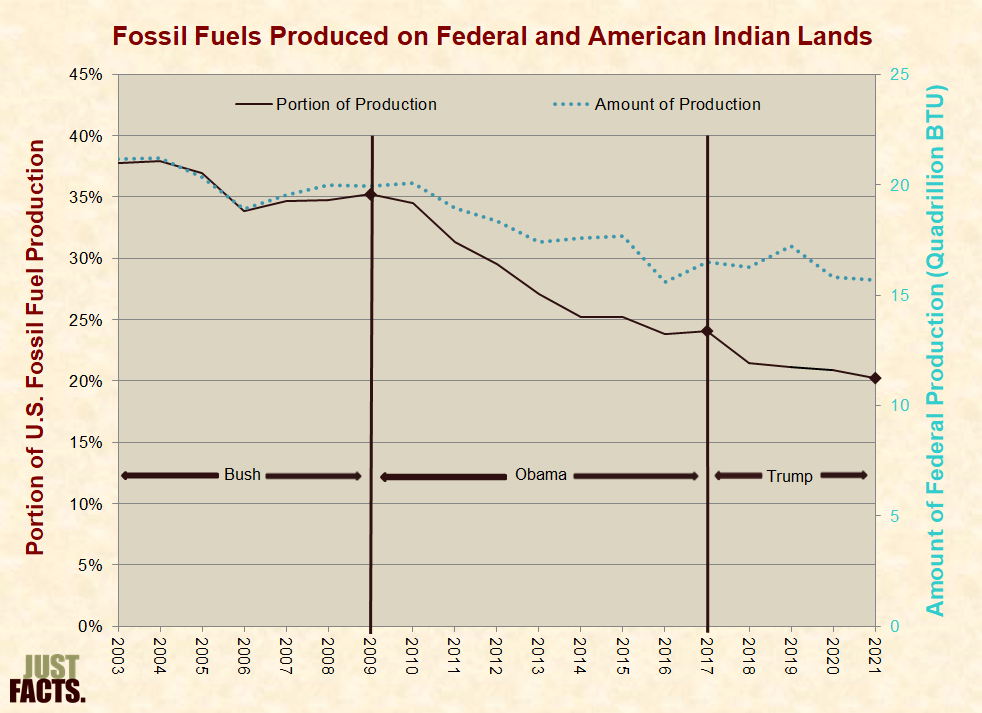
* From 2003 through 2014, energy from fossil fuels produced on federal and American Indian lands declined by 20%, and the portion of U.S. energy from fossil fuels produced on these lands declined by 35%:

Fossil Fuels Produced on Federal, Indian Lands

[1062]
* A 2013 paper in the journal Wildlife Society Bulletin estimated that 888,000 bats and 573,000 birds are killed each year by wind turbines in the U.S. Approximately 83,000 of the bird fatalities are raptors such as hawks, eagles, owls and falcons, which are protected under federal and state laws.[1063] [1064]
* An investigation published by the Associated Press in May 2014 found that:

  • wind farms in Converse County, Wyoming, “have killed more than four dozen golden eagles since 2009….”
  • “The Obama administration has charged oil companies for drowning birds in their waste pits, and power companies for electrocuting birds on power lines. But the administration has never fined or prosecuted a wind-energy company, even those that flout the law repeatedly.”
  • “Getting precise figures is impossible because many companies aren’t required to disclose how many birds they kill. … When companies voluntarily report deaths, the Obama administration in many cases refuses to make the information public….”[1065]

* In November 2013, the Associated Press reported that the Obama administration:

for the first time has enforced environmental laws protecting birds against wind energy facilities, winning a $1 million settlement from a power company that pleaded guilty to killing 14 eagles and 149 other birds at two Wyoming wind farms.[1066]

* In December of 2013, the Obama administration issued a regulation that allows it to give permits to wind farms to accidentally kill eagles for periods of up to 30 years.[1067]
* In June 2014, the Obama administration gave a permit to a California wind farm that allows it to kill up to five golden eagles over five years.[1068]
…………….To Be Continued………………….
Email this author

Posted in Energy | Comments Off on Energy Facts and Figures for Dummies Part XI

Virginia as Best-Educated State – A Worthy Goal?

Share this article on:

The Virginia Plan for Higher Education, the strategic plan for Virginia’s public colleges and universities, has set a bold objective: to make Virginia the best-educated state in the nation by 2030.
To accomplish this goal, the State Council for Higher Education in Virginia (SCHEV) plans to increase the number of degrees and workforce credentials granted from 80,000 per year to 118,000 by 2030 — 1.5 million in all. There are many interesting facets to this plan, particularly SCHEV’s ideas on how to provide affordable access, and I hope to get around to blogging about them in time.
But for now, I want to focus on the goal of making Virginia the best-educated state in the country. What does that mean? And is it even an appropriate goal?
By some metrics, Virginia is a well-educated state. Measured by the percentage of the 25-and-older population with an advanced degree, Virginia is the 4th best educated state in the country, according to Wikipedia. Measured by bachelor’s degrees, we rank No. 6. Ranked by high school graduates, the Old Dominion falls to 29th.
The higher education establishment cannot get Virginia to No. 1 entirely on its own. The Commonwealth needs to increase the pipeline of high school graduates seeking degrees and workforce certifications. Fortunately, the gap between Virginia (where 86.6% of the population 25 years or older has a high school degree) and No. 1 Massachusetts (89.0%) is less then three percentage points. That’s a ravine, not a chasm. It should be bridgeable.
Next issue: What do we gain by churning out thousands of graduates with bachelor’s and advanced degrees? Educated people, like anyone else, need jobs. And if they can’t find jobs in their home state, they will move to a place where they can find them. Thus, Massachusetts, the best educated state in the country as measured by college degrees, suffered a net domestic out-migration between 2010 and 2012 of 9,721 people. Likewise, No. 2-ranking Maryland suffered a net loss of 2,540. By contrast, Virginia enjoyed a net gain of 22,299. The stats don’t tell us how well educated Virginia’s newcomers were, but it is a truism that better educated people are more geographically mobile overall than their less-educated counterparts, so it’s a good bet that they improved the state’s average educational achievement.
States can create more well-educated people than local labor markets can absorb. If Virginia’s economy doesn’t create jobs for those well-educated people to fill, we’re spending millions of dollars to educate citizens who leave the Old Dominion. Here’s the concern:  SCHEV selected the goal of 1.5 million degrees and certifications as a way to get to the No. 1 “best educated state,” not because there is a demonstrated demand for 1.5 million degrees and certifications.
Here’s how the 2015 annual report justifies the best-educated-state goal:

Becoming the best-educated state supports the future prosperity of Virginia, its citizens and its regions. An educated population and well-trained workforce increase economic competitiveness, improve the lives of individuals and support greater community engagement. The best-educated state means that Virginia supports higher education at all levels. This spectrum includes workforce credentials, such as industry certifications, state licensures, apprenticeships, and certificates, as well as traditional degrees.

That’s it. Without more data, we don’t know if becoming the best educated state will contribute to the state’s economic development or will steer resources into an unnecessary and expensive expansion of Virginia’s higher ed establishment.
There is abundant anecdotal evidence that there are widespread skills shortages in certain occupations. So, clearly, there is a need to ramp up education/training in specific areas. Many if not most of these skills can be delivered by community college-level certifications and associate degrees. Whether becoming the “best educated state in the country” will address those specific skills or churn out locally unemployable college graduates is an open question.
(This First ran in Bacon’s Rebellion on Dec. 12, 2016
–
bacon-90Email this author

Posted in Education | Comments Off on Virginia as Best-Educated State – A Worthy Goal?

Censoring Jefferson to safeguard ignorance: President's legacy misunderstood

Share this article on:

The recent demand by nearly 500 faculty members and students that University of Virginia President Teresa A. Sullivan stop quoting UVa founder Thomas Jefferson in her emails reminds us that, when ignorance and arrogance join hands, the results are seldom pretty.
To her credit, President Sullivan did not succumb to the pressure.
And, to be fair, the ignorance of the letter’s signers should not be surprising. We are all ignorant about many important things, and prominent historians have achieved fame and fortune — including prestigious book awards — for their efforts to bring down the man professor Joseph Ellis has described as “the Dead White Male who matters most” and “the most valued trophy in the cultural wars.”
The signers of the letter complain that Jefferson “owned slaves” and held “racist views.” Virtually everyone during Jefferson’s era held racist views (as did Abraham Lincoln decades later); and until the Virginia legislature enacted a 1782 statute — initially drafted by Jefferson 13 years earlier — permitting the manumission of slaves, it was unlawful for him to free the roughly 175 slaves he had inherited from his father and father-in-law.
Philip Foner, editor of “The Complete Writings of Thomas Paine,” noted that the characterization of Paine as “the first American abolitionist” was inaccurate, due to Jefferson’s 1769 effort to legalize the manumission of Virginia slaves.
President Sullivan’s critics appear oblivious to the reality that Thomas Jefferson was a lifelong opponent of slavery. In his original draft of the Declaration of Independence, he denounced King George III for having “waged cruel war against human nature itself” on “a distant people who never offended him” by “carrying them into slavery in another hemisphere.”
Writing for a British abolitionist newspaper in 1843, former President John Quincy Adams noted that this language was too strong for the many other signers of the Declaration who also owned slaves, and at their insistence the language was removed. But the draft was preserved, where Adams declared: “It stands, an unanswerable testimonial to posterity, that on the roll of American abolitionists, first and foremost after the name of George Washington, is that of Thomas Jefferson.” (In reality, Washington never once spoke out publicly against slavery.)
Upon returning to Virginia after drafting the Declaration of Independence, Jefferson prepared a law prohibiting the importation of new slaves into Virginia, which was enacted two years later.
The Constitution prohibited Congress from enacting any law restricting the slave trade until 1808. In 1806, President Jefferson sent a letter to Congress congratulating it on the approaching opportunity “to withdraw the citizens of the United States from all further participation in those violations of human rights which have been so long continued on the unoffending inhabitants of Africa, and which the morality, the reputation, and the best interests of our country, have long been eager to proscribe.” Congress complied.
Writing in his only book, “Notes on the State of Virginia” (1783), Jefferson once again eloquently denounced slavery: “[C]an the liberties of a nation be thought secure when we have removed their only firm basis, a conviction in the minds of the people that these liberties are of the gift of God? That they are not to be violated but with his wrath? Indeed I tremble for my country when I reflect that God is just: that his justice cannot sleep for ever. … The Almighty has no attribute which can take side with us in such a contest.”
When called upon in 1784 by his colleagues in the Second Continental Congress to draft rules to govern the Northwest Territories, Jefferson provided in Article Six: “There shall be neither slavery nor involuntary servitude in the said territory, otherwise than in the punishment of crimes whereof the party shall have been duly convicted.”
It failed by a single vote. Jefferson later lamented: “God was silent in that awful moment.”
But seven decades later, following the Civil War, the authors of the Thirteenth Amendment selected this language for its text to honor Jefferson’s courageous struggle against slavery. (Would those who wish to censor Jefferson’s words strike down the constitutional ban against slavery?)
In addition to the fact that he “owned slaves,” Jefferson’s critics like to remind us that 1998 DNA tests proved he fathered children by the enslaved child Sally Hemings. Wrong again.
I had the honor of taking part in the most thorough examination of all of the evidence on that issue in 2000-2001, when a team of more than a dozen Jefferson scholars from across the nation spent a year looking at all of the evidence and published a 400-page book (“The Jefferson-Hemings Controversy: Report of the Scholars Commission”) concluding with but a single mild dissent that the story is likely false.
They noted that historical evidence had been altered, and that the widely misunderstood DNA tests did not even involve genetic material from Thomas Jefferson. The tests showed merely that one of the more than two-dozen Jefferson men in Virginia at the time likely fathered Sally’s youngest child, Eston. Based solely on the DNA tests, the odds that Eston’s father was President Jefferson were no greater than 4 percent.
Eston’s descendants passed down the story that he was not the president’s child but the son of an “uncle.” The president’s much younger brother Randolph was invited to visit Monticello 15 days before Eston’s likely conception date to see his beloved twin sister, who had just arrived following an extended absence. Because of his relationship to daughter Martha — who ran Monticello while her father was in the White House — he was known as “Uncle Randolph” at Monticello.
In the book “Memoirs of a Monticello Slave,” former blacksmith Isaac Granger stated that Randolph spent his evenings at Monticello playing his fiddle and “dancing half the night” with the president’s slaves. There is no evidence of President Jefferson socializing with slaves.
Days before concluding his second term as president and returning to his beloved Monticello, Jefferson wrote in a Feb. 25, 1809, letter to Henri Grégoire that no person would be more pleased than himself to see a refutation of the doubts he had expressed about the intellectual abilities of black slaves — a distinction he repeatedly acknowledged might be but a consequence of their circumstances.
He added: “[W]hatever be their degree of talent, it is no measure of their rights. Because Sir Isaac Newton was superior to others in understanding, he was not therefore lord of the person or property of others.”
When Jefferson traveled to Paris in 1784, he took with him a servant named James Hemings to be trained as a French chef. Among the most talented servants at Monticello, James was manumitted in 1796 — and within five years had turned to alcohol and committed suicide. The news caused great sadness at Monticello, and likely reinforced Jefferson’s view that — until what he termed “this moral and political depravity” could be outlawed — freeing individual slaves did them no service.
Historian Joseph Ellis expressed the view in his prize-winning biography “American Sphinx” that Jefferson could have passed a polygraph test confirming his conviction that his own slaves “were more content and better off as members of his extended family than under any other imaginable circumstances.”
In an 1814 letter to fellow Albemarle County abolitionist Edward Coles, Jefferson wrote about the duties owed to slaves: “My opinion has ever been that, until more can be done for them, we should endeavor, with those whom fortune has thrown on our hands, to feed and clothe them well, protect them from ill usage, require such reasonable labor only as is performed voluntarily by freemen, and be led by no repugnancies to abdicate them, and our duties to them.”
Much has been made of the fact that Jefferson did not free his slaves in his will. The simple explanation is that during Jefferson’s life, African slaves were treated under the law as chattel property (like cattle), and Section 54 of the Revised Virginia Code of 1819 protected the rights of creditors. Jefferson died deeply in debt, and thus freeing his slaves in his will was not a legal option.
As the world confronts religious extremists who brutally behead and burn alive those who refuse to embrace their theology, we should remember that Jefferson also authored the Virginia Statute for Religious Freedom — protecting our right to worship the God of our choice (or none at all).
He also championed the cause of what he called “Native Americans” (a term primarily used at the time to refer to people of European ancestry born in the New World), and acknowledged in 1785 they were in body and mind “equal to the white man.” The following year he declared: “The want of attention to their rights is a principal source of dishonor to the American character.”
Indeed, Jefferson’s primary criticism of Native Americans was that they subjected their women to “unjust drudgery,” which he contended was the case “with every barbarous people.”
“[F]orce is law,” he said. “The stronger sex imposes on the weaker.”
Was Jefferson perfect? Certainly not. But he was ahead of his time in so many ways.
Rather than promoting ignorance by censoring his thoughts and writings, UVa faculty and students should feel honored to have the opportunity to teach and study at the remarkable university he founded nearly two centuries ago.
I have repeatedly offered to debate as many as three critics of Jefferson at a time on these issues — UVa faculty or from elsewhere. Thus far, there have been no takers. The offer remains open.
Professor Robert F. Turner holds both professional and academic doctorates from the University of Virginia Law School and is a Distinguished Fellow at the Center for National Security Law.
(This article first ran in the Charlottesville Daily Progress on November 27, 2016)
turner-updated  Email this author

Posted in History | Comments Off on Censoring Jefferson to safeguard ignorance: President's legacy misunderstood