What’s the Hold-up on the Surry-Skiffes Permit?

Share this article on:

Yorktown Power Station. Photo credit: Daily Press

Yorktown Power Station. Photo credit: Daily Press


In the late summer of 2015, Dominion Virginia Power issued grave warnings that residents and businesses of the Williamsburg-Newport News area could face electricity blackouts if the power company didn’t quickly receive permits to build the proposed 500 kV Surry-Skiffes Creek transmission line. When Dominion shuts down its aging, coal-fired units at the Yorktown Power Station in 2017, the company said, existing transmission lines serving the Virginia Peninsula would not have enough capacity to meet federal reliability standards on days of heavy power demand. Any kind of adverse event on the system would force the company to execute controlled blackouts in order to prevent an uncontrolled, cascading failure.
More than a year has passed, and the U.S. Army Corps of Engineers (ACOE) still has not ruled for or against Dominion’s Joint Permit Application to build the 20-mile, $179 million transmission line. Environmentalists and conservationists say that the transmission line would visually disrupt a  historically significant stretch of the James River near Jamestown, and that Dominion never seriously explored alternative ways to meet the Peninsula’s electricity needs.
There are two main procedural steps yet to complete. First, Dominion must either complete or terminate a Memorandum of Understanding (MOU) detailing its plan to “mitigate” the negative impact of the transmission line. ACOE also must complete an “alternatives” analysis demonstrating that the Surry-Skiffes line is the most practical way to ensure a reliable supply of electricity to the Peninsula. Then the ACOE can conduct the final “public interest review” that weighs all the benefits and detriments of the proposal. Tom Walker, Norfolk chief of the COE’s regulatory branch, tells Bacon’s Rebellion he “won’t hazard a guess” as to how much longer it will take to complete the regulatory review.
To obtain a mitigation MOU, Dominion must get buy-in from the ACOE, the Virginia Department of Conservation and Natural Resources, and the Advisory Council on Historic Preservation (ACHP). More a dozen other “consulting parties” are invited to sign the MOU but their signatures are not required.
Foes of the Surry-Skiffes project say the high towers of the transmission line crossing the James River will be highly visible from the original Jamestown settlement and many other vantage points along the river where historic conservation is a high priority. Despoiling these views would desecrate Virginia’s “founding river.” Dominion counters that the towers will be barely visible on the horizon.
However, facing political reality, the power company has proposed a series of measures to mitigate whatever harm is done by the transmission line. In a draft agreement dated June 7, Dominion would dedicate $85 million to landscape, conservation and water-quality initiatives in the vicinity, coat the metal towers with a finish that minimizes glare, and initiate a heritage-tourism study. If, prior to the conclusion of the project’s 50-year lifespan, Dominion concludes the line is no longer needed, it will remove the towers and supporting infrastructure.
Those proposals don’t come close to mollifying the more outspoken opponents of the project. “This can’t be mitigated,” says Margaret Nelson Fowler, co-founder of the Save the James Alliance. “From what I’m told, the consulting parties are nowhere close to an agreement. ACHP is pretty far apart from Dominion.”
“Termination does not kill the project,” says ACOE’s Walker. But it does create a higher hurdle for Dominion to surmount when the ACOE conducts its final public interest review. Working in Dominion’s favor is the fact that the ACOE has ascertained that proposed alternatives such as installing scrubbers on the Yorktown power units or converting them to natural gas are not practical. However, even that determination is tentative, based on the information the ACOE had at the time, and could be revised.
Whatever solution Dominion pursues, time is of the essence. Last week, the Daily Press’s David Ress reported that Dominion ran its Yorktown coal-fired units on 20 days this past July and August. Dominion is under EPA orders to fire up the polluting boilers only when absolutely needed to preserve the reliability of service to the Peninsula; the units must be shut down next spring. Wrote Ress:

If the Yorktown plants had not run on those occasions, any failure on the high voltage lines serving the Peninsula could have forced PJM — the operator of the electric grid serving 13 states from New Jersey west to Illinois and south to North Carolina — to order interruptions of electric service, PJM spokesman Ray Dotter said.

Even if Dominion got the go-ahead to build the transmission line tomorrow, construction would take more than a year. Given the prospect of blackouts next summer, does ACOE feel a sense of urgency in reaching a conclusion one way or the other?
Walker did not answer that question directly, but said that ACOE is obligated to follow a certain process. The ACOE is “moving as expeditiously as possible,” he said. “We do have folks focused on this thing.”
(This column first appeared in Bacon’s Rebellion on Oct. 24)
bacon-90Email this author

Posted in Energy | Comments Off on What’s the Hold-up on the Surry-Skiffes Permit?

Economic Impact: Signs in the economy show presidential race is too close to call

Share this article on:
Luckiest Generation In U.S. History?( Editor’s note: This year’s election is certainly one that we won’t soon forget, even if we want to! This column was written two weeks ago.)
With the election less than a month away, pundits are providing a variety of reasons why either presidential candidate will win in November.
What does the economy tell us about a potential winner? It seems to be telling us that the race is too close to call.
One key indicator gives Donald Trump the advantage while two other indicators tend to give Hillary Clinton the edge.
The analysis is based on three economic indicators that give us a sense of the mood of voters looking at whether the incumbent party retained or lost control of the White House over the past 16 presidential elections – from 1952-2012.
The three economic indicators are:
• Stock market performance (three months leading up to the election);
• Change in the unemployment rate (year leading up to the election); and
• Change in employment (six months leading up to the election).
For the stock market indicator, if the S&P 500 is up in the three months leading up to the election, then the incumbent party won 78 percent of the time.
But the incumbent party lost 86 percent of the time when the S&P 500 is down over the same period.
The S&P 500 is currently down 0.8 percent from the beginning of August which predicts that Trump has a slight advantage over Clinton. But we still have another month of stock market results to consider.
If the unemployment rate increases in the year leading up to the election, then the incumbent party lost 100 percent of the time. Yet the incumbent party won 67 percent of the time when the jobless rate decreases.
The jobless rate edged up to 5 percent in September after three months at 4.9 percent. But September’s rate is down from the 5.1 percent rate in September 2015 but it is unchanged from October and November 2015 figures. That gives Clinton a slight edge over Trump. But one more jobless report is slated to be released before the election.
On the employment indicator, the incumbent party lost 100 percent of the time when the number of jobs created fell over the six months leading up to the election. But the party’s candidate won 68 percent of the time when employment rose over the same period.
Employers have added about 850,000 jobs since May 2016, which gives the advantage to Clinton.
Using historical view of changes in the stock market, unemployment rate, and employment as a predictor of the election is a simple approach.
Even using more complex models such as the Vote-Share Model created by Ray Fair at Yale University or the Political Economy model by Michael Lewis-Beck of the University of Iowa and Charles Tien of Hunter College, the presidential outcomes differ by narrow margins.
The Fair Model—which is based on broad measures of growth captured in GDP—predicts a Trump victory, while the Political Economy Model—which is based on economic growth as well as Gallup’s Presidential Approval—suggests a Clinton victory.
With no clear winner based on the economy or the most recent polls, it looks like it will be a long election night.
(This Column first appeared in the Richmond Times Dispatch on Oct.10, 2016)
chmura-100Email this author
Posted in Economy | Comments Off on Economic Impact: Signs in the economy show presidential race is too close to call

Another ammonia case dismissed, but the environmentalists will keep fighting

Share this article on:

another_ammonia_case_dismissed_environmentalists_keep_fighting_1_636123739200536000On Dec. 7, 2015, I wrote that ammonia regulation of large animal operations would be delayed again. The Humane Society of the United States (HSUS), Iowa Citizens for Community Improvement and Clean Wisconsin were told by a U.S. District Court in Washington, D.C. that EPA was not required to regulate ammonia emissions from Concentrated Animal Feeding Operations (CAFOs) pursuant to the Clean Air Act (CAA). I wrote in the December blog that only one case had been decided.
A second suit was filed in January, 2016 by HSUS, Association of Irritated Residents, Environmental Integrity Project, Friends of the Earth, and Sierra Club against EPA. Plaintiffs filed their original petition to regulate ammonia from CAFOs in 2009.
Environmental groups have been persistent in their effort to compel EPA to regulate ammonia from CAFOs.
On September 19, 2016, the U.S. District Court for the District of Columbia dismissed the environmental groups’ second request to force EPA to regulate ammonia and other emissions of pollutants from CAFOs. The environmental groups are unlikely to stop their effort to regulate ammonia. The environmentalists say CAFOs are harmful to citizens living in the area, claiming that “Given the robustness of the data set, this demonstrates a statistically significant correlation between livestock [ammonia emissions] and infant death.”
Deadly pollutant?
Infant deaths!! To the environmentalists, ammonia is a deadly pollutant.
The September 19, 2016, opinion is a recitation of legal procedure under the CAA and the Administrative Procedures Act (APA). In this case, EPA moved to dismiss the environmentalists’ lawsuit by simply claiming again that the environmental groups had failed to provide sufficient notice, 180 days, which is required by the CAA.
The environmentalists used the APA as its jurisdictional base to sue EPA and claimed it had not responded to the environmental petition for rule making. In an argument only lawyers could love, the parties simply disagreed as to whether the U.S. District Court had jurisdiction to hear this case under the APA or the CAA.
You might say, as another famous person has said, “What difference does it make?” A lot!
These cases have been wasting the Court’s time for a long time. EPA takes the position that under the citizens’ suit provision in the CAA, environmentalists must provide EPA with 180 days’ before filing suit under the CAA. For inexplicable reasons the environmentalists’ did not follow the simple dictate of the statute.
I wrote last December that this case presumably would be dismissed, and it has been.
Environmentalists in this case wanted to use the APA to move quickly because it “provides a cause of action for the plaintiff and a waiver of sovereign immunity by the government.” The Court made it clear that “[T]he APA’s waiver of immunity comes with an important carve-out: the waiver does not apply if any other statute that grants consent to suit expressly or impliedly forbids the relief which is sought by the plaintiff.”
EPA’s lawyers simply pointed out the CAA trumped the APA and the environmentalists are required to give EPA 180 days notice before commencing a lawsuit regarding unreasonable delay. The Court goes into reviewing what Congress did in 1990 which required the 180-day requirement. Congress clearly wanted to allow EPA sufficient time to respond. The Court makes it clear in its opinion that it has jurisdiction to review and compel agency action if it is “…unreasonably delayed”.
Even though this is a victory in the short term, the Court suggests all plaintiffs have to do is give EPA a 180-day notice before filing a lawsuit, which the environmentalists conceded in this case that they did not do. Based on 2 legal defeats, one can only presume the environmentalists will follow the law and continue their efforts to regulate ammonia under the CAA. CAFOs beware!
(This article first ran in Farm Futures on October 20, 2016)
Email this author

Posted in Agriculture | Comments Off on Another ammonia case dismissed, but the environmentalists will keep fighting

Energy Facts and Figures for Dummies, Part VII

Share this article on:

(This is part VII of this series on energy. We hope it helps the reader better understand the issues facing our country and our state as we endeavor to tackle the problem of providing our citizens and our businesses with their energy needs.)


just-facts-energy 150Safety
* A commonly utilized measure of radiation dosage is millisieverts (mSv). On average, each person receives 2.4 mSv per year of natural background radiation, typically varying from 1-13 mSv per year. Per the United Nations Scientific Committee on the Effects of Atomic Radiation, “sizeable population groups receive 10-20 mSv annually” of natural radiation. This does not include any radiation from human activities.[644] [645]
* Over the course of a lifetime, most people receive about 70-700 mSv of radiation from natural sources.[646]
* After tobacco smoke, the second leading cause of lung cancer in the U.S. is radon, a gas that arises from the decay of natural uranium, which is common in rocks and soils.[647] The EPA estimates that 14.4 percent of lung cancer deaths in the U.S. are related to radon.[648]
* Due to hot springs that leach a radioactive element from underground, 2,000 residents in the city of Ramsar, Iran, receive up to 260 mSv of natural background radiation per year. Per a 2002 paper in journal Health Physics, preliminary studies indicate an “apparent lack of ill effects among observed populations of these high dose rate areas….”[649]
* Regarding manmade sources of radiation, on average: a person underdoing a CT scan receives a dose of 10 mSv. a nuclear power plant worker receives a dose of 1 mSv per year. the general population receives a dose of 0.0002 mSv per year as a result of the nuclear power industry.[650] [651]
* Concentrated (i.e., high-level, high-rate) radiation doses generally cause more harm than the same doses spread out over longer periods of time.[652] Concentrated radiation doses of:more than 10,000 mSv are always fatal.1,000-10,000 mSv can cause radiation sickness (which may result in death) and can increase the risk of certain cancers.
10-1,000 mSv have no immediate effects but may increase the long-term risk of certain cancers.[653]
* Two major studies of survivors of the 1945 atomic bombings in Hiroshima and Nagasaki have found increased rates of certain cancers among populations who received concentrated radiation doses below 100 mSv, but none of the results were statistically significant below this level.[654]
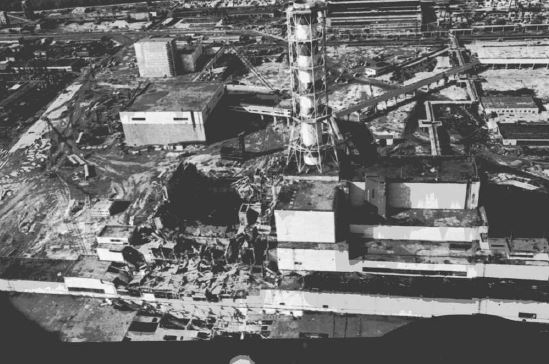
* The largest nuclear power accident in the world occurred in the city of Chernobyl in the Soviet Union in 1986.[655] A picture of the reactor after the accident is shown here:

* Per the official summary of a 2006 three-volume report by the International Atomic Energy Agency, World Health Organization, U.N. Development Programme, Food and Agriculture Organization, U.N. Environment Programme, U.N. Office for the Coordination of Humanitarian Affairs, U.N. Scientific Committee on the Effects of Atomic Radiation, World Bank, and the governments of Belarus, the Russian Federation, and Ukraine:
“Approximately 1,000 on-site reactor staff and emergency workers were heavily exposed to high-level radiation on the first day of the accident….”
“More than 350,000 people have been relocated away from the most severely contaminated areas, 116,000 of them immediately after the accident.”
“An estimated five million people currently live in areas of Belarus, Russia and Ukraine that are contaminated with radionuclides due to the accident….”
“[M]ost recovery operation workers and those living in contaminated territories received relatively low whole body radiation doses, comparable to background radiation levels and lower than the average doses received by residents in some parts of the world having high natural background radiation levels.”
“As of mid-2005 … fewer than 50 deaths had been directly attributed to radiation from the disaster, almost all being highly exposed rescue workers, many who died within months of the accident but others who died as late as 2004.”
“About 4,000 cases of thyroid cancer, mainly in children and adolescents at the time of the accident, have resulted from the accident’s contamination and at least nine children died of thyroid cancer; however the survival rate among such cancer victims … has been almost 99%.”
“A total of up to 4,000 people could eventually die of radiation exposure from the Chernobyl nuclear power plant accident…. The estimated 4,000 casualties may occur during the lifetime of about 600,000 people under consideration. As about a quarter of them will eventually die from spontaneous cancer not caused by Chernobyl radiation, the radiation-induced increase of about 3% will be difficult to observe.”
“Because of the relatively low doses to residents of contaminated territories, no evidence or likelihood of decreased fertility has been seen among males or females. Also, because the doses were so low, there was no evidence of any effect on the number of stillbirths, adverse pregnancy outcomes, delivery complications or overall health of children.”
“Persistent myths and misperceptions about the threat of radiation have resulted in ‘paralyzing fatalism’ among residents of affected areas.”
“Poverty, ‘lifestyle’ diseases now rampant in the former Soviet Union and mental health problems pose a far greater threat to local communities than does radiation exposure.”[657]
* Per the “environment” volume of the above-cited 2006 report:
“Radiation from radionuclides released by the Chernobyl accident caused numerous acute adverse effects in the biota [plants and animals] located in the areas of highest exposure (i.e. up to a distance of a few tens of kilometers from the release point).”
Such effects included: “(a) Increased mortality of coniferous plants, soil invertebrates and mammals; (b) Reproductive losses in plants and animals; (c) Chronic radiation syndrome in animals (mammals, birds, etc.).”
“Beyond the CEZ [Chernobyl exclusion zone, which is 30 km or 19 miles around the site of the accident], no acute radiation induced effects on biota have been reported.”
“Following the natural reduction of exposure levels due to radionuclide decay and migration, populations have been recovering from the acute radiation effects.”
“By the next growing season after the accident, the population viability of plants and animals substantially recovered as a result of the combined effects of reproduction and immigration. A few years were needed for recovery from the major radiation induced adverse effects in plants and animals.”
“Both in the CEZ and beyond, different cytogenetic [cellular/genetic] anomalies attributable to radiation continue to be reported from experimental studies performed on plants and animals. Whether the observed cytogenetic anomalies have any detrimental biological significance is not known.”
“At present, traces of adverse radiation effects on biota can hardly be found in the near vicinity of the radiation source (a few kilometers from the damaged reactor), and on the rest of the territory, both wild plants and animals are flourishing because of the removal of the major natural stressor: humans.”[658]
* The second-largest nuclear power accident occurred in March of 2011 at the Fukushima Daiichi nuclear power facility in Japan. A 9.0-magnitude earthquake and resulting tsunami killed roughly 18,500 people, caused $220 billion in damage, and caused explosions and radiation leaks in multiple reactors at the nuclear power facility.[659] [660]
* A 2014 report about the Fukushima nuclear accident by the United Nations Scientific Committee on the Effects of Atomic Radiation found that:
“no radiation-related deaths or acute diseases have been observed among the workers and general public exposed to radiation from the accident.”
“no discernible increased incidence of radiation-related health effects are expected among exposed members of the public or their descendants.”
“a total of 24,832 workers were reported to have been involved in mitigation and other activities on the site and were occupationally exposed to radiation.”
among the workers, 16,162 received radiation doses of 10 mSv or less, 173 received doses of 100 mSv or more, and 6 received doses of 250 mSv or more (the highest dosage was 679 mSv).”[661] [662]
* The largest nuclear power plant accident in the U.S. occurred near Middletown, Pennsylvania, at the Three Mile Island nuclear facility in March of 1979.[663]
* As a result of the Three Mile Island accident, the maximum radiation dosage to local residents was less than 1 mSv.[664] [665] [666] Per the U.S. Nuclear Regulatory Commission:
In the months following the accident, although questions were raised about possible adverse effects from radiation on human, animal, and plant life in the TMI [Three Mile Island] area, none could be directly correlated to the accident. Thousands of environmental samples of air, water, milk, vegetation, soil, and foodstuffs were collected by various government agencies monitoring the area. Very low levels of radionuclides could be attributed to releases from the accident. However, comprehensive investigations and assessments by several well respected organizations, such as Columbia University and the University of Pittsburgh, have concluded that in spite of serious damage to the reactor, the actual release had negligible effects on the physical health of individuals or the environment.[667] [668]
* As of 2014, the U.S. nuclear power industry had accumulated 3,500 reactor-years of operation without any known deaths or injuries to the public.[669]

To be continued ……………………….

Email this author

Posted in Energy | Comments Off on Energy Facts and Figures for Dummies, Part VII

Needed in Virginia: A Fiscal Early Warning System

Share this article on:

In the wake of the City of Petersburg’s fiscal meltdown, the warningGeneral Assembly has appointed Del. R. Steven Landes, R-Augusta, to head a subcommittee to study how other states deal with fiscally stressed localities. In surveying best practices in other states, it’s a good bet that Landes will familiarize himself with a new report, “State Strategies to Detect Local Fiscal Distress,” published by the Pew Charitable Trusts.
It turns out that 22 states, many of whom have learned from hard experience, have established mechanisms for monitoring the fiscal health of local governments. The idea is to spot the warning signs of fiscal distress in the hopes that local elected officials will take action before their municipality becomes the next Detroit, Mich., Stockton, Calif., or Central Falls, R.I.
Virginia requires cities, counties and towns to file audited documents called Comprehensive Annual Financial Reports (CAFRs), but the oversight ends there. No one at the state level analyzes the data or conveys findings to the public.
Of the 22 states that monitor local fiscal health, Pew classifies eight as “early warning states” with laws defining when local governments are in “fiscal distress” and systems to identify when a locality reaches that status. As Pew notes, an early warning system can save states big headaches and liabilities down the road if it can avert local government failure.
Another big bonus: Credit-rating agencies look positively upon such systems. “All else being equal, we tend to assign higher ratings to troubled governments in states with strong oversight, well-established policies of intervention, and a track record of success,” the study quotes Moody’s Investors Service as saying. Among the key indicators that analysts in other states scrutinize:

  • Audits and other financial information submitted on time
  • Deficits and minimum fund balances
  • Size of debt-service obligations, and debt service as a ratio of population and operating revenue
  • Sufficiciency of cash for services
  • Total revenue and expenditures per capita
  • Unrestricted fund balances
  • Cash-to-liabilities ratio
  • Pension plan funding ratios

Few local elected officials have the financial training to read municipal balance sheets and spot the signs of impending trouble. A state report card on key indicators and ratios would be invaluable to them and to members of the public. Flashing warning signs would give them time to address problems before they reached the point where, like Petersburg, city officials have to make catastrophic cuts to core government services.
(This article first ran in Bacon’s Rebellion on October 10, 2016)
bacon-90Email this author
 

Posted in Economy | Comments Off on Needed in Virginia: A Fiscal Early Warning System