Workforce training that focuses on unfilled jobs

Share this article on:

unemployment-office-150x150The Martinsville area, a manufacturinging powerhouse as recently as the 1980s, has become the poster child for Virginia’s rust belt. Unemployment hit 20% during the bottom of the last recession, and still lingers at 6.8%. Ironically, the Martinsville-Henry County area simultaneously suffers from a labor shortage — a shortage of labor with the right skills, that is.
I addressed this issue back in August in “Is It Time to Blame the Victim,” which described the difficulty local authorities had in finding people willing to undergo the training required to fill hundreds of vacant jobs. Now the Martinsville Bulletin has published an in-depth look at the workforce dilemma.
There is a serious mismatch between workforce skills and the jobs available. As of last week, there were 1,325 jobs open in Martinsville and Henry County. Factors influencing the difficulty in filling the positions include the need for daycare, lack of transportation, and the inability of applicants to pass drug tests. “But a skills mismatch and need for training is the problem area officials most often cited,” states the article.
Patrick Henry Community College (PHCC) and the New College Institute (NCI) battle a perception that education is unaffordable. Adults with families to support must make significant sacrifices even to earn a two-year degree.
One possible solution is to award certifications geared to the needs of particular employers, such as the Center for Advanced Film Manufacturing that grooms students for jobs at Eastman Chemical Co. That program offers a paid internship with Eastman and a guaranteed interview with the company. The company has hired more than 90% of the graduates of the program.
PHCC has launched a similar program with Radial, a logistics and distribution company. Kim Smith-Glisson, director of operations in Martinsville, explains the motivation:

As we grew the business in Martinsville/Henry County we did not want to have to continue to relocate our supervisors, our managers, our senior managers externally from outside of the area. We wanted to be able to develop the talent locally and continue to promote from within.

Drake Extrusion, a polypropene fiber manufacturer, announced a $6 million expansion in Henry County earlier this year, creating 30 jobs. CEO John Parkinson said additional job training is a necessity:

We’ve got a lot of people who are willing to apply for jobs, but they don’t really have the technical skills, the problem-solving skills, the ability to use computers on the shop floor and things like that, which is what we’re really looking for these days. Gone are the days when you’re just looking for people who can press buttons and watch machines.

Bacon’s bottom line: Two-year programs have their place, but they often take too long and impose too high a cost on adults who support families while acquiring new workplace skills. Community colleges and career colleges need to develop programs that deliver employers the specific skill sets their employees need. Likewise, employers need to get over the idea that job training is mainly a public responsibility. They need to partner with community colleges and help underwrite the cost of training programs that benefit them.
Meanwhile, Virginia needs to look at the panoply of job training programs — Nine state agencies distribute more than $340 million in federal and state funds for employee assistance and training — to see how effectively their programmatic models align with labor market realities. Are there obsolete and/or ineffective programs that can be shut down and their resources reallocated to programs proven to work?
The McAuliffe administration has sponsored creation of the Go Virginia program to develop a collaborative approach to workforce development involving business, local government and higher education. Whether Go Virginia delivers a focused approach to workforce training and education, or just adds another layer of bureaucracy, remains to be seen. But one thing seems evident: Training Virginians to fill unfilled jobs that already exist should be a lot easier than solving unemployment by recruiting new businesses to invest in the state.
Update: Patrick Henry Community College already has numerous certification programs that require less than a two-year course of study. See comments of PHCC’s Jim Bove here.
(This article first ran in Bacons Rebellion on November 23, 2016)
–
bacon-90Email this author

Posted in Economy | Comments Off on Workforce training that focuses on unfilled jobs

Virginia shouldn’t waste its unique opportunity to overhaul its school accountability system

Share this article on:

By Michael J. Petrilli and Brandon L. Wright
pencilVirginia needs to improve its accountability system for K–12 education. A relic of the No Child Left Behind era, it has a critical flaw: It encourages schools to narrowly focus on the progress of their lowest-performing students. That’s a worthy and important objective, but it shouldn’t be the only outcome schools are held responsible for.
This shortcoming is particularly pernicious for high-achieving poor and minority children, students who deserve better and are critical to Virginia’s—and our nation’s—competitiveness. They’re the most dependent on the school system to cultivate their potential and accelerate their achievement, yet that system is failing them. This is a tragedy, particularly at a time when Virginia is struggling to help these students complete college and rise to positions of leadership. For instance, only 32 percent of Black students attending the state’s four-year public universities graduate on time. Meanwhile, the Old Dominion is spending $37 million a year in “remedial education”—high-school level courses that college freshmen take because they aren’t really ready for higher learning.
Thankfully, a new federal law, the Every Student Succeeds Act (ESSA), gives policymakers in Richmond a rare opportunity to set schools on the right trajectory for years to come. They now enjoy far greater leeway to design a school accountability system that will work best for all students by turning annual tests results in reading, writing, and mathematics, and other information, into sound judgments of school effectiveness—what it means to be great school or a failing one.
Specifically, when Virginia submits its new accountability system to the U.S. Department on Education for approval in the coming year, it should include three components that will ensure that all kids count.
First, it should rate schools using a model that gives additional credit for students achieving at a high level—something today’s system doesn’t do. Under ESSA, Virginia must continue to track the percentage of students who attain proficiency on annual tests, but the state is free to give schools incentives for students who earn high marks. Policymakers could, for example, create an “achievement index” that gives schools partial credit for getting students to “basic,” full credit for getting students to “proficient,” and additional credit for getting them to “advanced.”
Second, the system should continue to measure the growth of individual students from one year to the next, but it should make this count for at least 50 percent of school ratings. Under Virginia’s current system, growth doesn’t count toward a school’s summative rating at all, and it isn’t publicly reported. Policymakers ought to correct this immediately. Such measures do a better job of capturing schools’ effect on student achievement than proficiency rates, which are strongly correlated with student demographics, family circumstance, and prior achievement.
Finally, Virginia should signal that high-achieving students matter and report their progress separately, much as it already does for special education students and English language learners. Whether they’re growing or languishing is important to know.
Policymakers in Richmond ought to use their newfound flexibility responsibly. Given their freedom under the new federal law to fix the flaws of the past, now is the time to ensure that all students are receiving the education they deserve. High achievers, especially those growing up in poverty, need all of the attention they can get. But for too long, they’ve been an afterthought—a fate no child should suffer. Let’s not make the same mistake again.
petrilli-and-wright
Email Michael J. Petrilli 
Email Brandon Wright
Michael J. Petrilli and Brandon L. Wright are president and editorial director, respectively, of the Thomas B. Fordham Institute.
–

Posted in Education | Comments Off on Virginia shouldn’t waste its unique opportunity to overhaul its school accountability system

Now is the time for immigration deal

Share this article on:

Border Patrol Agents Monitor US-Mexico BorderWith the election over and Republicans keeping control of Congress while also securing the White House, our nation has an opportunity to finally fix our broken immigration system, secure our borders, and deal with those living in the United States illegally.
To date, both sides have refused to budge on their positions, resulting in no compromises—and neither side getting anything they want. Continued failure to solve this problem will put an unacceptable and unnecessary financial burden on state governments, local governments and taxpayers, who absent congressional action are the ones who pay for education and social services for illegal residents in their communities. (Just educating children not lawfully present in my County of Fairfax, Virginia costs our school system well over $100,000,000/yr!)
After more than a decade of discussion with nothing to show for it, without compromise, nothing will happen.  (Note:  Just because there is a House and Senate controlled by Republicans does not mean that a “Republican only” solution can be passed.  A bill needs 60 votes in the Senate and the Republicans only have 52 Senate seats).  
The time to act is now. I say this as a Republican with a clear record of fighting against amnesty.
Not only was I the first legislator in the U.S. to pass a law requiring people to be legally present in order to get a driver’s license, I also carried the law in Virginia that requires adults to be legally present in the U.S. to qualify for non-emergency taxpayer benefits. In addition, I sponsored the Virginia law that requires all people arrested for crimes to be checked for legal status, and was the primary force behind Virginia’s e-verify law.
So I am no “softie” when it comes to immigration reform.
However, I am also a realist. Practically speaking, it would be impossible to deport all of the 12 million illegal immigrants living in our nation.  At the same time, it is equally impossible that we leave our borders unsecure.  I believe that lawmakers and citizens of both parties can find common ground on this issue, if both are willing to compromise on certain aspects of their positions.  From the conservative point of view, such a compromise must be predicated on two conditions:

  1. Our borders must be secure (via a physical wall, virtual wall, or any other effective solution).
  2. Those with criminal records must be deported.

Only when these two conditions are met—and verified by agreed-upon metrics—should we consider allowing some of those not lawfully present in our country (e.g. those who have paid taxes and/or children who grew up in the US) to remain and acquire some type of legal status.  Such a solution is not perfect from either side’s perspective, but it could actually pass Congress in 2017.  Under this scenario, everyone wins—those here illegally who are law abiding and pay taxes can come out of the shadows, our borders will finally be secure so the tide of illegal immigration will be halted, and criminal illegal immigrants will no longer be allowed to live among us.
You can tell from my record of leadership on fighting illegal immigration, that if I had my way, we would have a wall, the criminal illegal immigrants would, after serving their prison time, be deported and barred forever from re-entry into the US, and all 12 million illegal immigrants would somehow be deported and have to re-petition under the rule of law to get back in.  But I don’t want to complain.  I want a solution!   So I am willing to compromise in order to secure our borders and kick out criminal illegal immigrants.  Now, I am sure that as soon as this article is published there will be Republican nay-sayers who attack this idea because they refuse to accept anything other than 100% of what they want.
But their lack of finding a solution that will actually pass Congress is creating the exact opposite of what they want: de facto amnesty and porous borders. The same thing goes for the inevitable Democrat nay-sayers who will attack this article.  Their demand for nothing but open borders and amnesty for everyone leaves the hard working and otherwise law abiding illegal immigrants nowhere.  Like the Republican nay-sayers, the Democrat nay-sayers refusal to find a solution that will pass is preventing citizens who want to get their loved ones into this country from ever being able to have their children, spouses or parents be legally in the US.  
Further delay is unacceptable.  And without a filibuster-proof majority in the Senate, Republicans have little chance of passing a bill of their own. Compromise is necessary in order for our nation to be preserved.  No nation can survive without borders. The time for action is now.
albo Email this author

Posted in Immigration | Comments Off on Now is the time for immigration deal

Energy Facts and Figures for Dummies, Part IX

Share this article on:
(This is part IX of this series on energy. We hope it helps the reader better understand the issues facing our country and our state as we endeavor to tackle the problem of providing our citizens and our businesses with their energy needs.)
Hydropower
* Hydropower is generated by harnessing the energy of moving water. Hydroelectric power plants typically channel water through turbines, thus causing them to spin and produce electricity.[758] [759] [760] [761]
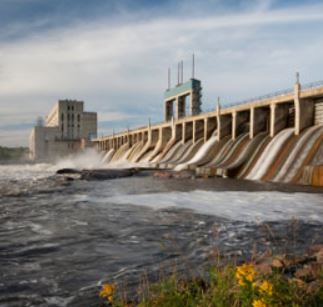
Hydropower Dam * More than 2,000 years ago, the ancient Greeks used hydropower to grind corn, pump water, and power other types of machinery. The world’s first hydroelectric power plant was built in Appleton, Wisconsin (U.S.A.), and became operational in 1882.[762] [763] [764] [765]
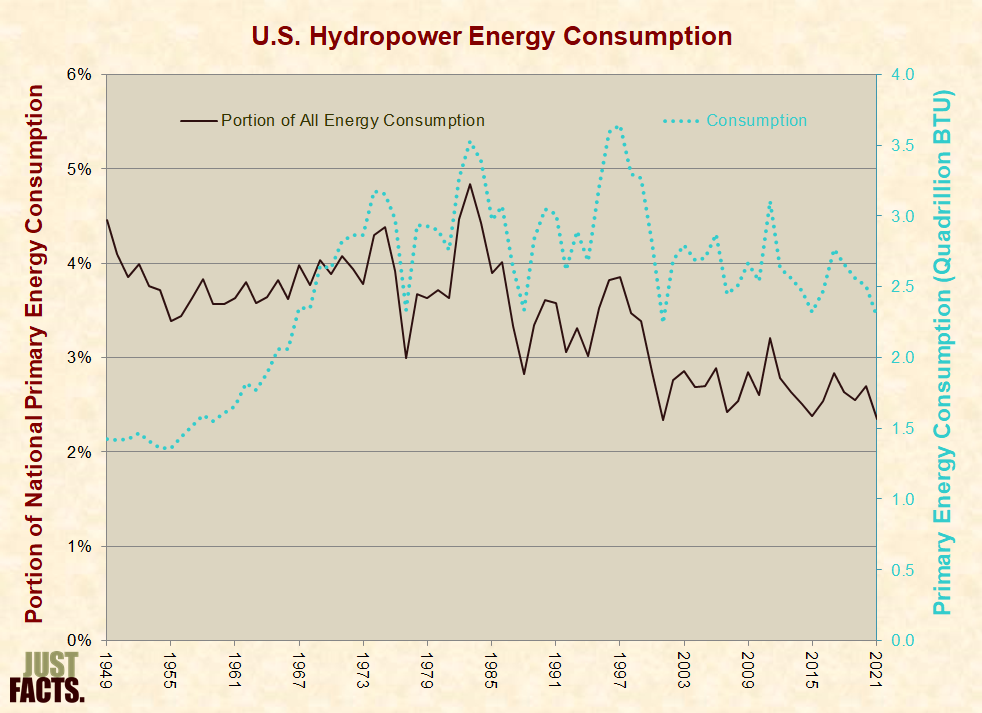
* Hydropower output typically varies from year to year, because it is dependent upon rainfall and other elements of climate and weather.[766] In 2015, hydropower supplied 2.4% of all primary energy consumed in the United States:

Hydropower Energy Consumption

[767]
* In 2015, hydropower generated 6.0% of all electricity produced in the U.S.[768]
* Most large-scale hydroelectric power plants are built on rivers and use a dam to accumulate and release water. This allows the plant to generate varying amounts of electricity as the demand for electricity fluctuates.[769] [770] [771][772]
* Large-scale hydroelectric power plants that use dams can displace surrounding residents, impede the migration of fish, modify water temperatures, and cause other changes to river ecosystems.[773] [774] [775] [776]
* Per the U.S. Energy Information Administration’s Office of Energy Efficiency & Renewable Energy:
Research and development efforts have succeeded in reducing many of these environmental impacts through the use of fish ladders (to aid fish migration), fish screens, new turbine designs, and reservoir aeration.[777]

* Roughly 2-3% of the dams in the U.S. are used to generate hydropower. The rest are primarily used for recreation (35%), fish stock/farm ponds (18%), flood control (15%), public water supply (12%), irrigation (11%), and other uses (7%).[778] [779] [780]
* A 2012 analysis by Oak Ridge National Laboratory estimated that the U.S. could increase its hydropower generation by 15% through adding hydroelectric generators to existing non-powered dams [NPDs]. The analysis “did not consider the economic feasibility of developing each unpowered facility” but noted that:

 many of the monetary costs and environmental impacts of dam construction have already been incurred at NPDs, so adding power to the existing dam structure can often be achieved at lower cost, with less risk, and in a shorter timeframe than development requiring new dam construction.[781]

* Hydroelectric power can also be produced without dams by “run-of-the-river” generators, which temporarily divert a portion of the river through canals or pipes that flow through turbines.[782]
* A 2006 analysis by Idaho National Laboratory estimated that U.S. rivers and streams have an average hydropower potential of 297,436 megawatts. The analysis also estimated that:

  • 8% of this total potential is being harnessed.
  • 33% of this total potential cannot be developed because of environmental and land use restrictions, lack of accessibility, or because it is located large distances from electrical power grids.
  • 33% of this total potential could feasibly be developed.
  • 8% of this total potential could be harnessed without using dams.
  • 4% of this total potential could be harnessed without using dams and without using sites that have low-power potential, which makes them economically unattractive.[783] [784]

Wind

* Wind power is harnessed by converting the energy of natural air movements into mechanical energy used to drive electric power generators, pumps, and mills.[785]

Wind Turbine

[786]
* More than 2,000 years ago, the Chinese used windmills to pump water. Around 600 A.D., Persians used windmills to grind grain.[787]
* From 1998 through 2015, the portion of U.S. primary energy supplied by wind grew from 0.03% to 1.9%:

Wind Energy Consumption

[788]
* In 2015, wind generated 4.7% of all electricity produced in the U.S.[789]
* Ideally, commercial wind turbines should be located:

  • where average wind speeds are at least 13 miles per hour.
  • within short distances of electrical power grids.
  • far enough away from humans to avoid noise pollution.
  • in places with limited bird traffic.[790] [791] [792] [793] [794]

* Wind speeds fluctuate on an hourly, daily, monthly, and seasonal basis. In wind-rich areas, winds are sometimes not strong enough to drive turbines for days at a time.[795] [796] [797] Per the U.S. Energy Information Administration (EIA):
Even at the best sites, there are times when the wind does not blow sufficiently and no electricity is generated.[798]

Wind generators are subject to abrupt changes in wind speed, and their power output is characterized by steep ramps up or down.[799]

* Power capacity (a commonly cited statistic for wind energy installations[800]) is the amount of electricity that wind turbines produce when operating at full capacity, which occurs when wind conditions are optimal. It is not a measure of actual production.[801] [802] In the U.S. during 2004–2014, actual production from wind turbines was 29% of their power capacity.[803]
* With the exception of pumped hydropower, current technology cannot economically store large quantities of electricity. Thus, utilities must produce enough electricity to meet their customers’ demands on a second-by-second basis.[804] [805] [806] [807] [808] [809] [810]
* Because wind power is intermittent and utility-scale electricity cannot be easily stored, most wind power capacity must be backed-up by other energy sources that can generate electricity on demand, such as natural gas power plants.[811] [812] [813] [814] [815] [816] Per EIA:

Often, wind generation does not coincide with the demand for electric power; wind resources are generally more prevalent overnight, when demand for electric power is at a minimum. In most areas, summer peak demand for electricity coincides with hot afternoons when consumers have turned up their air conditioners – but in many areas, such times are calm and wind resources may be quite low.[817] [818]
* As the amount of wind capacity rises in a given region, so do the challenges and costs of backing up its intermittent energy output.[819] [820] [821] [822]

Solar

* Solar power is harnessed by converting electromagnetic energy from the sun into heat or electricity. The current primary solar energy technologies include:

  • thermal collectors, which capture sunlight and covert it to heat that can be used to warm items such as indoor air, tap water, and swimming pools.
  • concentrating power systems, which use mirrors to focus sunlight in order to heat liquids that power electricity-generating steam turbines.
  • photovoltaic (PV) cells, which use layers of semi-conductive materials (like silicon) to convert sunlight directly into electricity.[823] [824] [825] [826]

* In the third century B.C., Greeks and Romans used mirrors to concentrate solar energy for the purpose of lighting torches. In the late 1800s, a French mathematician built the world’s first solar-powered steam engine.[827]
* In 1953, three U.S. scientists built the world’s first silicon photovoltaic cell. This was the first photovoltaic cell that generated enough energy to power common electrical devices. One year later, Western Electric began selling commercial licenses for silicon photovoltaic technologies.[828]
* With the exception of nuclear and geothermal power, all major current energy sources ultimately derive from solar energy. Wind energy arises from sunlight heating the atmosphere, biofuels and fossil fuels are made of organic materials that were nourished by sunlight, and hydropower is driven by the hydrological cycle, which is powered by the sun.[829] [830] [831] [832]
* From 1988 through 2015, the portion of U.S. primary energy supplied by solar power grew from 0.0001% to 0.5%:

Solar Energy Consumption

[833]
* In 2015, solar energy produced 0.9% of all electricity generated in the U.S.[834]
* From 1998-2011, the average reported installed price for residential and commercial PV systems declined by about 5-7% per year. Primarily, this was due to technological advancements, economies of scale, and federal, state and local government subsidies.[835] [836] [837] [838] [839] [840]
* In 2009, Jeffrey Punton of Rochester, N.Y., installed 20 solar panels at his home for a cost of $42,480. The federal government and state of New York paid for $29,504 or 69% of these costs.[841] Per a 2012 report by Lawrence Berkeley National Laboratory:
The market for PV in the United States is, to a significant extent, driven by national, state, and local government incentives, including up-front cash rebates, production-based incentives, renewables portfolio standards, and federal and state tax benefits.[842]

* Power capacity (a commonly cited statistic for solar energy installations[843]) is the amount of electricity that solar systems produce when operating at full capacity, which occurs when the sun is directly overhead, the solar panels are perpendicular to the sunlight, the sky is clear, and temperatures are low. It is not a measure of actual production.[844][845] [846] In the U.S. during 2004–2014, actual production from utility-scale solar systems was 17% of their power capacity.[847]
* With the exception of pumped hydropower, current technology cannot economically store large quantities of electricity. Thus, utilities must produce enough electricity to meet their customers’ demands on a second-by-second basis.[848] [849] [850] [851] [852] [853] [854]
* Because solar power is intermittent and utility-scale electricity cannot be easily stored, most solar power capacity must be backed-up by other energy sources that can generate electricity on demand, such as natural gas power plants.[855] [856] [857] [858] [859]
* As the amount of solar capacity rises in a given region, so do the costs of backing up its intermittent energy output.[860] [861]

Geothermal

* Geothermal energy is harnessed by transferring heat from or to the earth. The current main geothermal technologies include:

  • district heating systems, which heat buildings by piping in water from hot springs and reservoirs.
  • power plants, which generate electricity through steam turbines that are powered by steam or superheated water typically piped in from a mile or two beneath the surface of the earth.
  • heat pumps, which cool and heat buildings by transferring heat to and from the ground. In most places, the temperature of the earth at 10 feet underground stays between 50-60°F throughout the year. In the summer, heat pumps cool buildings by transferring their heat into the ground. In winter, heat pumps warm buildings by transferring heat from the ground into the buildings.[862] [863] [864] [865] [866]

* Since ancient times, people have used hot springs for bathing, cooking, and heating.[867]
* The world’s first electricity-generating geothermal plant was built in 1904 in Tuscany, Italy.[868]
* From 1980 through 2015, the portion of U.S. primary energy supplied by geothermal power grew from 0.07% to 0.23%:

Geothermal Energy Consumption

[869]
* In 2015, geothermal generated 0.4% of all electricity produced in the U.S.[870]
* Electricity-generating geothermal plants are typically built at sites where geothermal reservoirs are not buried too deeply. In the U.S., such resources are mostly in the western states and Hawaii. [871] [872]
…..To be continued……

Email this author

Posted in Energy | Comments Off on Energy Facts and Figures for Dummies, Part IX

The Sugar Industry Wants a Free Market

Share this article on:

sugar-1-150x150There are a lot of issues that aren’t Virginia specific but which impact everyone of us and the dynamics of public policy on these issues is reflected in our everyday lives.

One of those issues is the price and availability of sugar.  Sugar is in so much of what we eat.  Take a look at a box of most prepared foods, and sugar is listed as one of the ingredients. So, although we don’t produce sugar in Virginia and we don’t refine sugar here, the price of sugar hits us in the pocket book most every day.
So when a long-time friend of mine asked me to take a look at the import/tariffs policy of the U.S. on sugar what I found was pretty interesting.  As a free market kind of guy, and one who believes in free trade this issue was one of those that caught my attention.
So Last month, the Thomas Jefferson Institute hosted a small breakfast meeting during the annual gathering of the State Policy Network in Nashville to discuss U.S. farm policy and growing rates of agricultural subsidization around the globe.  Because all Americans eat and depend on a secure supply of homegrown food, this is an issue that affects each and every one of us.
We zeroed in on the U.S. sugar program and a new concept known as the zero-for-zero sugar policy, where America would agree to roll back its sugar subsidies in return for commitments by other countries to do the same.  In other words, a subsidy cease-fire so a free market can form.  And the sugar industry here in the U.S. favors such a policy so it is not whetted to the current program and would rather have a level trading field where government subsidies and tariffs were eliminated.
We invited state policy leaders from the sugar producing states and the states that refine sugar to come and talk about this issue and a vast majority of those states joined us: California, Florida, Louisiana, Maryland, Michigan, Minnesota, Montana, Nebraska, Oregon, and Texas attended the briefing and contributed to a lively discussion.
We talked about sugar production in our various states.  How the sugar producers in many cases also are the refiners.  We talked about price fluctuation and how foreign governments subsidize their sugar industry and we do not.  We talked about the revolving loan program used by sugar growers most every year where they borrow money from the government for planting and pay back the government with interest after the harvest.  And we talked about the politics of working toward a truly free trade mechanism in the world sugar market.
A special thanks also goes to Louisiana Attorney General Jeff Landry, a free-market conservative, who was an early adopter of zero-for-zero and offered a unique perspective as someone who grew up working in agriculture.  His perspective was most helpful.
In the coming months, TJI will be exploring this issue in greater detail and we are currently working on a report about the best ways to keep farm subsidies and government policies from manipulating the market.   In the meantime, if you are interested in learning more on the topic, be sure to check out the links below.

Sugar is not a “big deal” to Virginia’s economy but the price sugar does impact each and every one of us most every day in one way or another.
Oftentimes we think that the industries that get some sort of government “protection” through tariffs or payments for not growing crops, etc are the ones who don’t want freer trade policies. In the case of sugar, it seems that the industry would like to have government out of the picture – our government and foreign governments as well. You see, foreign governments are subsidizing our competitors in order to lower the price of sugar below what our U.S. growers are able to do.
This is an interesting issue and the study we will soon release will shine more light on what’s happening in the sugar industry.
Email this author

Posted in Economy | Comments Off on The Sugar Industry Wants a Free Market